The cash flow statement, explained on a real company
The cash flow statement tracks the cash that actually came in and went out. This lesson explains its three sections and free cash flow, then reads Arista Networks' latest quarter, where cash came in below profit.

Key points
- The cash flow statement records cash when it actually comes in or goes out, unlike the income statement.
- It has three sections: cash from operations, cash used for investing, and cash from or to financing.
- The first line to look at is operating cash flow, then free cash flow: operating cash flow minus capital expenditure.
- One quarter of cash below profit is common and often temporary; years of it are a question worth asking.
The income statement follows accounting rules that record a sale when it is earned and a cost when it is incurred. That is the right way to measure a period's performance, but it means profit and cash can drift apart. The cash flow statement closes the gap. It starts from net income and shows, line by line, how much cash the business really produced and where it went. This lesson explains how to read it, then reads a real company's quarter as filed.
The concept: three sections of cash
Cash from operating activities is the cash the business itself produced (glossary). The statement starts from net income and makes two kinds of adjustment. It adds back costs that used no cash this period, such as depreciation and stock-based compensation. And it adjusts for changes in working capital (glossary): if customers owe more at the end of the quarter than at the start, profit was booked but the cash has not arrived, so it is taken away; if the company paid its suppliers more slowly, cash stayed in the business, so it is added.
Cash from investing activities is cash spent on, or received from, long-lived assets and investments. The most important line is capital expenditure, or capex: cash spent on buildings, equipment and other assets that will be used for years (glossary). Buying and selling securities also sits here.
Cash from financing activities is cash exchanged with lenders and shareholders: borrowing and repaying debt, issuing shares, buying shares back and paying dividends.
The three sections add up to the change in the company's cash balance over the quarter, which is why the last line of the cash flow statement matches the cash on the balance sheet.
The figure most investors take from the statement is free cash flow: operating cash flow minus capital expenditure (glossary). It is the cash left after the business has paid to run itself and to maintain and grow its assets, the cash that could go to shareholders, to lenders or into acquisitions.
See it on a real company
Arista Networks (ANET) makes networking switches for data centers. Here is its third quarter of fiscal 2026 (Q3 FY2026), the three months to September 30, 2026, as filed with the SEC on November 4, 2026.
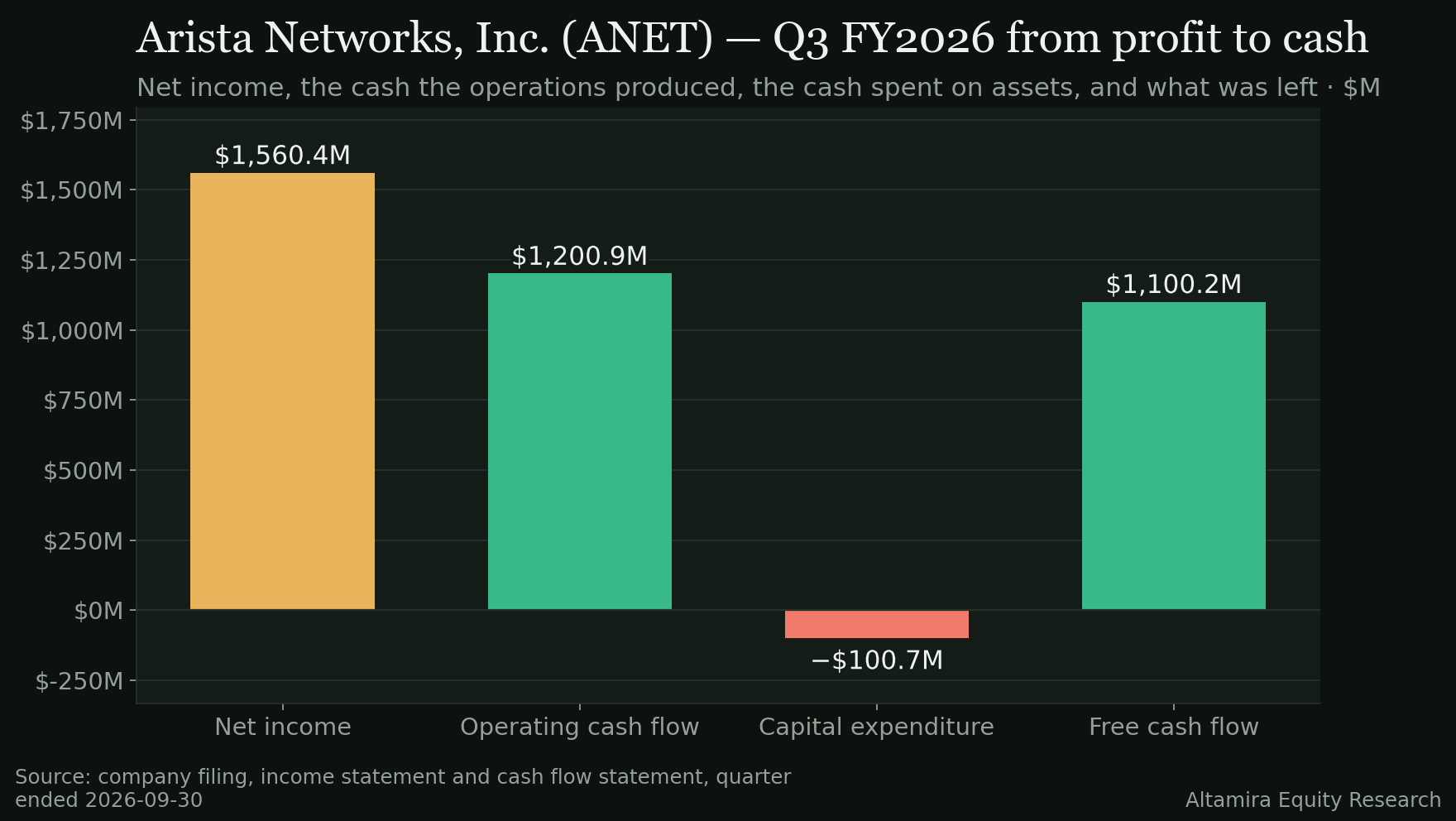
- Net income: $1,560.4M, the starting point of the statement.
- Operating cash flow: $1,200.9M. That is $359.5M less than net income: in this quarter the business booked more profit than it collected in cash.
- Capital expenditure: $100.7M, only 8.39% of operating cash flow. Arista does not need heavy factories of its own to grow.
- Free cash flow: $1,100.2M, which is 70.51% of net income.
- Financing: no dividends and no buybacks in the quarter.
Two more lines explain part of the picture. Items outside the core business added $273.1M between operating income and pretax income, and the company held $14,359M of cash and short-term investments at quarter-end. The statement's working-capital lines in the 10-Q show which items absorbed the cash this quarter; our data pack does not break them out, so this lesson does not guess.
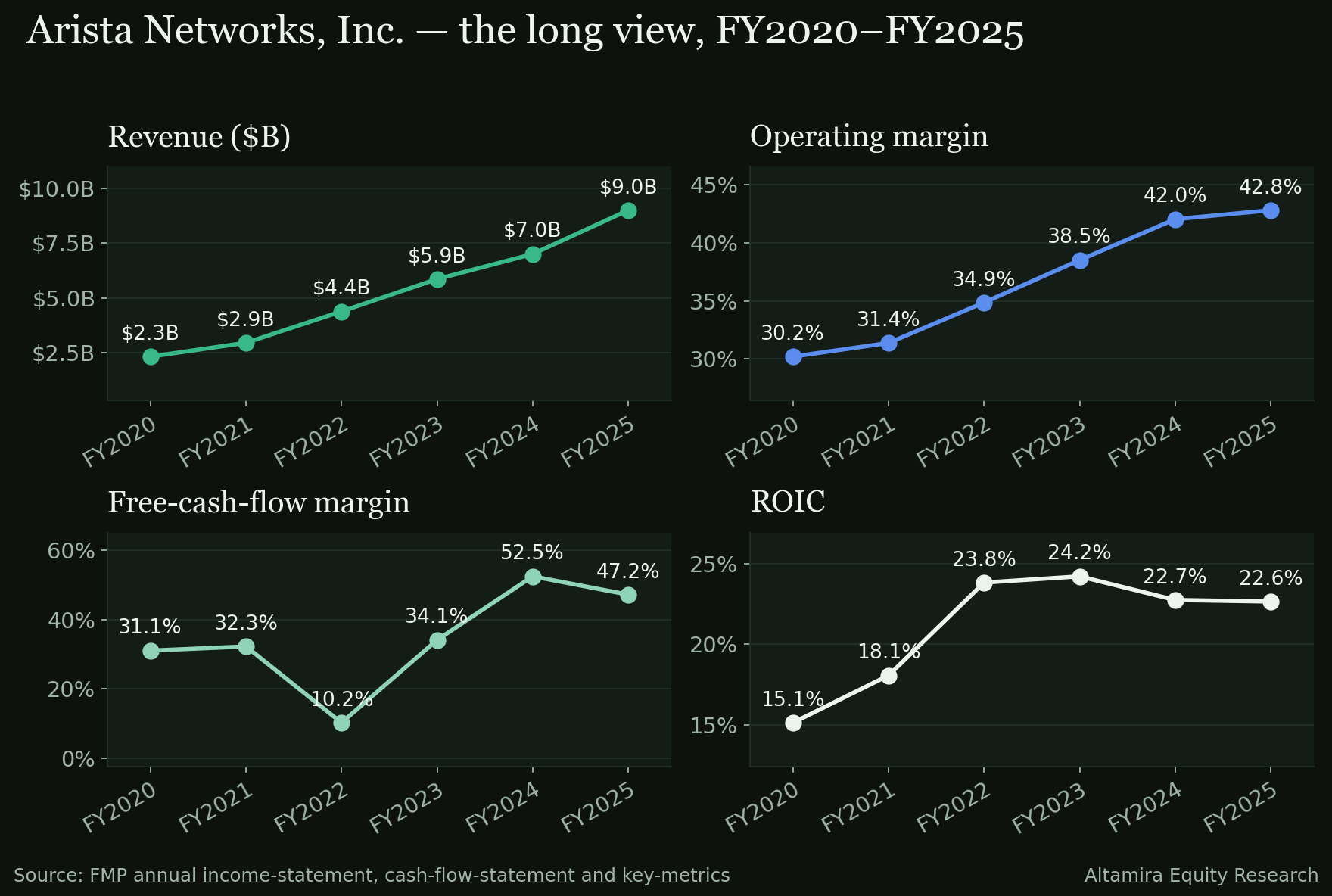
Now step back to a full year. In the same quarter a year earlier, Q3 FY2025, operating cash flow was $1,268.2M against net income of $853.0M: cash came in above profit. And for fiscal 2025 as a whole, free cash flow of $4,252.4M exceeded net income of $3,511.4M. One quarter of cash below profit, after a year of cash above it, is often a working-capital swing: a growing company can build up what customers owe it and what it holds in stock faster than it collects. The question to ask is whether it reverses in the next quarters.
What it does not tell you
- Whether the gap with profit is a problem. A single quarter can be timing. Look at several quarters and at the full year before drawing a conclusion.
- Whether capex is for maintenance or growth. The statement shows one capex line. The company's discussion in the filing sometimes says how much is needed just to keep the business running.
- Where the cash will go. Free cash flow is what was available. What management does with it, buybacks, dividends, acquisitions or nothing, is a separate decision, visible in the financing section.
- Anything about the share price. It describes a quarter that has ended.
Where you'll see this on the site
- Every earnings recap reports cash generation in its scoreboard, and every deep dive has a "quality of earnings" section built on this statement.
- The KPI scorecard grades cash flow as one of its pillars; the glossary defines FCF conversion and working capital.
- Next lessons: how the three statements connect, and net income against free cash flow.
Sources
- Arista Networks, Form 10-Q for the quarter ended September 30, 2026, filed with the SEC on November 4, 2026; net income, operating cash flow and capital expenditure cross-checked against the SEC's XBRL data.
- Prior-year quarter, fiscal 2025 annual figures and cash and short-term investments: market-data statements, pulled November 12, 2026.
Education for information only — not investment advice; see Disclosures.
On the data pages
- ANET company page — the filed figures, margins, cash flow and the print history, from SEC EDGAR.
- ANET vs NVDA, head to head — the two on the same scorecard cells (top composite in Technology (kpi-scorecard-2026-11-27.json)).
- Verdict ledger — every public call, on the record.
- Earnings schedule — who reports next, and how every print this season graded.