How to read an Altamira earnings recap
Every recap on this site follows the same order: the grade, the numbers, the long view, the counterweight, the key issue and the verdict. This lesson walks through each part on a real recap, Intuit's latest quarter.

Key points
- Every recap on this site follows the same order, so you can find the same information in the same place for any company.
- The grade (A to F) measures one thing: how revenue and EPS landed against consensus. It is not a rating of the business.
- The long view and the counterweight are there to stop one quarter from being read on its own.
- The verdict says whether the investment case the site tracks was strengthened, left intact, strained or broken. It is not a recommendation.
The concept: one structure, built to be checked
A recap answers four questions in order: what happened, how it compares with expectations, how it fits the longer record, and what could make the reading wrong. Each figure comes from a data pack built from the company's filing and market data, and every number in the text is checked against that pack before the draft can be saved.
The story in 30 seconds. The quarter in three or four sentences: revenue and EPS against consensus, the year-over-year change, the grade, and the one line that matters most.
At a glance. The headline figures in one strip: revenue, EPS, operating margin, and the share-price reaction when the post-report close is available.
Where the revenue dollar went. A flow chart from revenue through costs to net income, the income-statement lesson in a picture.
What to make of this print. The reading: which line carried the quarter and which did not.
The long view. Five years of revenue growth, margins, cash flow and share count, so a strong or weak quarter is set against the trend (glossary).
The honest counterweight. The strongest points against the reading above. Every recap has one; a recap without doubts is not trying hard enough.
The key issue. The one thing the next report has to answer.
Thesis verdict. Strengthened, intact, strained or broken, with the reason. Every verdict stays on the record on the verdict ledger.
See it on a real company
The worked example is the site's recap of Intuit (INTU), published on November 19, 2026. Intuit makes QuickBooks, TurboTax and Credit Karma. The quarter is its first quarter of fiscal 2027 (Q1 FY2027), the three months to October 31, 2026; it reported after the close on November 19, 2026 and filed its 10-Q the same day.
The grade. Revenue of $4,354M against a consensus of $4,305M, a beat of 1.14%. Adjusted EPS of $2.91 against $2.46, a beat of 18.29%. Both lines beat, one by less than 2%, so the rubric gives a B. The rubric's full scale is printed in every recap.
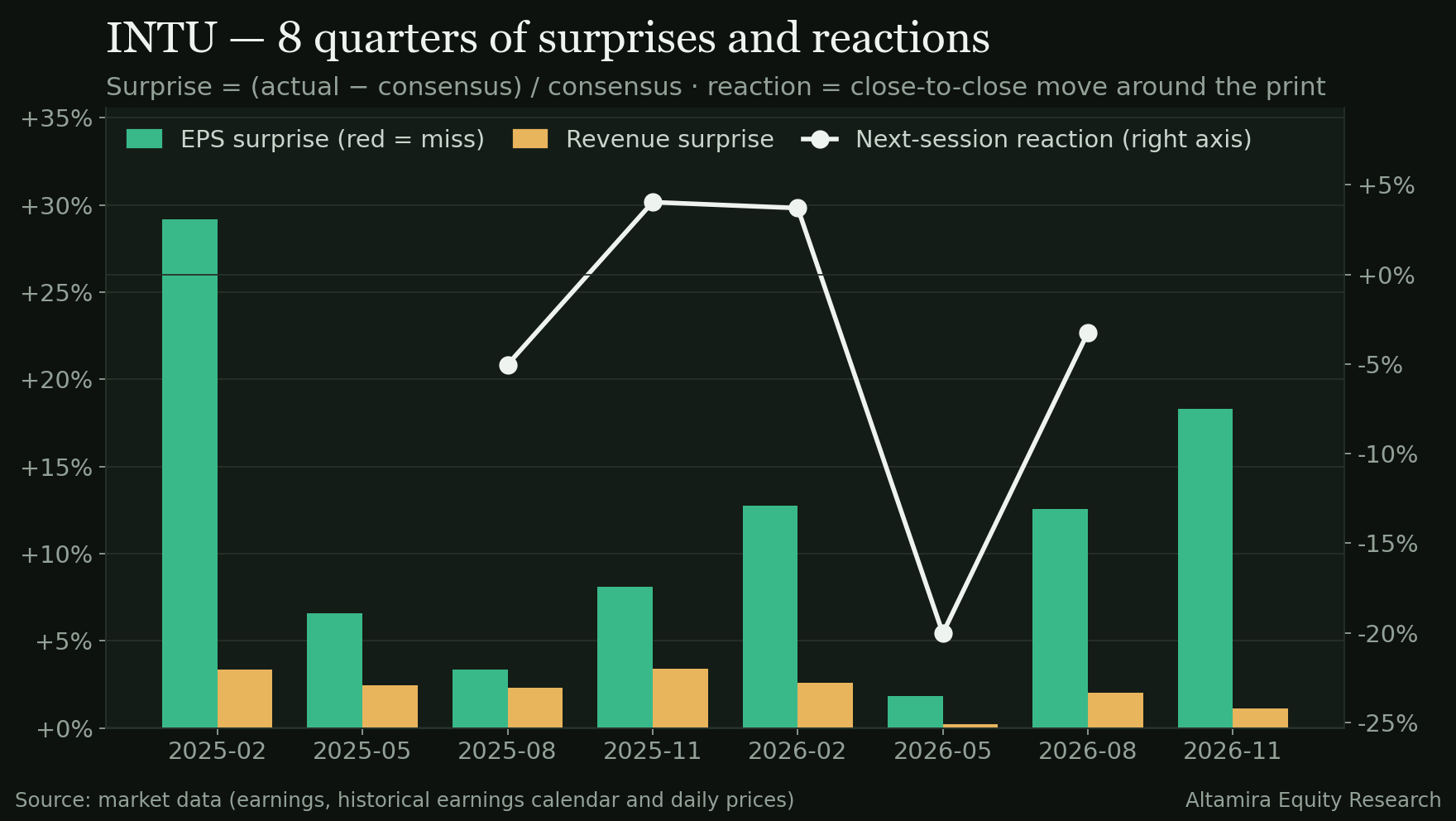
The reading. The recap's point is the gap between the two beats: the EPS surprise was the largest of the last eight quarters, while the revenue surprise was the smallest. Operating margin, 19.94% on the GAAP basis, up 619 basis points from a year earlier, is where the gap shows up.
The long view. From fiscal 2021 to fiscal 2026, revenue grew at a compound rate of 17.36% a year, from $9,633M to $21,448M.
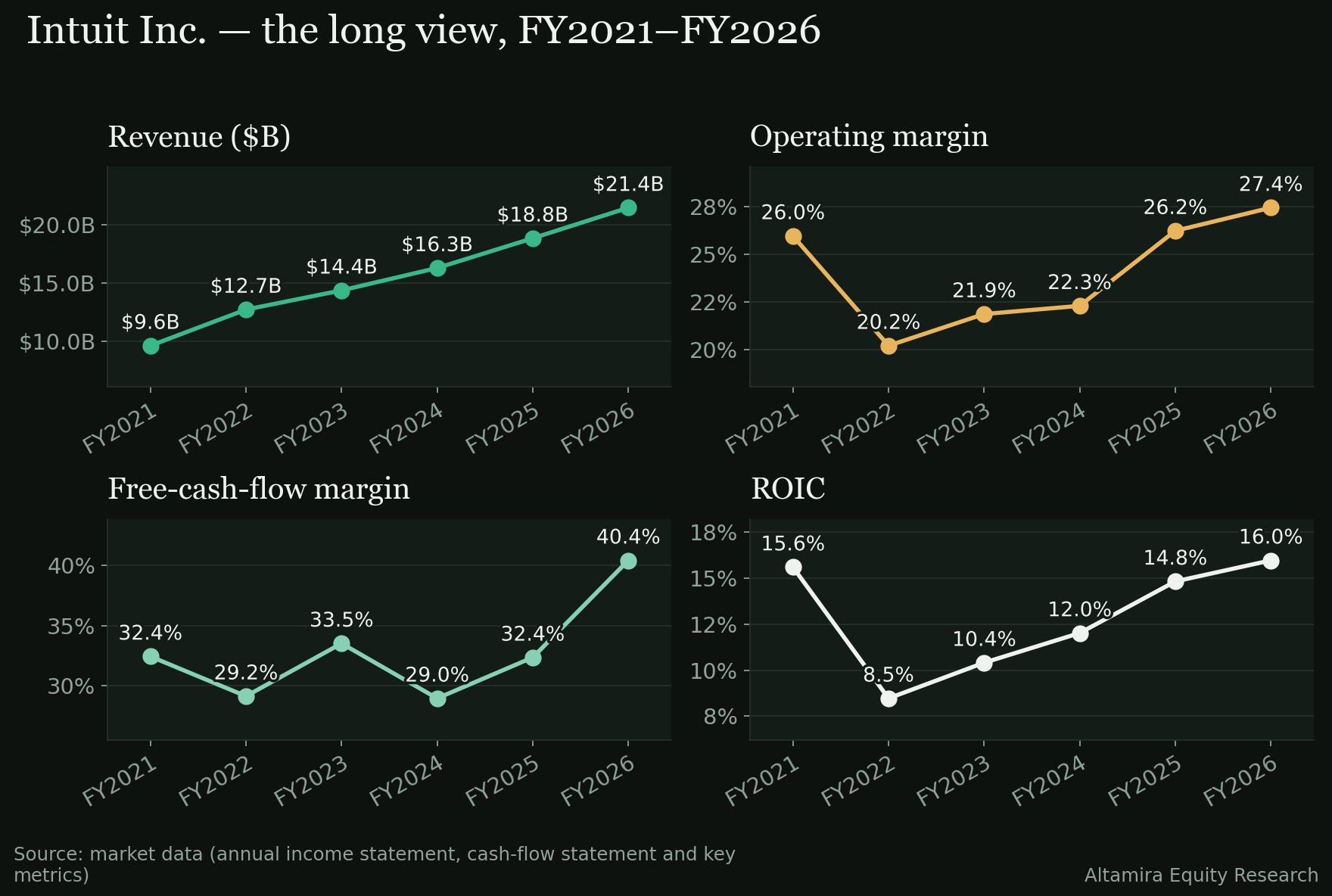
The counterweight. The recap names three points against a clean reading, among them that the diluted share count fell 4.63% in a year, which lifts earnings per share without the business earning more. GAAP diluted EPS in the 10-Q was $2.59, below the adjusted $2.91.
The reaction. The recap says plainly that no post-report close was in the data when it was written. A recap never fills in a missing figure.
The verdict. Intact, grade B, with the reason in two sentences.
What it does not tell you
- Whether to buy or sell. The grade measures a quarter against forecasts; the verdict tracks a case. Neither is advice.
- Anything the data pack does not hold. When guidance or the reaction is missing, the recap says so instead of guessing.
- What happens next. The key issue names a question; it does not answer it.
Where you'll see this on the site
- Earnings coverage lists every recap and preview, with the grade.
- The verdict ledger keeps every call on the record.
- The glossary explains the grade, the verdict and "not stated".
- Previous lesson: reading the reaction. Next track: judging a business.
Sources
- Intuit, Form 10-Q for the quarter ended October 31, 2026, filed with the SEC on November 19, 2026; revenue, operating income and diluted EPS cross-checked against the SEC's XBRL data.
- Consensus estimates, adjusted EPS, the surprise history and the five-year series: market data, pulled November 19, 2026. Consensus figures are analyst estimates as pulled on that date.
- The recap quoted: Altamira Equity Research, Intuit Q1 FY2027 earnings recap, November 19, 2026.
Education for information only — not investment advice; see Disclosures.
On the data pages
- INTU company page — the filed figures, margins, cash flow and the print history, from SEC EDGAR.
- INTU vs NVDA, head to head — the two on the same scorecard cells (top composite in Technology (kpi-scorecard-2026-11-27.json)).
- Verdict ledger — every public call, on the record.
- Earnings schedule — who reports next, and how every print this season graded.