The income statement, explained on a real company
The income statement shows how a company's sales became profit, one line at a time. This lesson walks through each line, then reads Micron's latest quarter as filed.

Key points
- The income statement shows how a company's sales in a period turned into profit, one cost at a time.
- It reads top to bottom: revenue, then the cost of making what was sold, then overhead, then interest and tax, then net income.
- The first line to look at after revenue is gross margin: how much of each sale is left once the direct costs are paid.
- It records sales and costs when they are earned, not when cash moves, so profit and cash can differ a lot.
Every company listed in the US files an income statement every quarter. It is the page that answers the question most people ask first: did the business make money? Earnings headlines, beats and misses, and most of the figures in our recaps come from it. This lesson shows you how to read it from top to bottom, then reads every line on a company that reported this season.
The concept: a staircase from sales to profit
Think of the statement as a staircase. Each step down takes one kind of cost away from what is left.
Revenue is what the company billed its customers for the period (glossary). It is also called sales or the top line.
Cost of revenue is the direct cost of producing what was sold: materials, factories, the people who deliver the service. Revenue minus cost of revenue is gross profit, and gross profit as a share of revenue is the gross margin (glossary). A high gross margin means each sale leaves a lot of room to pay for everything else.
Operating expenses are the costs of running the company rather than making the product: research and development (R&D), and selling, general and administrative costs (SG&A). Gross profit minus operating expenses is operating income, the profit from the business itself (glossary). Operating income as a share of revenue is the operating margin.
Below operating income come the items that are not about running the business: interest paid on debt, interest earned on cash, and other gains and losses. What is left is pretax income. Take away income tax and you reach net income, the bottom line that belongs to shareholders (glossary). Divide it by the number of shares and you get earnings per share, the figure analysts forecast and headlines compare.
One rule sits underneath every line: accrual accounting. A sale is recorded when it is earned, even if the customer pays next quarter, and a cost is recorded when it is incurred. That is why the income statement is not a record of cash. The cash flow statement is.
See it on a real company
Micron Technology (MU) makes memory chips. Here is its fiscal fourth quarter of 2026 (Q4 FY2026, the three months to September 3, 2026), as filed with the SEC on October 9, 2026, read down the staircase.
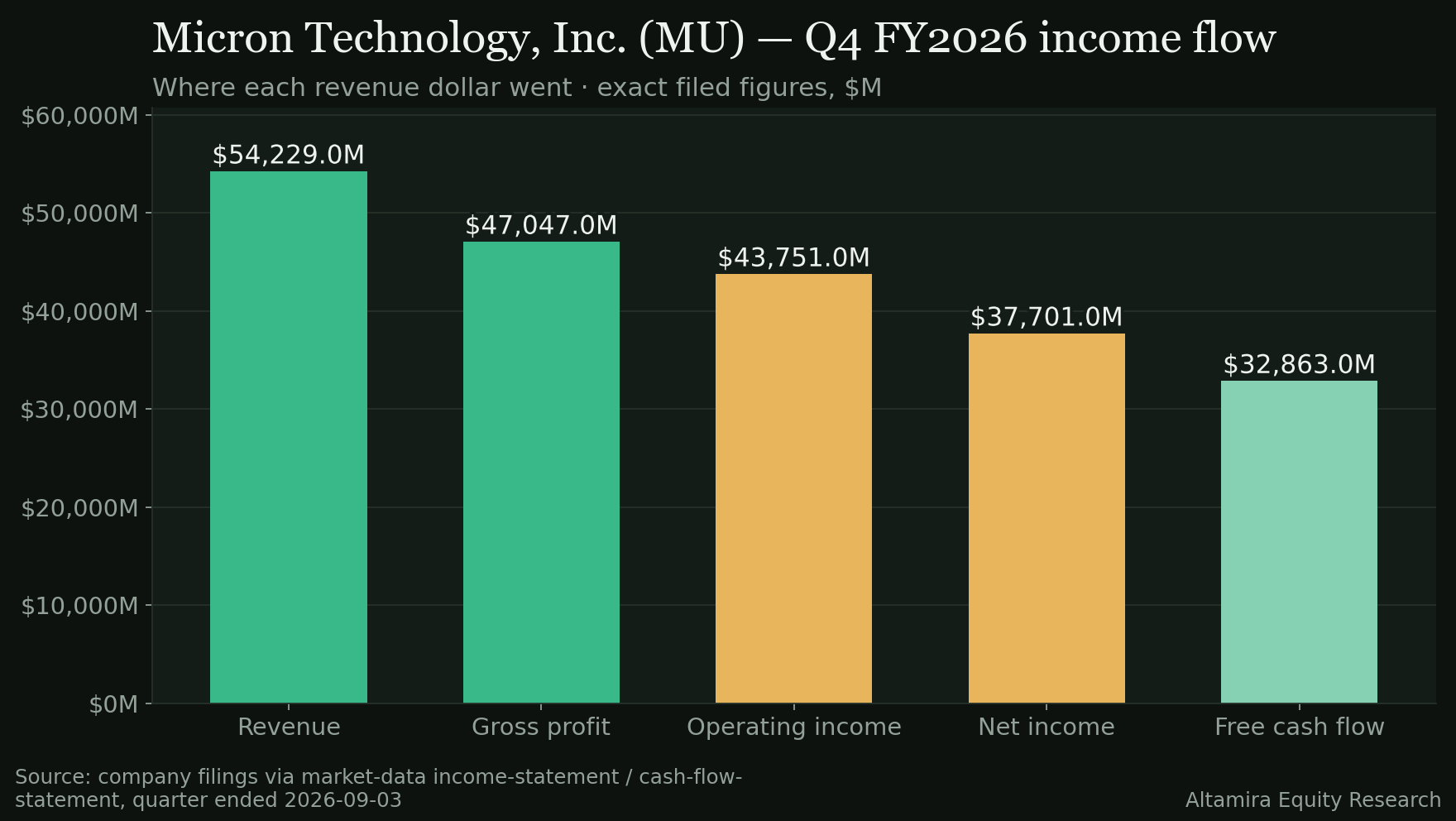
- Revenue: $54,229M. A year earlier, in Q4 FY2025, it was $11,315M, so revenue grew 379.27% year on year.
- Cost of revenue: $7,182M, which leaves gross profit of $47,047M and a gross margin of 86.76%. In the same quarter a year earlier the gross margin was 44.67%.
- Operating expenses: $3,296M in total, of which R&D was $1,913M (3.53% of revenue) and SG&A $859M (1.58% of revenue).
- Operating income: $43,751M, an operating margin of 80.68%.
- Below the line: pretax income of $44,284M is $533M above operating income, so interest and other items added to profit this quarter rather than taking from it.
- Income tax: $6,583M, an effective rate of 14.87%.
- Net income: $37,701M, a net margin of 69.52%.
Read as a whole, the staircase is unusually short. Almost all of each sales dollar survived to the bottom: very little went to producing the chips and even less to research and overhead. That is what the margins say. The statement does not say why prices for memory were high enough to produce those margins; for that you read the company's own discussion in the filing and its earnings call.
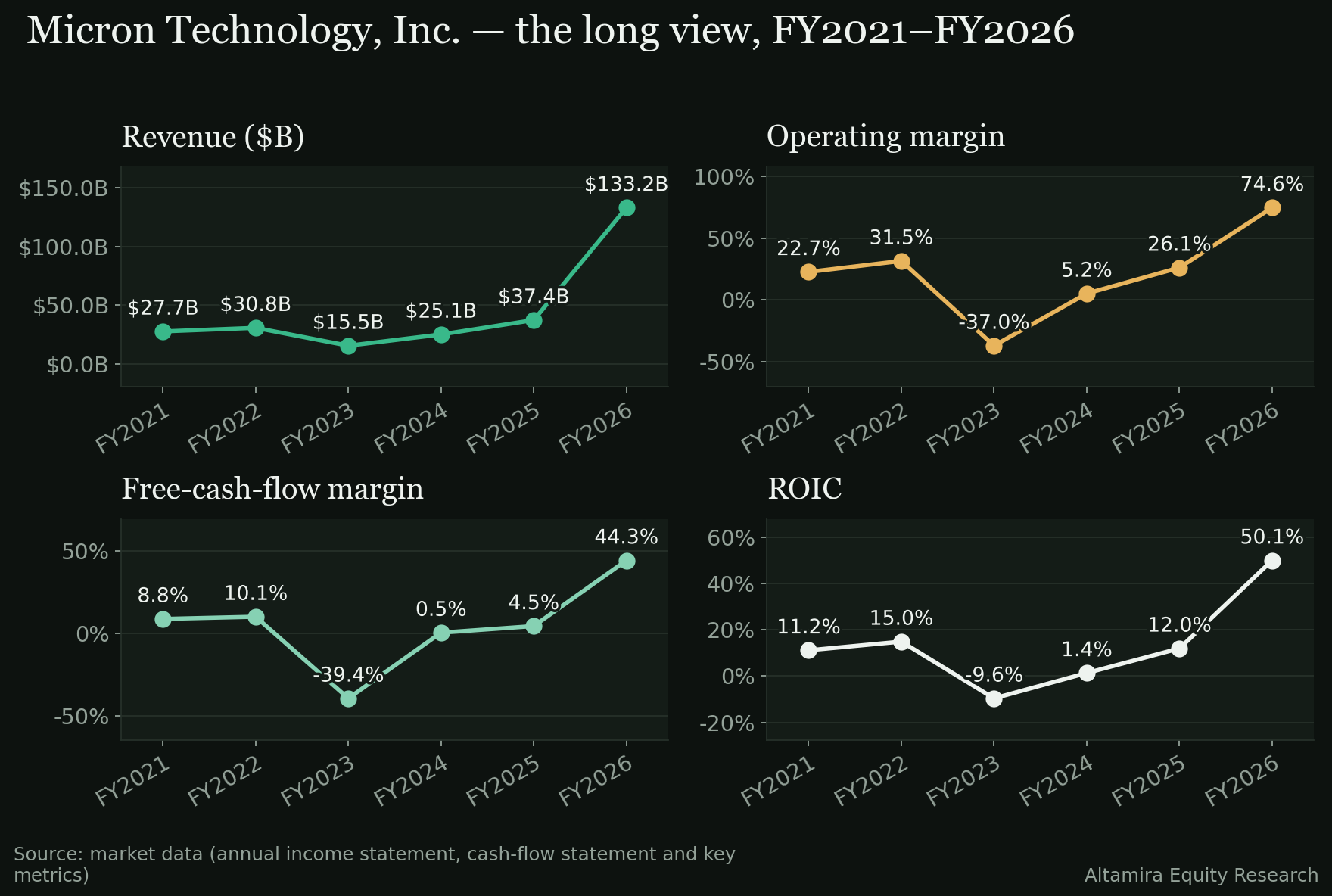
One quarter is also a single step in a long record. The same company reported a net loss of $5.83B for fiscal 2023, and net income of $778M for fiscal 2024. Memory is a cyclical business, and the five-year chart shows it.
What it does not tell you
- Whether the cash arrived. Revenue is recorded when earned. A company can report a large profit while customers have not yet paid, or while it spends heavily on new factories. Check the cash flow statement next.
- Whether the quarter is typical. One period says little about the cycle. Compare the same quarter a year earlier and the five-year record.
- Why the numbers moved. Prices, volumes and product mix sit behind every line, and the statement shows none of them. The company's discussion in the filing and the earnings call do.
- Anything about the share price. A strong income statement describes a period that has ended. It is not a forecast and not a reason on its own to own anything.
Where you'll see this on the site
- Every earnings recap opens its scoreboard with these lines: revenue, operating margin and earnings per share against the same quarter a year earlier.
- The income-flow chart in this lesson appears in every recap and Company Insights deep dive, under "where the revenue dollar went".
- The KPI scorecard grades margins and growth for every company it covers; the glossary defines each term.
- Next lesson: the balance sheet, what a company owns and owes on a single day.
Sources
- Micron Technology, Form 10-K for fiscal 2026, filed with the SEC on October 9, 2026 (quarterly figures for Q4 FY2026 and Q4 FY2025); cross-checked line by line against the SEC's XBRL data.
- Annual series and margins: market-data statements, pulled November 22, 2026.
Education for information only — not investment advice; see Disclosures.
On the data pages
- MU company page — the filed figures, margins, cash flow and the print history, from SEC EDGAR.
- MU vs NVDA, head to head — the two on the same scorecard cells (top composite in Technology (kpi-scorecard-2026-11-27.json)).
- Verdict ledger — every public call, on the record.
- Earnings schedule — who reports next, and how every print this season graded.