Share count, dilution and buybacks
Earnings per share depends on two things: profit, and how many shares it is divided among. This lesson explains dilution and buybacks and how to read the share count, then follows Netflix's share count through its latest quarter.

Key points
- Earnings per share is net income divided by the number of shares, so the share count matters as much as profit.
- Dilution is a rising share count: new shares issued to employees, to buy other companies, or to raise money.
- Buybacks shrink the share count: the company uses its cash to buy its own shares and retire them.
- The first thing to check is the diluted share count over several years: is it falling, flat or rising?
If a company's profit doubles but it also doubles the number of shares, each share earned exactly what it did before. That is why the share count deserves a place next to profit in any reading of a company. It moves for two opposite reasons: dilution pushes it up, buybacks pull it down. This lesson explains both, shows where to find the share count in the filings, and follows a real company's share count quarter by quarter.
The concept: the denominator
Diluted shares count every share already outstanding plus the shares that could be created from options, restricted stock and convertible bonds that are likely to turn into shares (glossary). Diluted earnings per share uses this larger count, which is why recaps quote it.
Dilution happens when the count rises. The common causes:
- Stock-based compensation. Employees receive shares or options as part of their pay (glossary). Every year new shares are created to deliver them.
- Acquisitions paid in stock. The company issues new shares to the sellers instead of paying cash.
- Raising money. A company that needs cash can sell new shares to investors.
Buybacks work the other way (glossary). The company spends cash to buy its own shares in the market and retires them, so each remaining share owns a bigger slice of the business. Buybacks appear in the financing section of the cash flow statement as "repurchases of common stock".
The check that matters: compare the money spent on buybacks with what happened to the share count. A company can spend large sums on buybacks and see its share count stay flat, because the buybacks only absorb the new shares handed to employees. In that case the buybacks are, in effect, a cash cost of stock-based pay.
A second check: where the money comes from. Buybacks paid from free cash flow are one thing; buybacks larger than free cash flow are paid from cash on hand or from borrowing, which the financing section and the balance sheet will show.
See it on a real company
Netflix (NFLX) runs the streaming service. Here is its third quarter of fiscal 2026 (Q3 FY2026), the three months to September 30, 2026, as filed with the SEC on October 21, 2026. Share figures are on the same basis throughout.
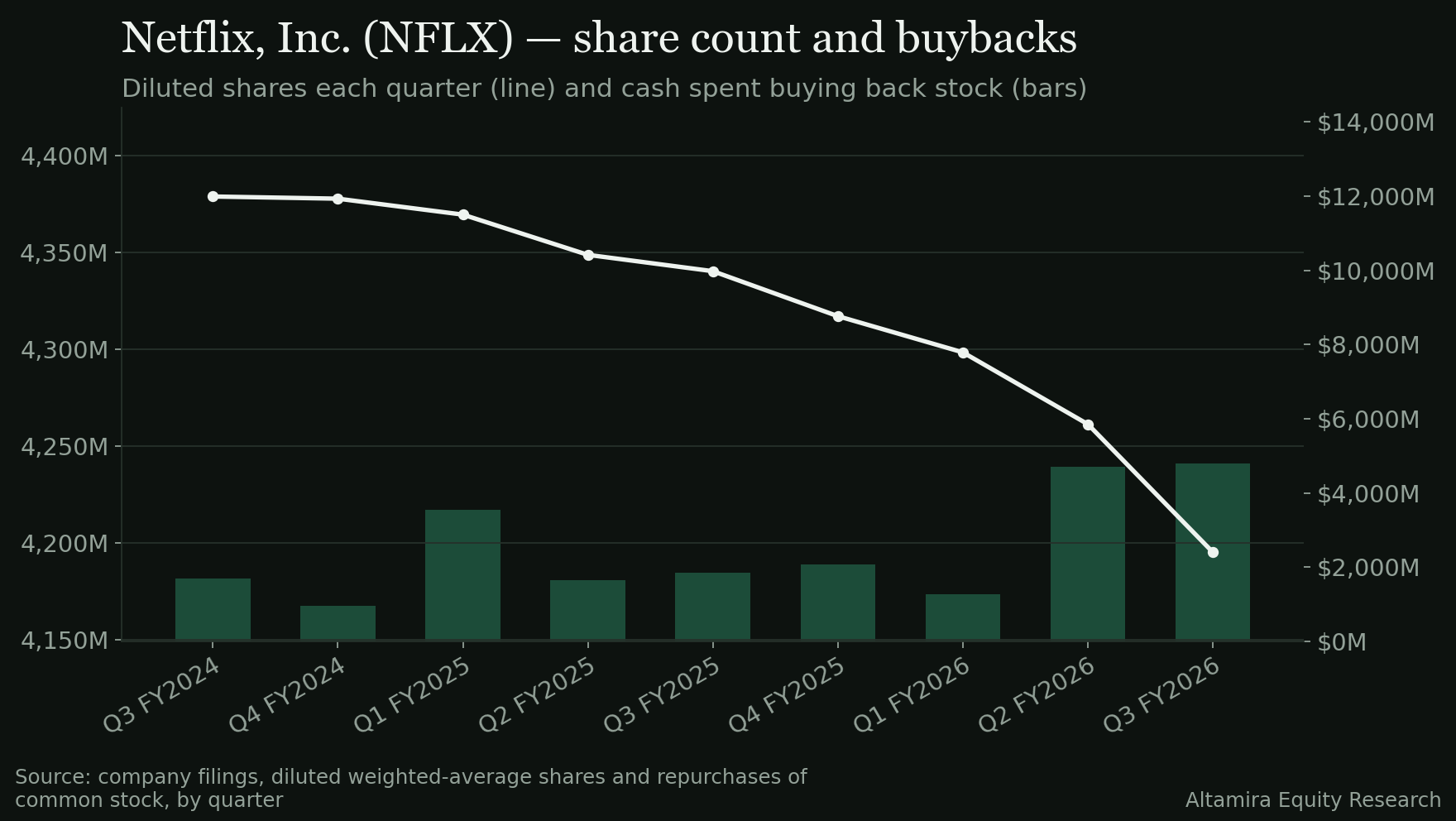
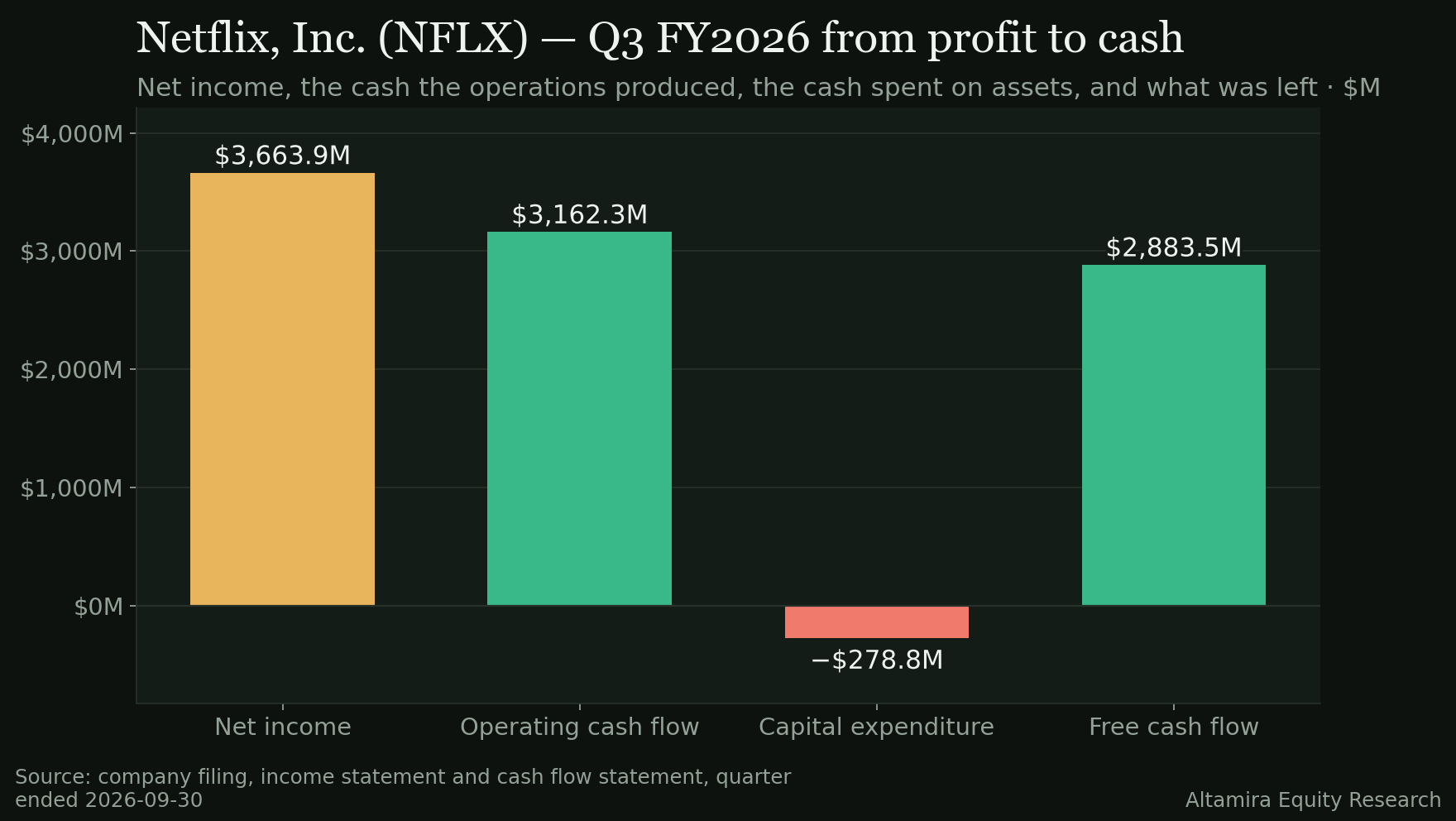
- Net income: $3,663.9M, and diluted shares of 4,195M, which gives diluted EPS of $0.87.
- Buybacks: $4,796.7M in the quarter.
- Share count: down 1.55% from the previous quarter and down 3.35% from a year earlier.
- Against free cash flow: free cash flow was $2,883.5M, so buybacks were 166.35% of the quarter's free cash flow. The difference was paid from cash already on the balance sheet or from borrowing; the financing section of the 10-Q shows which.
Here the buybacks did more than offset employee shares: the count fell. Over the longer record, diluted shares went from 4,542M in fiscal 2020 to 4,317M in fiscal 2025, a change of −4.95% over five years. Fewer shares means that, with the same net income, each share's earnings would be higher, which is how buybacks lift earnings per share without the business itself changing.
What it does not tell you
- Whether the price paid was sensible. A buyback at a high price returns less value than one at a low price. The share count shows the quantity, not the value received.
- The full cost of stock pay. The diluted count shows the shares created; the notes to the financial statements show the expense and the shares still to come from unvested awards.
- Whether the cash was better spent elsewhere. Buybacks compete with investment, debt repayment and dividends for the same cash.
- Anything about the share price. A falling share count describes what the company did, not what the market will do.
Where you'll see this on the site
- Every earnings recap reports the dividend and share count line in its scoreboard and checks buybacks in its quality-of-earnings reading.
- The KPI scorecard tracks capital return for every company it covers; the glossary defines buybacks, dividends and the payout ratio.
- Previous lesson: GAAP vs adjusted earnings. This completes the track on reading the financial statements.
Sources
- Netflix, Form 10-Q for the quarter ended September 30, 2026, filed with the SEC on October 21, 2026; net income, diluted EPS, diluted shares and operating cash flow cross-checked against the SEC's XBRL data.
- Buybacks, free cash flow and the annual share series: market-data statements, pulled November 10, 2026.
Education for information only — not investment advice; see Disclosures.
On the data pages
- NFLX company page — the filed figures, margins, cash flow and the print history, from SEC EDGAR.
- NFLX vs RDDT, head to head — the two on the same scorecard cells (top composite in Communication Services (kpi-scorecard-2026-11-27.json)).
- Verdict ledger — every public call, on the record.
- Earnings schedule — who reports next, and how every print this season graded.