Margin of Safety, Explained: How to Read the Site's Most Misunderstood Column
Margin of safety is the gap between price and fair value, measured against fair value — one third of the Value pillar, scored from -30% to +40%. What a +25.7% reading on TSMC does and does not promise, and the three habits that make the column earn its place.

Of every number on this site, the margin of safety is the one most often read upside down. This short guide fixes the reading: what the column measures, how it feeds the score, and what it does — and does not — promise.
The definition
Margin of safety = (fair value − share price) ÷ fair value, expressed as a percentage. A positive reading means the market price sits below the fair-value estimate, and the percentage is the size of the gap relative to that estimate. A reading of +25% does not mean the shares are expected to rise 25%: it means that if the price converged to fair value, the gain from today's price would be larger than 25% — because the discount is measured against the higher number. A negative reading means the shares trade above fair value.
The reference value itself is an independent estimate maintained for the scorecard, blended from published external estimates and model estimates where both exist. It is a reference layer, not a target price and not a forecast: it moves when the underlying estimates move, and the scorecard re-reads it every edition.
How it feeds the score
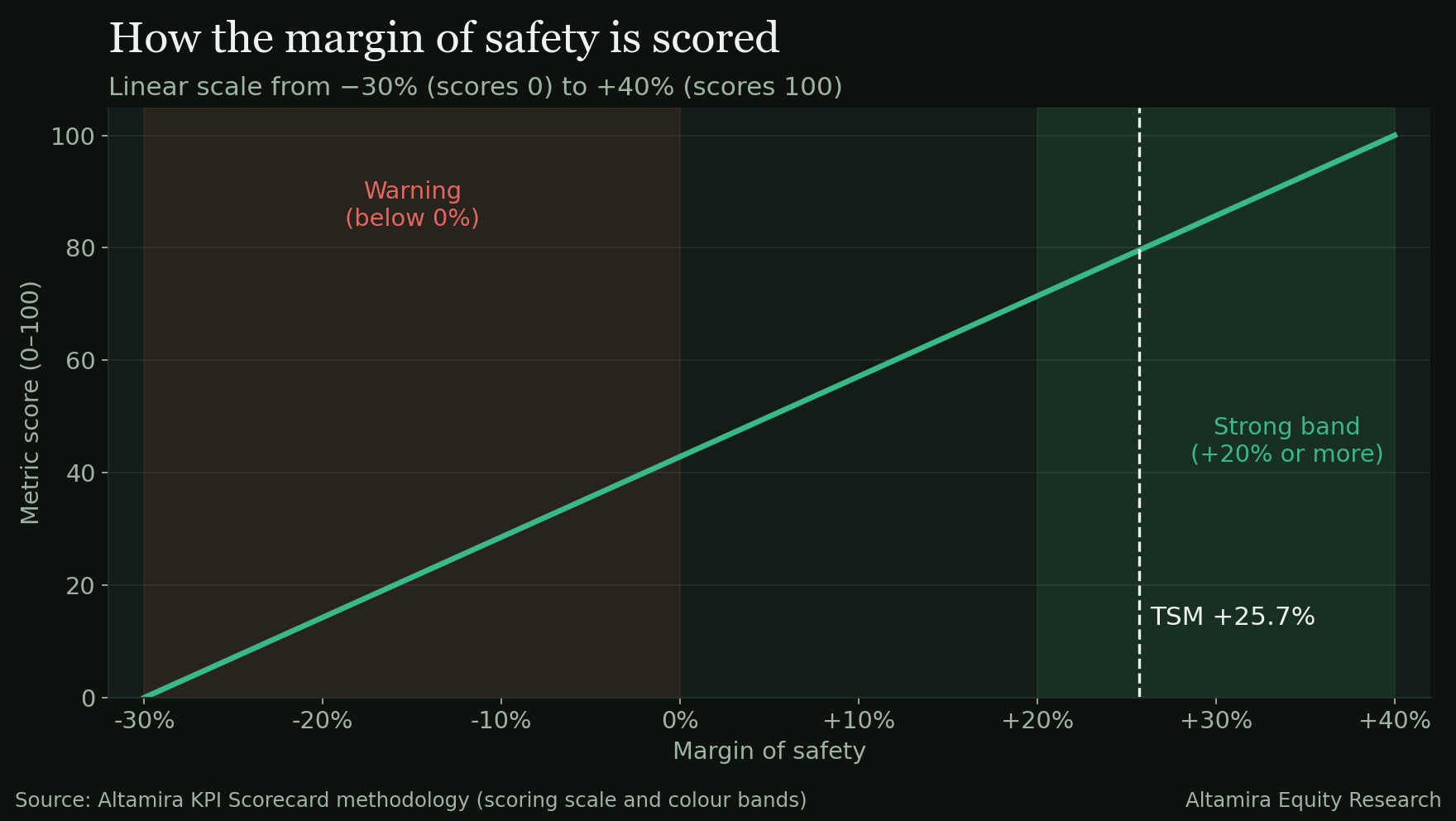
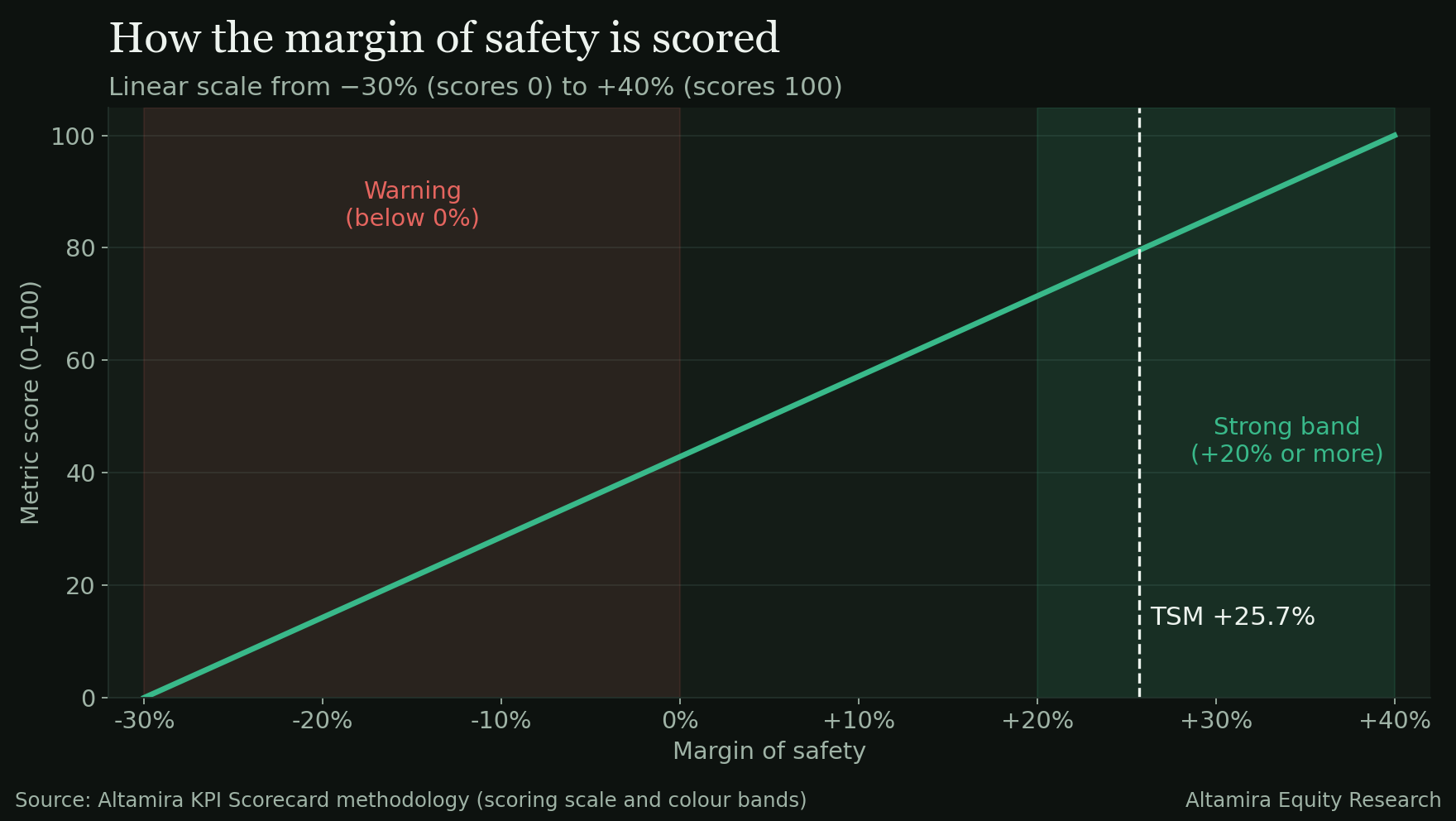
Margin of safety is one of three metrics inside the Value pillar, where it carries a 30% weight alongside free-cash-flow yield (35%) and forward price-to-earnings (35%). Inside the model it is scored on a linear scale running from −30% (scoring 0) to +40% (scoring 100), and the methodology's colour bands treat +20% or more as strong and anything below 0% as a warning.
Two consequences follow. First, a deep discount cannot rescue a weak company on its own: even a perfect margin-of-safety score contributes only its slice of one pillar worth a fifth of the fundamental composite — quality, growth and health still have to agree. Second, an expensive stock is not automatically a poor scorer: a name trading above fair value loses points on this metric but can still earn them back on yield and multiple. The column is a cushion gauge, not a verdict.
A worked example from the live dataset
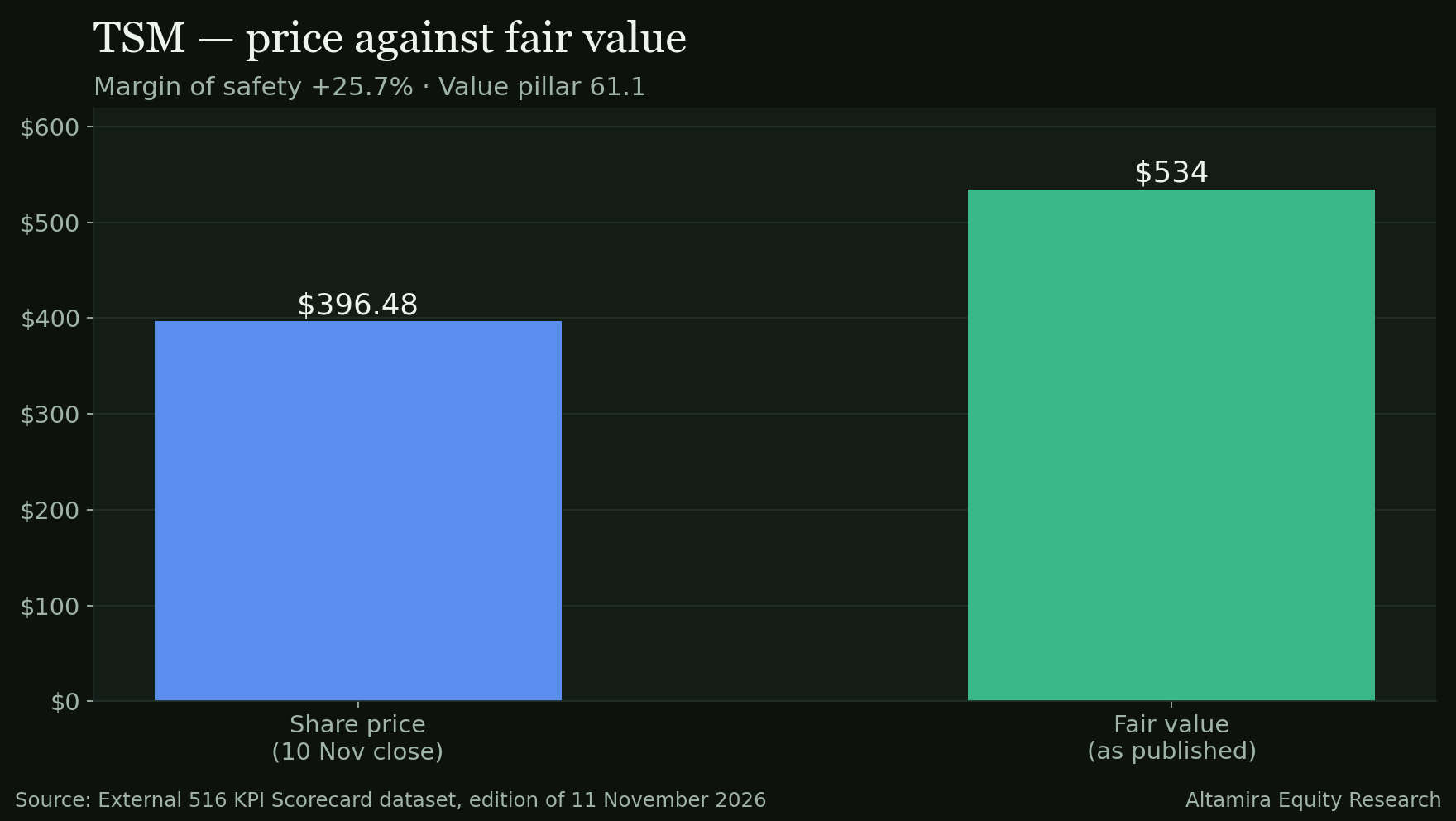
Taiwan Semiconductor (TSM) in the scorecard edition of 11 November 2026: price $396.48 against a fair value of $534, a margin of safety of +25.7% — inside the methodology's strong band. Read in full, the same row shows why the cushion is only part of the story: TSM's Value pillar scores 61.1, because a modest free-cash-flow yield and a full earnings multiple pull against the discount. The cushion says the downside reference is favourable; the pillar says the market is still charging for the quality — and the quality, on the same row, is genuinely there (Quality 79.2, Health 96.0, QC gate passed 13 of 13).
How to use the column
Three habits make the column earn its place. Compare it with the QC gate: a wide cushion under a QUALIFIED name is a different animal from the same cushion under a NOT QUALIFIED one — the first is a strong business on sale, the second is often a value trap being priced correctly. Watch it across editions: a widening cushion on a flat fair value means the price fell; on a rising fair value it means the estimate moved — the two stories demand different responses. Respect the negative: a negative margin of safety is not a sell signal by itself, but it removes the shock absorber — from there, the investment case has to be carried entirely by growth arriving on schedule.
Sources: Altamira KPI Scorecard methodology (margin-of-safety definition, scoring scale and colour bands; Value pillar weights) and the edition of 11 November 2026 (prices as of the 10 November close) for the worked example. Fair value is stated as published in the dataset. Research for information only — not investment advice.