GE Vernova: Orders Doubled the Backlog Story — Now Conversion Has to Cash It
Some earnings prints answer the question investors brought into the quarter. GE Vernova's third quarter changed the question.

Orders +96% YoY to $29.3B · backlog ~$176B → ~$197B · guidance raised on every line — revenue, margin and free cash flow
The story in 30 seconds - GE Vernova's third quarter was a demand quarter disguised as an earnings quarter: revenue of $12,642M beat consensus by 5.41% and orders of $29.3B — up 96% year over year — took the backlog to about $197B. - Management raised fiscal 2026 guidance on revenue ($46.5–47.5B), adjusted EBITDA margin (13.5%–14.5%) and free cash flow ($16–17B) at once, and confirmed gas turbine order pricing ran north of +20%. - The open question is conversion: slots sold into 2032 at today's prices must ship at tomorrow's margins, alongside a $9B acquisition and a newly profitable Wind segment.
Some earnings prints answer the question investors brought into the quarter. GE Vernova's third quarter changed the question. The debate going in was whether slot scarcity in gas turbines was real pricing power or a good story told by a capacity-constrained supplier. The print's answer was arithmetic: $29.3 billion of orders in a single quarter, a book-to-bill above two times, and turbine order pricing running north of +20% against the fourth-quarter 2025 baseline, as management confirmed on the call.
The market's first reaction was measured — a +2.91% close to $903.58 against an eight-quarter average absolute move of ±6.04%. Management, by contrast, did not behave like a team managing expectations down: guidance was raised on every line, the Power margin range was lifted two full points, the buyback authorisation was doubled to $20B, and the company committed $9B to acquiring Trench Group for its Electrification business. Capital allocation on that scale is either confidence or hubris, and the difference will be decided by conversion — whether a backlog sold into 2032 at today's pricing ships at today's promised margins.
In this post: (1) the print in one picture; (2) what to make of it; (3) the long view — with an honest warning about what five-year lenses mean for a 2024 spin-off; (4) the Key Issue — whether backlog conversion at +20% pricing survives Trench, time and the cycle.
At a glance — Q3 2026
This scoreboard is the quarter on one screen: what was filed, what consensus expected, and how the market reacted.
- Revenue: $12,642M vs $11,992.7M expected · +5.41% surprise · +26.81% YoY · +13.85% QoQ
- EPS: $4.81 vs $4.03 expected · +19.35% surprise · +193.29% YoY · estimate range $3.33–$4.46 (11 analysts)
- Guidance: RAISED — FY2026 revenue $46.5–47.5B · adjusted EBITDA margin 13.5%–14.5% · free cash flow $16–17B
- Reaction: +2.91% close, to $903.58 from $878.03 · 8Q average absolute move ±6.04%
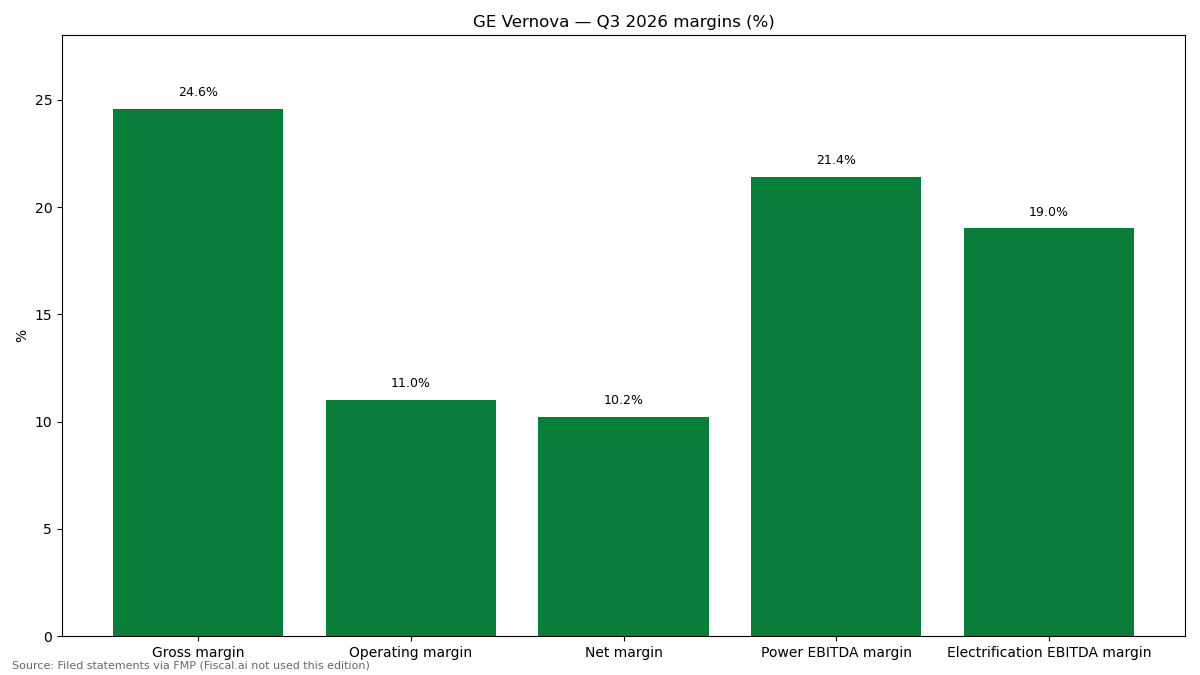
- Margins: gross 24.58% (+554 bp YoY) · operating 11.03% (+736 bp YoY) · net 10.21% (+568 bp YoY)
- Orders & backlog: orders $29.3B (+96% YoY) · backlog ~$197B (from $176B) · 122 GW under contract, ≥130 GW expected by end-2026
- Cash: operating cash flow $6,057M · free cash flow $5,410M · cash $16,764M · total debt $2,795M
The quarter in one line: a demand quarter disguised as an earnings quarter — orders nearly doubled, backlog jumped $21B, margins expanded hundreds of basis points, and management raised every guidance line it has.
The quarter in one picture
The flow below shows how each revenue dollar was split between running costs, tax and profit, in exact filed figures ($M).
- Revenue — $12,642M · 100.0%
- Cost of revenue — $9,536M · 75.4%
- Gross profit — $3,107M · 24.6%
- Operating expenses — $1,713M · 13.5%
- Operating income — $1,394M · 11.0%
- Pre-tax income — $1,782M · 14.1%
- Income tax — $493M · 3.9%
- Net income — $1,291M · 10.2%
Operating expenses of $1,713M are research and development of $358M plus selling, general and administrative costs of $1,354M and $1M of other expenses. Other income of $388M lifts operating income to the pre-tax line; the effective tax rate was 27.7%.
What to make of this print
Seven readings of the quarter — each is a finding plus what it implies.
- Orders are the headline; revenue is the footnote. Orders of $29.3B were 2.3 times the quarter's revenue, and a backlog of about $197B against a $46.5–47.5B revenue guide is more than four years of cover. Near-term growth is no longer a demand question — it is an execution and conversion question.
- Quality of earnings — operational, emphatically. EPS grew +193.29% YoY while the diluted share count fell only 0.75% sequentially to 268M. Growth of that size came from revenue and margin. One flattering line deserves a flag: free cash flow of $5,410M is 419.71% of net income on the dashboard basis, reflecting cash collected ahead of recognised earnings in a quarter of very large orders — strong cash, not a run-rate conversion to extrapolate.
- Pricing is now a disclosed fact, not a hope. Management confirmed third-quarter turbine order pricing ran north of +20% versus the fourth-quarter 2025 baseline, with slots sold for 2032 delivery across roughly 100 customers in 25 countries, about 20% of them data centres.
- Margins expanded everywhere at once. Power EBITDA margin reached 21.4% (+830 bp) in the seasonally weakest services quarter — the first quarter of better-priced equipment shipments. Electrification delivered a 19% EBITDA margin, and Wind turned profitable with $72M of EBITDA.
- Capital allocation turned aggressive — funded, not levered. The quarter returned $1,758M, October added $1.3B+ of buybacks, the authorisation doubled to $20B, and Trench Group was signed for $9B — against $16,764M of cash and $2,795M of total debt. The risk is paying 13x 2028 EBITDA (before synergies) for Trench, not the balance sheet.
- The guidance raise is broad, which makes it testable. Revenue, EBITDA margin and free cash flow were all raised, and management pre-committed to the fourth quarter being the largest orders quarter of the year, with backlog growth above the third quarter's.
- The story now has a clock on it. A backlog sold into 2032 must survive six years of cost inflation and execution. The bull case is conversion; the bear case is time.
Takeaway: the strongest demand-and-margin quarter in GE Vernova's short public life — the argument has moved from whether the supercycle is real to whether conversion and a $9B acquisition can keep pace with it.
How GE Vernova makes money
This section shows where revenue comes from — the mix decides which growth rates matter.
GE Vernova is the supply side of electrification: gas turbines and their services tails, high- and medium-voltage grid components, transformers, and wind turbines. Economics turn on slot scarcity and backlog duration — when demand for firm power outruns turbine and transformer capacity, lead times stretch years out, pricing shifts to the manufacturers, and long services streams attach to every equipment sale.
Three segments. Power — gas turbines (heavy-duty and aeroderivative) and services on the installed fleet — is the profit engine: a 21.4% EBITDA margin this quarter, 122 GW under contract, and services orders growing 10%. Electrification — grid components, transformers and high-voltage equipment — printed a 19% EBITDA margin and is being scaled by acquisition, first Prolec and, on close, Trench Group. Wind — onshore and offshore turbines plus services — turned profitable this quarter, with $72M of EBITDA on services improvement. Segment revenue dollar splits are not published in the sources used for this post, so none are estimated here.
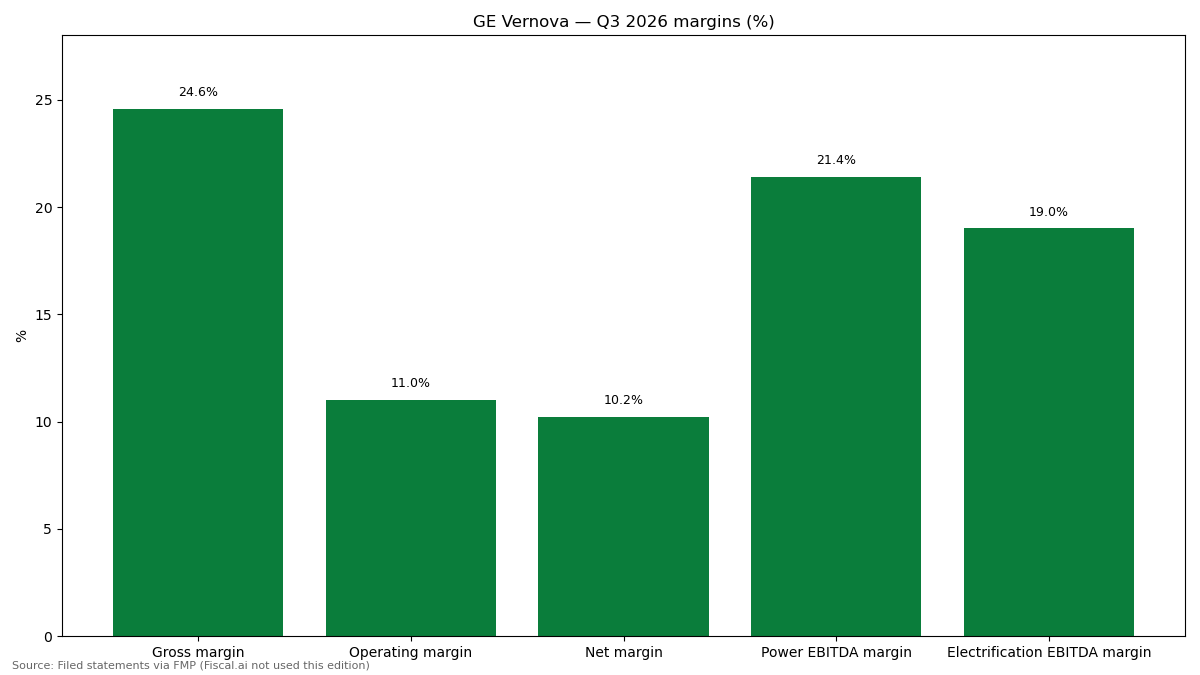
Q3 2026 margins. Gross margin 24.6% and operating margin 11.0% are filed consolidated figures; Power (21.4%) and Electrification (19%) are segment EBITDA margins as reported on the call. Source: company filings and earnings call.
The long view
One quarter is weather; five years are climate — with a caveat stated plainly: GE Vernova was spun off from GE in 2024, so long-window averages blend pre-spin history with a short public record. The figures below are the filed ones available, and the judgments weight them accordingly.
Revenue growth
Growth is the first quality test, because equipment cycles punish companies that mistake a backlog bulge for compounding. The three-year revenue compound rate is 8.68%; a clean five-year rate does not yet exist for the spun-off company. The visible check is acceleration: revenue grew +26.81% YoY this quarter, and the raised fiscal 2026 guide of $46.5–47.5B stands well above the prior year's filed base. Judgment: judge this company on conversion of a visible backlog, not on a five-year growth rate it does not yet honestly have.
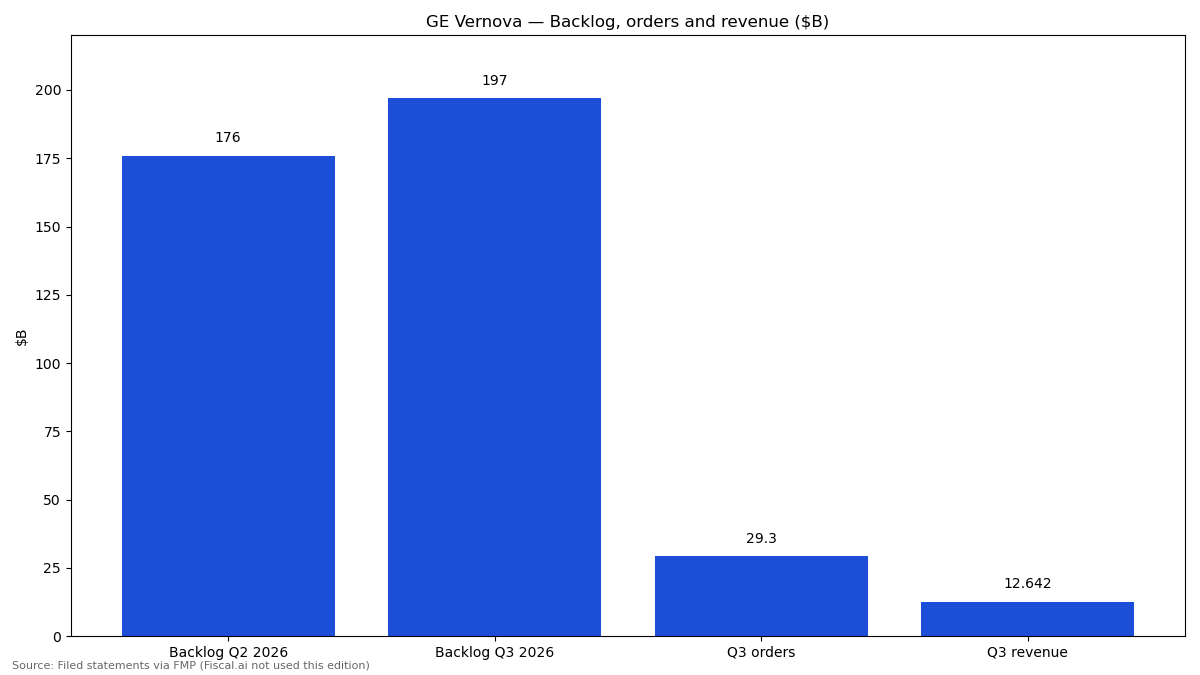
Backlog, orders and revenue for Q3 2026. Source: company filings and earnings call.
Operating margin
Margin tells you whether scarcity is being converted into profit or merely into revenue. The long-window gross margin is 19.79% and net margin 12.83%; this quarter printed above the gross line at 24.58%, with operating margin up 736 basis points year over year. Management's own framing is that margin expansion is early — the first quarter of better-priced equipment shipments has only just flowed through. Judgment: margin is the supercycle's proof-of-work, and the raised Power margin guide of 19%–21% says management expects it to hold.
Cash
Cash is where backlog stories are audited: orders that do not collect are just paper. This quarter produced $5,410M of free cash flow on $6,057M of operating cash flow, and the raised full-year free-cash-flow guide is $16–17B. Judgment: cash generation is the strongest verified leg of the story — customers are paying ahead of delivery, which funds both the enlarged buyback and the Trench acquisition without leverage.
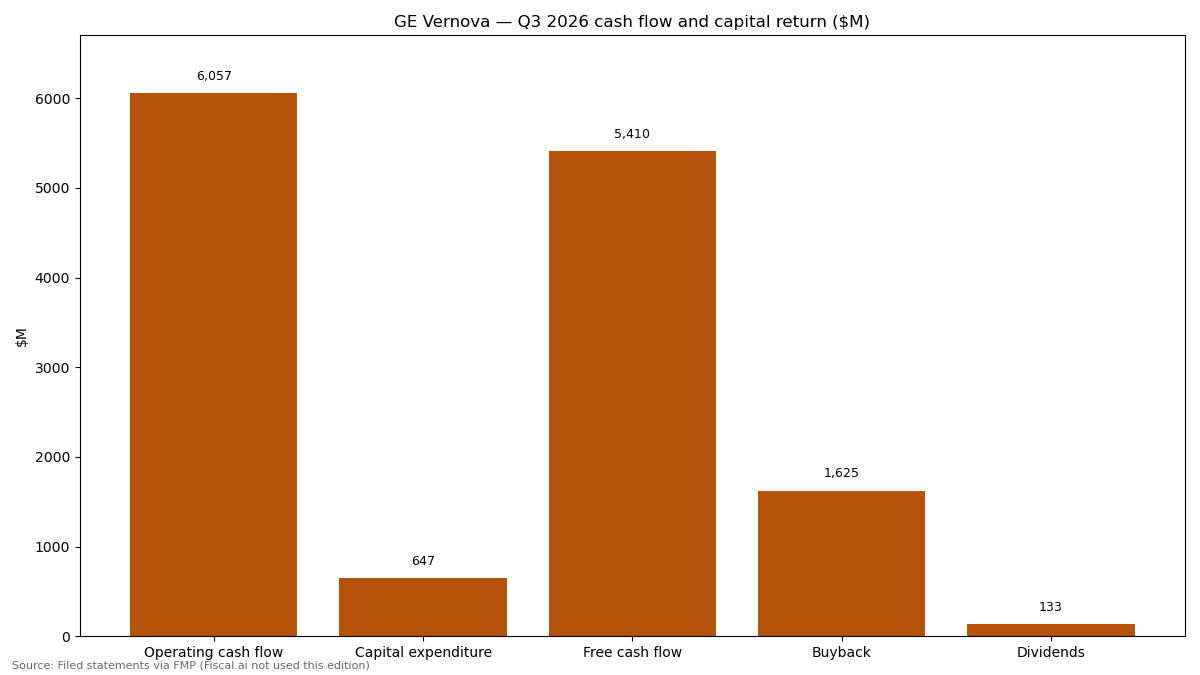
Q3 2026 cash flow and capital return, filed figures. Source: company filings.
Return on invested capital
Returns ask what the installed base earns on everything invested in it — and here the spin-off caveat bites hardest: long-window return measures are dominated by pre-spin history and are not yet meaningful for this company. The honest returns evidence today is the current margin and cash profile above. Judgment: revisit the returns lens once a clean post-spin record exists; for now it would mislead in both directions.
Beyond the print — the business this quarter
The earnings release is the scoreboard; this section is what changed in the business itself during and around the quarter.
The Trench Group acquisition (announced with the print). GE Vernova signed a $9B acquisition of Trench Group — high-voltage grid components — at 13x 2028 EBITDA before synergies, expected to close late 2027. Management framed Trench, with the earlier Prolec deal, as the two assets of scale it wanted in Electrification. The grid-equipment roll-up is now a stated strategy, funded from the cash pile.
The buyback doubled (announced with the print). The repurchase authorisation rose from $10B to $20B after $1,625M was spent in the quarter and $1.3B+ more in October; management said the original programme was largely completed, having acquired 15.6 million shares at an average of approximately $635.
Data centres are now a named demand channel. Roughly 20% of the customers taking gas-power slots were data centres, across about 100 customers in 25 countries, with slots sold for 2032 delivery. The AI power trade has moved from conference narrative to this order book — which also means the backlog now carries hyperscaler spending cyclicality as a named exposure.
Wind turned profitable. Wind delivered $72M of EBITDA on services improvement, with offshore execution described as improving. A profitable Wind removes the segment that most often supplied the execution bear case.
What management said — Q3 2026 call (Oct 28, 2026)
This section reports what management guided and claimed, in their own words, and what each claim commits them to.
Scott Strazik (Chief Executive Officer) — on demand: "our growth continues to accelerate with both our core business and new products with almost $30 billion in new orders and an expansion of our backlog from $176 billion to approximately $200 billion in 3Q, we continue to see strong pull from customers for the solutions we offer." Why it matters: the chief executive led with orders, not earnings — the company wants to be judged on backlog conversion from here, and the framing sets the fourth-quarter bar he then raised himself.
Scott Strazik (Chief Executive Officer) — on the gas book: "we've signed 52 gigawatts of new agreements year-to-date and now expect at least 130 gigawatts under contract by the end of '26 compared to 83 gigawatts when we started the year." Why it matters: a 57% expansion of contracted gigawatts inside one year, guided before the year ends, is the clearest quantification of the demand cycle — and a commitment that can be checked to the gigawatt in January.
Kenneth Parks (Chief Financial Officer) — the guidance raise: "Given the strength of third quarter performance and confidence in our fourth quarter trajectory, we are raising our revenue, margin and free cash flow guidance for '26." Why it matters: the raise was three-dimensional — revenue, margin and cash flow — so the fourth quarter has three independent tests, not one.
On the question-and-answer session: Deutsche Bank pressed on turbine pricing momentum (answered directly — pricing north of +20%); JPMorgan asked whether the 130+ GW trajectory keeps expanding and how slot reservations convert (answered directly, pointing to the fourth quarter as the largest orders quarter); Morgan Stanley asked about customer financing stress or slot-reservation exits (answered directly — none seen, and no change to cash terms); Bank of America probed Wind's long-term strategic optionality (management described the turnaround and deferred any strategic decision).
The Key Issue — can a $197B backlog convert at +20% pricing without Trench, time and the cycle eating the margin story?
Thesis: GE Vernova has sold the future at excellent prices — slots into 2032, pricing north of +20%, backlog above $197B. The question is no longer demand; it is whether conversion over the next six years — through a $9B acquisition, a Wind turnaround and an eventual turn in data-centre spending — delivers those orders at the margins the raised guide now promises.
Evidence for (conversion is credible): the first quarter of better-priced equipment shipments already printed a 21.4% Power EBITDA margin; cash is arriving ahead of earnings ($5,410M of quarterly free cash flow, a $16–17B full-year guide), which is what healthy conversion looks like before it shows in margins; services orders grew 10%, deepening the annuity that carries margins through equipment cycles; management answered the financing-stress question directly — no slot exits, no change to cash terms; and the balance sheet ($16,764M of cash against $2,795M of debt) means conversion problems would be earnings events, not solvency events.
Evidence against (time is the risk): a backlog sold into 2032 must survive six years of cost inflation, supply-chain strain and customer renegotiation — today's pricing is only as good as the cost base it eventually ships against; Trench, at $9B and 13x 2028 EBITDA before synergies, adds integration load exactly when execution capacity is scarcest, and its close is not expected until late 2027; about 20% of slot customers are data centres, tying the backlog to the most cyclical capital-spending programme in the market; and Wind's profitability is one quarter old.
What to watch: (1) Fourth-quarter delivery against management's own pre-commitment — the largest orders quarter of the year, backlog growth above the third quarter's, and at least 130 GW under contract by end-2026. (2) External datapoint: peer read-across — other grid-equipment suppliers' order books, and hyperscaler capital-spending guides, which govern the data-centre fifth of the slot book. (3) First Trench financing and synergy detail. (4) Slot-reservation conversion into firm backlog at pricing holding above +20%. (5) Historical analogy: the last turbine supercycle, in the 2000s gas build-out, rewarded manufacturers whose services fleets compounded and punished those whose equipment backlog was priced before a cost spike — the analogy argues the services attach rate (orders +10% this quarter) is the number that decides which side of that history GE Vernova lands on. The forward question: when the 2030–2032 slots ship, will they ship at 21%-plus Power margins — or will the backlog's best prices turn out to have been its best years?
Sources: GE Vernova Q3 2026 filed financial statements and consensus estimates via FMP (Earnings Recap, Oct 28, 2026); Q3 2026 earnings-call transcript (Oct 28, 2026).
Disclosure: This post is published for information only and is not financial advice. The author may hold positions in companies discussed.