Eli Lilly: The Beat Was Enormous — and the Question It Leaves Is About Size, Not Execution
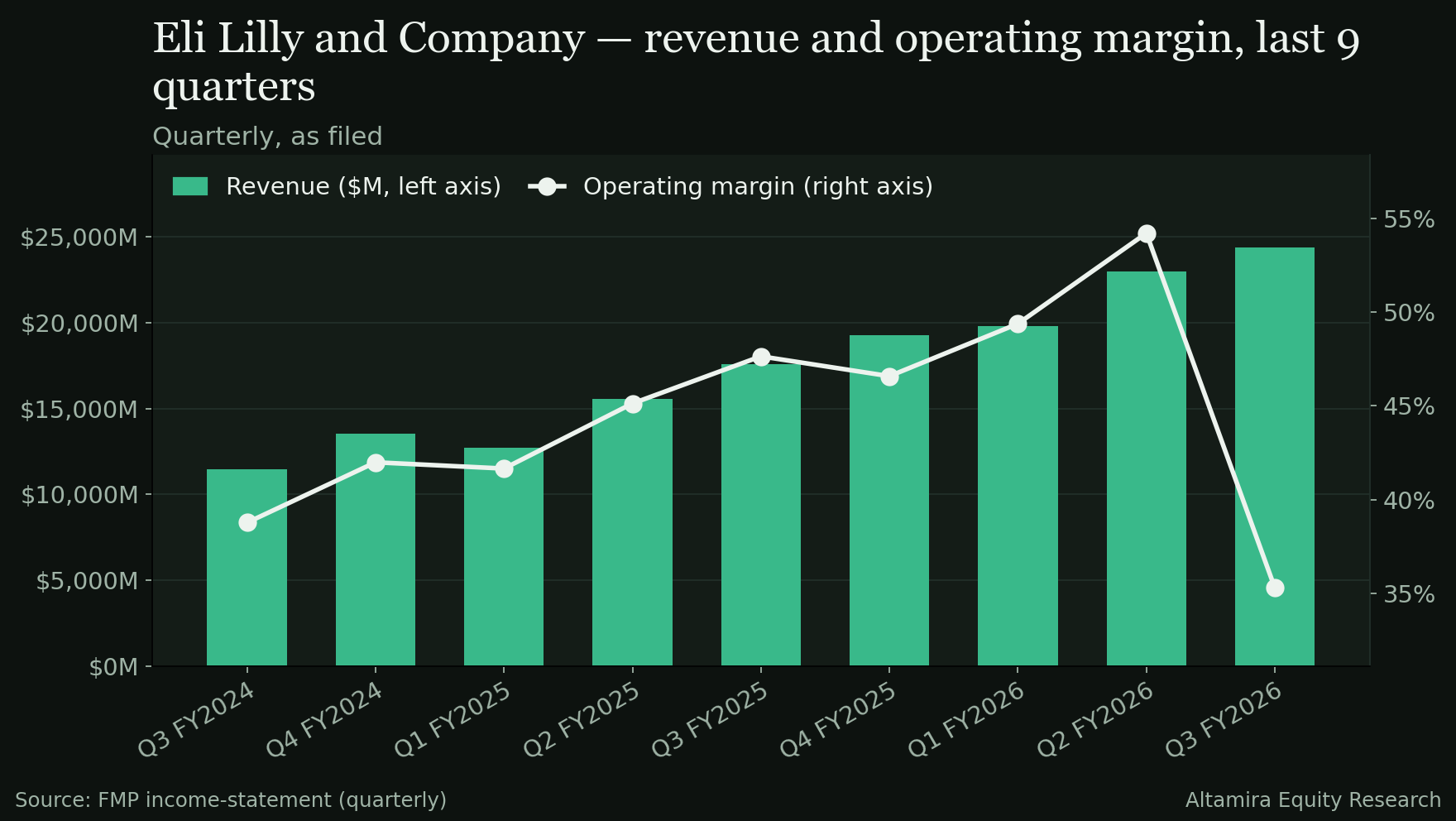
Revenue $24,397M, +8.03% vs estimate and +38.61% YoY · non-GAAP EPS $7.48 vs $5.68 (+31.69%) · guidance raised to $91–92B of revenue and $35–36 of EPS — and the close was +6.57% to $1,373

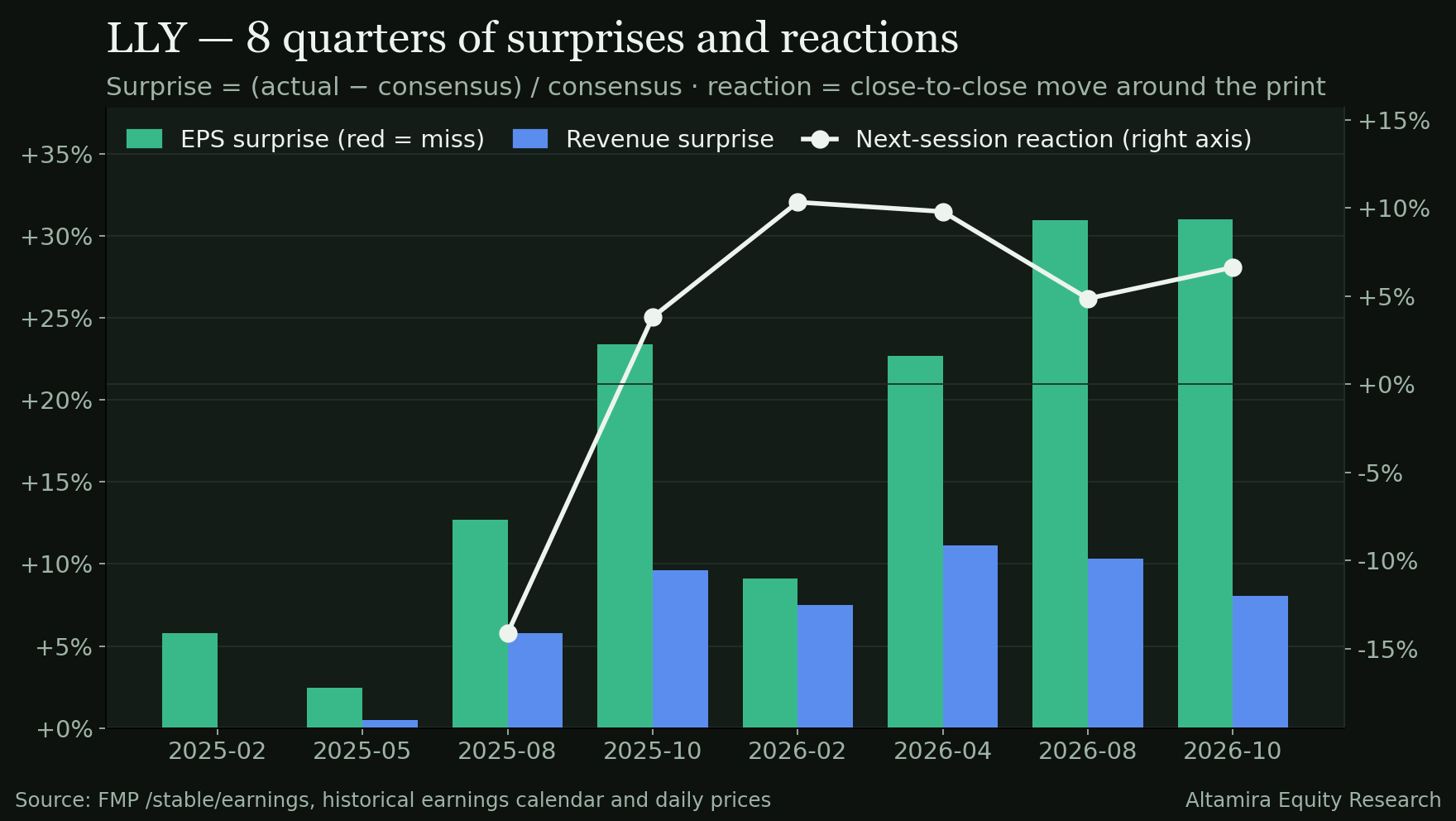
Revenue $24,397M, +8.03% vs estimate and +38.61% YoY · non-GAAP EPS $7.48 vs $5.68 (+31.69%) · guidance raised to $91–92B of revenue and $35–36 of EPS — and the close was +6.57% to $1,373
Eli Lilly and Company (LLY, NYSE) · Q3 2026 (quarter ended Sep 30, 2026), reported Thu Oct 29, 2026 before the open. All figures are filed figures or earnings-call figures, traced to the sources at the end of this post.
The story in 30 seconds
- The beat is broad: revenue beat by 8.03% with growth in every geography the call disclosed — US +34%, Europe +29% in constant currency, China +62%, rest of world +87% — and non-GAAP EPS beat by 31.69% while absorbing $4.57 per share of acquisition-related charges.
- The margin line that fell is an accounting line: GAAP operating margin fell 1,236 basis points year over year to 35.28% on those charges, while gross margin rose — 83.88% filed (+97 basis points), 84.4% on the non-GAAP basis the business is run on (+80 basis points).
- The open question is not execution — it is duration: whether the incretin category is as large, for as long, as a quarter like this invites the market to assume.
There are earnings beats, and then there is what Lilly just did. A 31.69% EPS beat on an 8.03% revenue beat, in a quarter where revenue grew 38.61% year over year, would normally settle every argument. It settles most of them. The demand argument is over for now: Mounjaro and Zepbound combined for more than $16 billion in one quarter, the Medicare bridge filled more than half a million prescriptions in its first quarter, and management raised full-year guidance for the third time this year — roughly $10 billion of top-line raises year to date, by the JPMorgan question that opened the Q&A.
What the print does not settle is the size question. Lilly closed up 6.57% to $1,373 — a move inside its own eight-quarter average, which tells you the market found the quarter strong but not shocking. The investor question is whether this growth rate is the early slope of a very long curve or the high-water mark of a category being pulled forward. That is the question this post works through.
Why it matters beyond one stock: Lilly is the purest listed expression of the incretin category — by management's own framing, the largest new category expansion in the history of the pharmaceutical industry — and its capacity, pricing and pipeline decisions now set the terms for the whole sector.
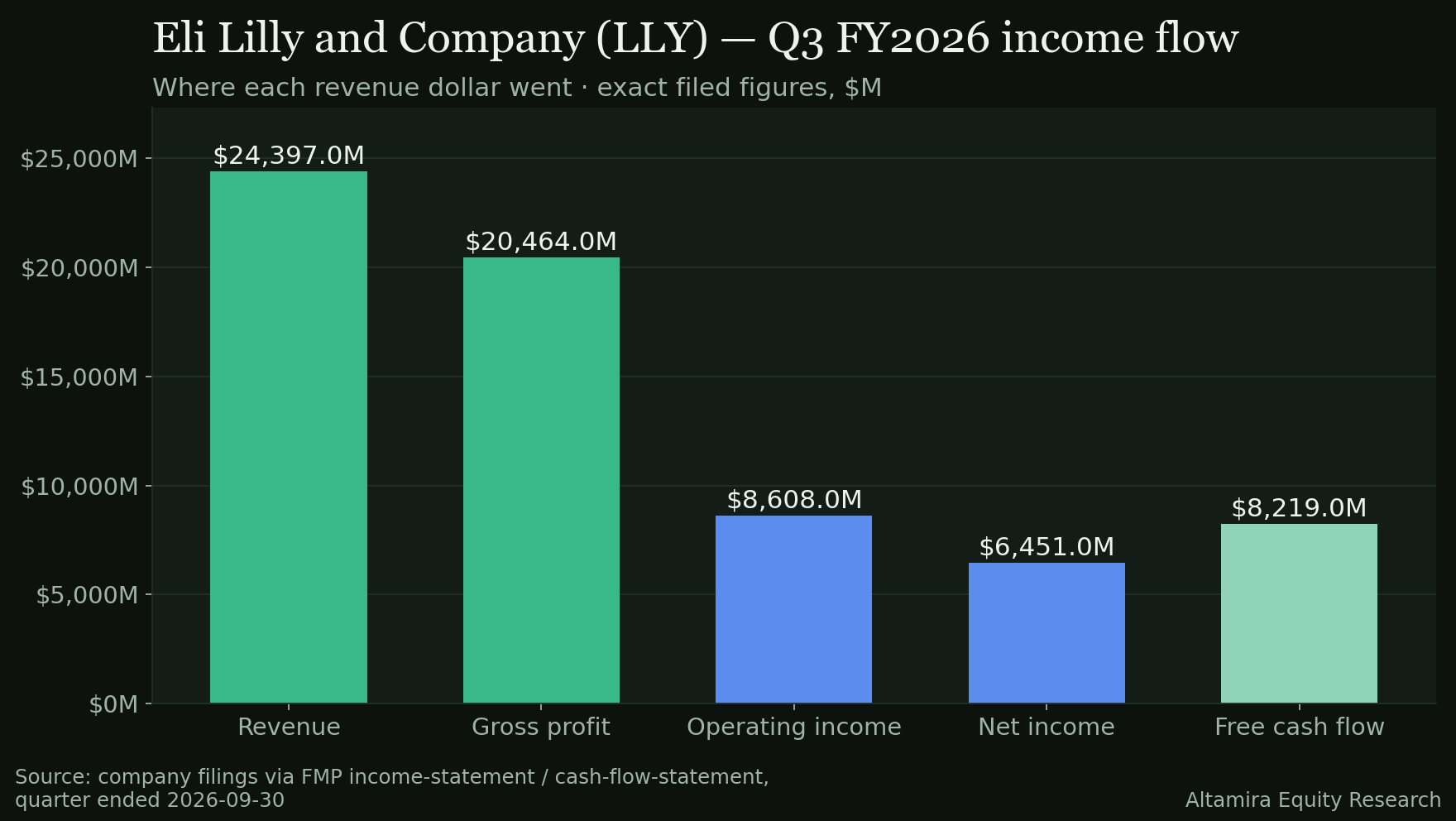
In this edition: (1) the print in one picture — where $24.4 billion of revenue actually went, and why the GAAP margin fall is not one; (2) what to make of it — including the quality-of-earnings line; (3) the long view — five years of compounding against one stubborn cash-conversion number; (4) the Key Issue — whether the opportunity is fundamentally larger than modelled, or whether demand is being pulled forward.
At a glance — Q3 2026 scoreboard
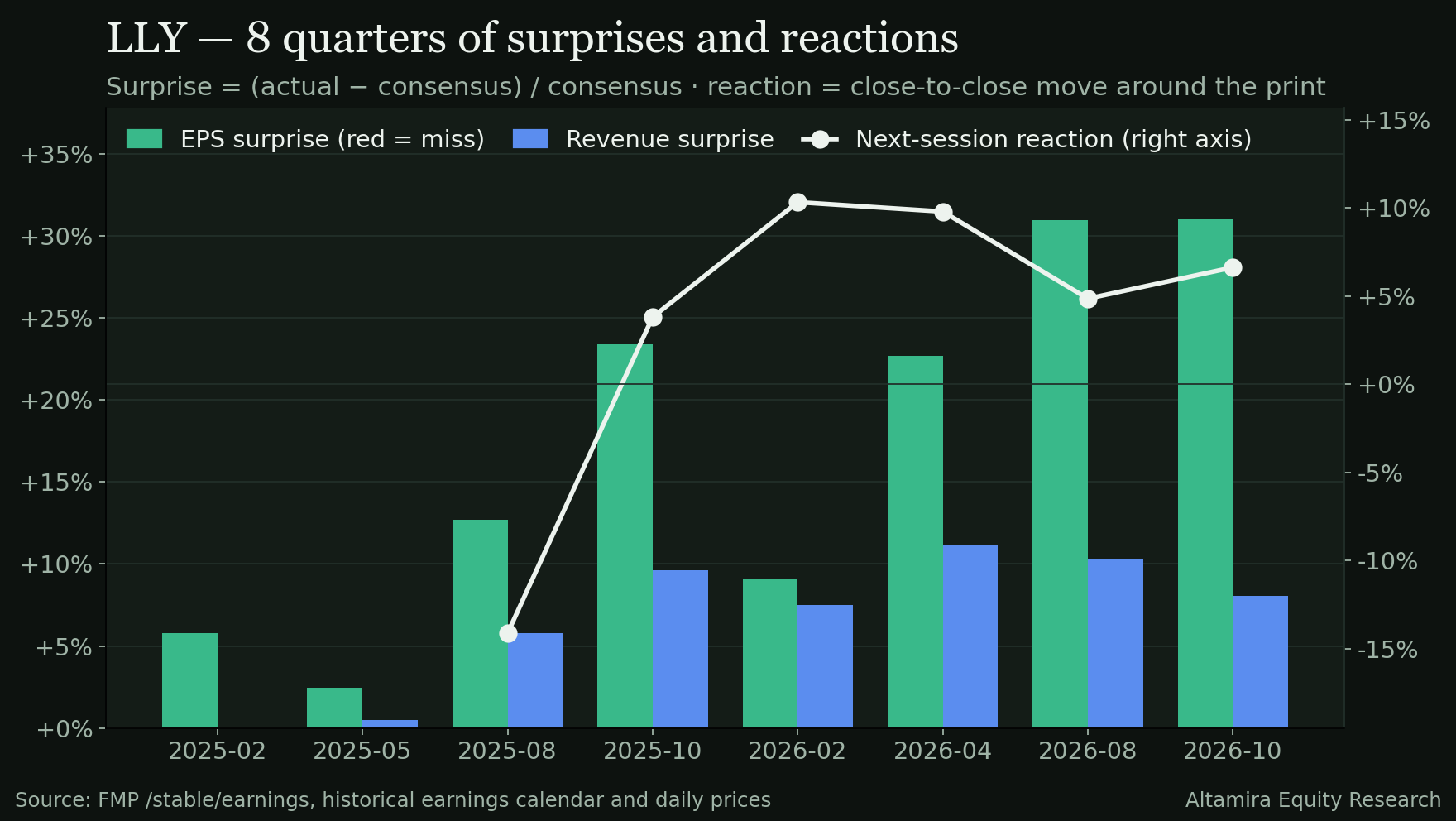
This scoreboard is the quarter on one screen: what was filed, what consensus expected, and how the market reacted.
- Revenue: $24,397M — vs $22,583M est · +8.03% surprise · +38.61% YoY · +6.19% QoQ
- Non-GAAP EPS: $7.48 — vs $5.68 est · +31.69% surprise · includes $4.57 per share of acquired in-process R&D charges (GAAP diluted EPS $7.22)
- Guidance: raised — FY2026 revenue $91–92B · non-GAAP EPS $35–36 · non-GAAP performance margin about 52.5%
- Reaction: +6.57% close, to $1,373 from a $1,288.30 previous close · eight-quarter average absolute move ±8.03%
- Gross margin: 83.88% GAAP (+97 bp YoY) · 84.4% non-GAAP (+80 bp)
- Operating margin: 35.28% GAAP (−1,236 bp YoY, acquisition charges in operating expenses) · non-GAAP performance margin 54.2% (+5.9 points)
- Net income: $6,451M · 26.44% of revenue
- Cash generation: operating cash flow $11,397M · capex $3,178M · free cash flow $8,219M · conversion 127.41%
- Capital returned: dividends $1,541M · buybacks $377M
- Balance sheet: cash $4,885M · total debt $49,503M
The quarter in one line: Lilly sold $24,397M of medicine — more than $16B of it Mounjaro and Zepbound — beat both lines by wide margins, raised the year, and the only line that fell, GAAP operating margin, fell on acquisition accounting rather than on the business.
What to make of this print
Six readings of the quarter — each is a finding plus what it implies.
- The beat is broad, not built on one line. Revenue beat by 8.03% with growth in every geography the call disclosed — US +34%, Europe +29% in constant currency, Japan +26%, China +62%, rest of world +87% — so the surprise is a demand fact, not a mix accident. Implication: guidance credibility rises; the burden shifts to 2027.
- Quality of earnings: operational. Non-GAAP EPS of $7.48 absorbed $4.57 per share of acquired in-process R&D charges (vs $0.71 a year ago) and still beat by 31.69%; diluted EPS grew 16.26% year over year while the diluted share count moved −0.06% quarter over quarter and buybacks were just $377M. The growth is volume and mix, not financial engineering — labelled operational.
- The margin scare is accounting. GAAP operating margin fell 1,236 basis points year over year to 35.28% alongside the acquisition charges, which sit in operating expenses; filed gross margin rose 97 basis points to 83.88%, and non-GAAP gross margin expanded 80 basis points to 84.4% on favourable mix and improved production cost, partly offset by lower realised prices. Implication: judge Lilly's pricing power on the non-GAAP line — and it held.
- Part of the raise is one-time — management said so. The quarter's revenue included roughly $900M of milestones and rebate/discount estimate changes (including a $410M milestone that was the last under that agreement), and roughly $2B of 2026 one-time items will not recur. Implication: the 2027 guidance in January must replace that $2B with volume before it can grow — the print's real forward test.
- Volume is carrying price. US revenue rose 34% on incretin volume despite a 7% price decline (10% excluding a favourable rebate-estimate adjustment); US incretin prescriptions grew 32% and obesity prescriptions 82%. Implication: the model is working as designed — access expansion traded for volume — but net price is now a structural headwind, not a quarterly one.
- Cash confirms the earnings. Free cash flow of $8,219M at 127.41% conversion funds $1,541M of dividends, $377M of buybacks and two plant groundbreakings without balance-sheet strain. Implication: growth here, this quarter, is self-funding.
Takeaway: operationally this is about as strong as a quarter gets; the argument it leaves open is not about the business that reported, but about how many more years like it the category has in it.
How Lilly makes money
This section shows where revenue actually comes from — the mix decides which growth rates matter.
Sector primer — incretin-led pharmaceuticals. Incretin makers sell patented diabetes and obesity medicines into the largest new drug category in industry history. Economics turn on volume (penetration is still low), net price (falling as access widens, so growth must be volume-led), and manufacturing capacity — multi-billion-dollar plants, not demand, are the binding constraint. The moat is the pipeline ladder: weekly injectable today, daily oral next, triple agonists behind it. The named peer context for this post is the broader pharmaceutical group; Lilly's one scaled global rival in incretins sits at the centre of the Key Issue below.
Lilly's engine is tirzepatide in two brands: Mounjaro for type 2 diabetes and Zepbound for obesity, which combined for more than $16B of the quarter's $24,397M — over 65% of revenue from one molecule. Around it, the rest of the key-product portfolio — oncology (Verzenio, Jaypirca, Inluriyo), immunology (Taltz, Ebglyss) and neuroscience (Kisunla, revenue +175% year over year) — doubled its revenue year over year in aggregate, on the CEO's call summary. Foundayo, the daily oral, is the expansion leg into patients who will not inject: roughly 4 in 10 new oral obesity starts in the US, with new patients doubling quarter over quarter. Pricing works against volume by design: broader access through the Medicare bridge (over 500,000 prescriptions filled since July 1; 7 of 10 new bridge patients on a Lilly medicine) and ex-US cash-pay markets lowers realised price per prescription while total prescriptions compound. No product-level revenue split beyond the figures above is in the traced set, so this section is built from the call's disclosed product and geography figures, labelled as such.
The long view
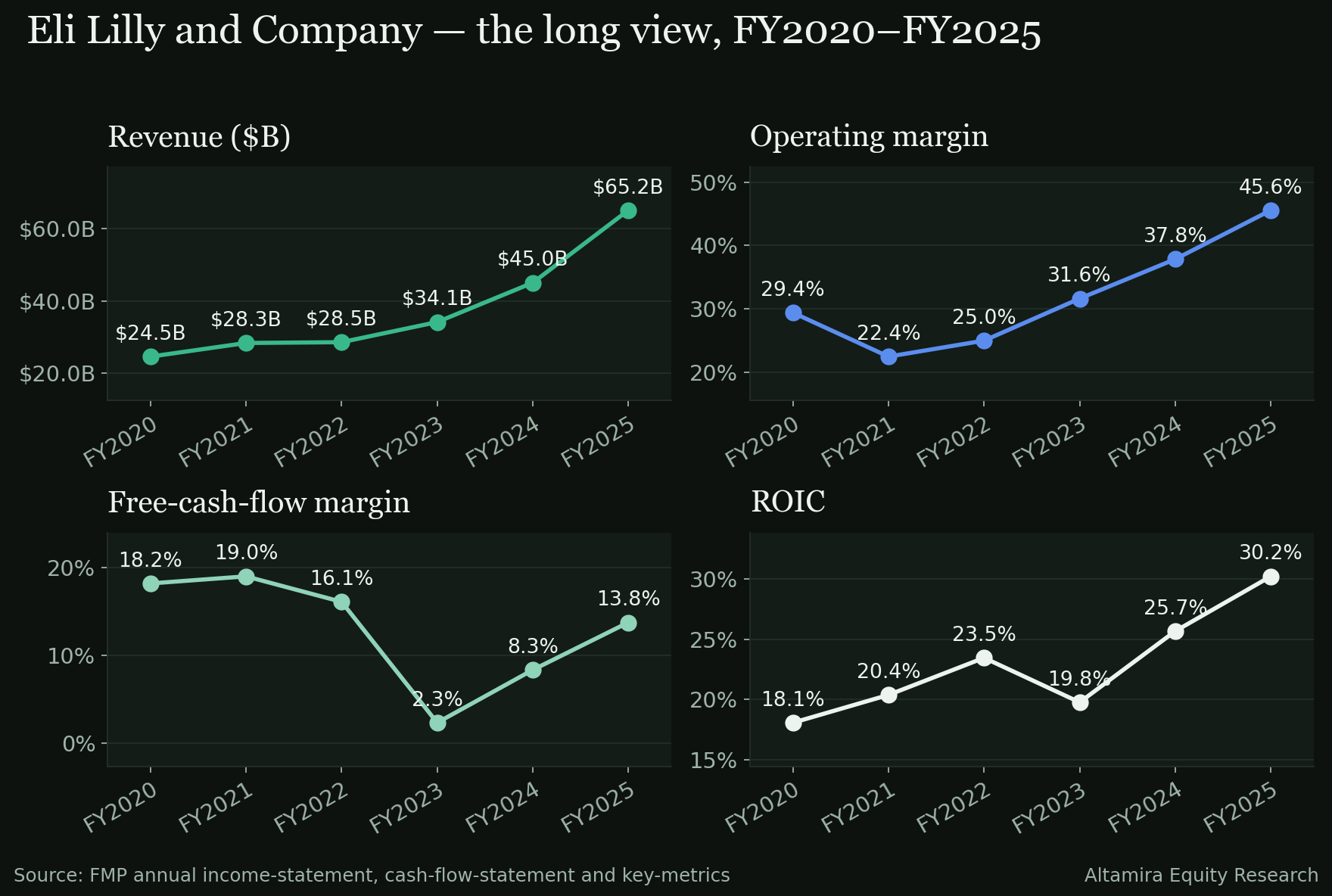
One quarter is weather; five years are climate. These four lenses judge Lilly on its filed history, with the quarter as the latest data point rather than the story. The charts in this section are rendered from verified filed values.
Revenue growth
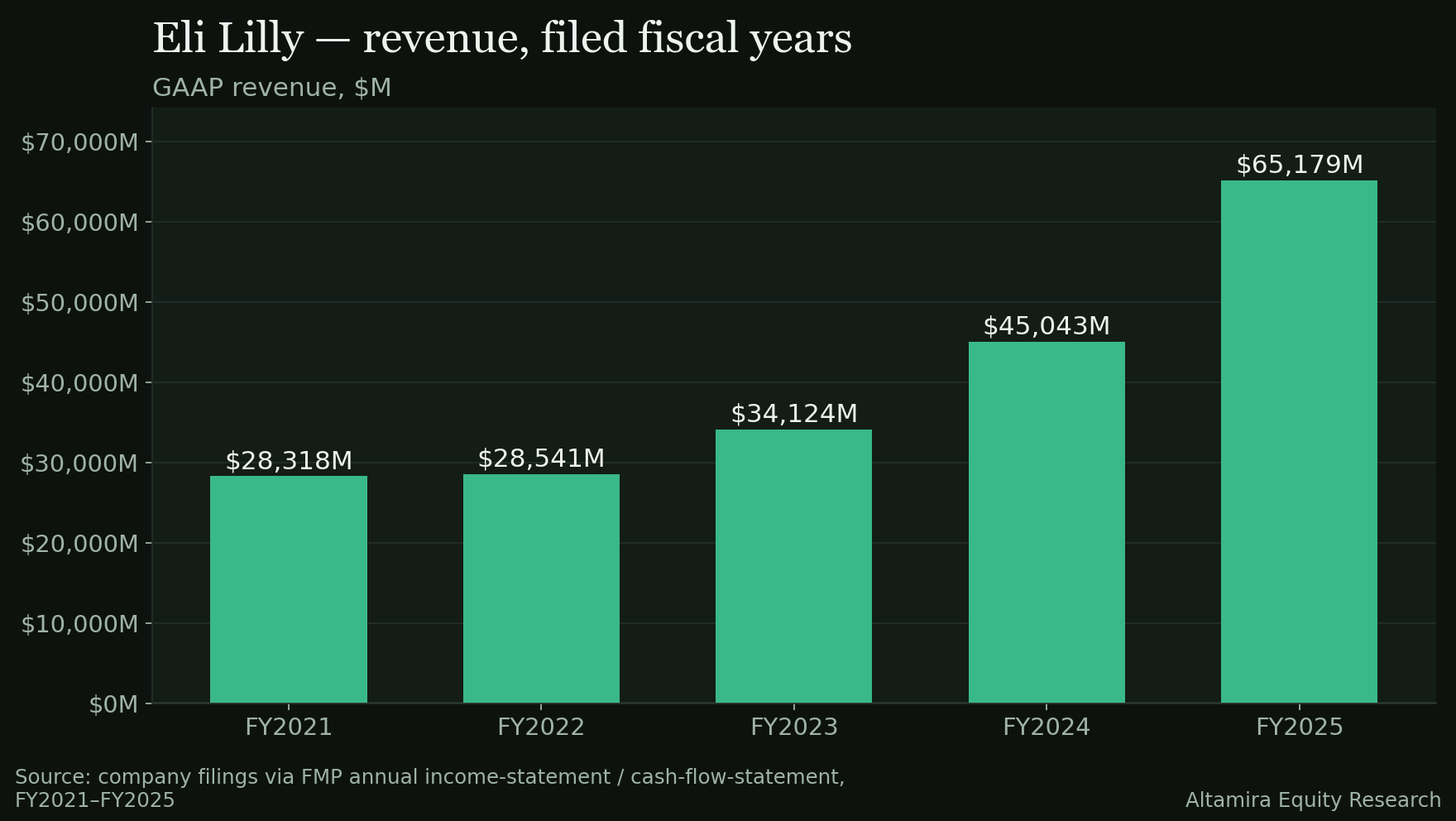
Growth is the first lens because Lilly's story is a growth claim before it is anything else. Filed revenue rose from $28,318M (FY2021) to $28,541M (FY2022), $34,124M (FY2023), $45,043M (FY2024) and $65,179M (FY2025) — a five-year compound rate of 21.58%, accelerating to 31.69% over the most recent three years. This quarter's +38.61% year over year sits above even the three-year trend. Judgment: growth passes — the rare case where the recent past is stronger than the long past.
Operating margin
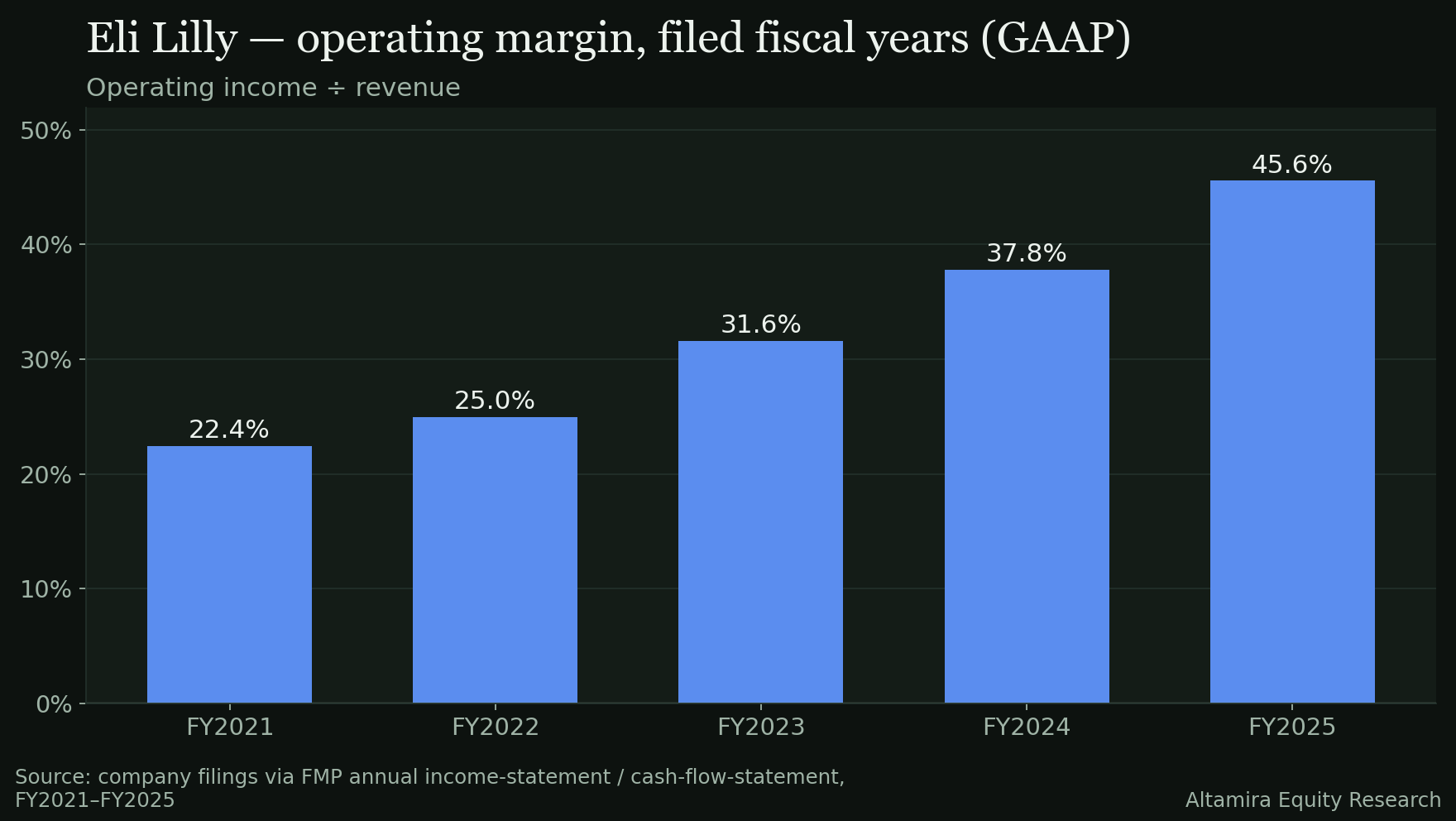
Margin is the second lens because volume-led growth at falling prices only works if scale keeps expanding the profit share. Filed GAAP operating margin rose every year from 22.45% (FY2021) to 45.56% (FY2025), a five-year average of 32.48% derived from those filed years. This quarter's GAAP operating margin printed 35.28% under the acquisition charges, while the non-GAAP performance margin reached 54.2%. Judgment: margin passes — the five-year staircase is intact; the quarter's GAAP dip is acquisition accounting, flagged wherever it appears.
Cash
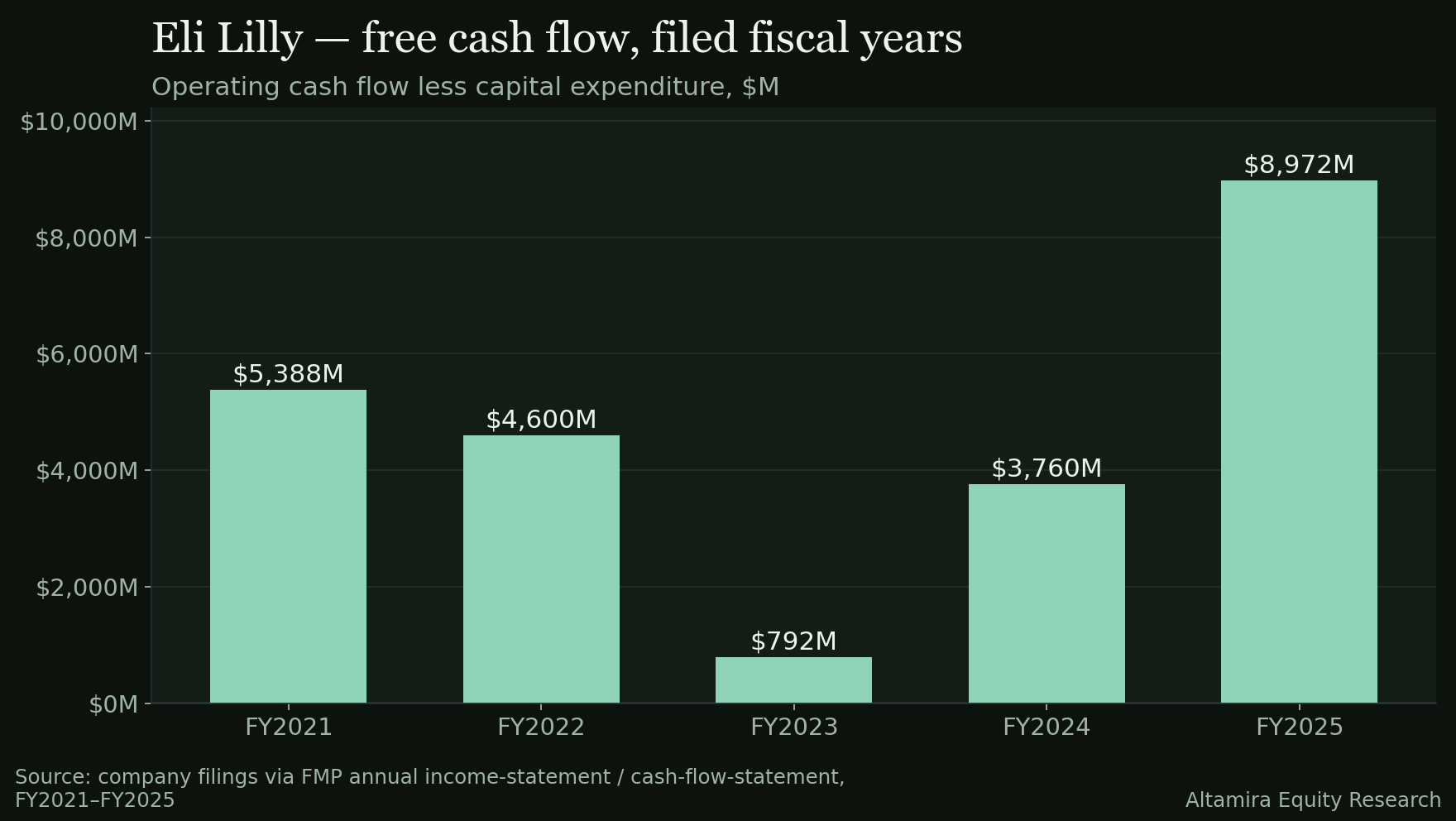
Cash is the third lens because pharmaceutical earnings carry heavy non-cash and acquisition charges, and only conversion proves them. Free cash flow compounded at 14.95% over five years and reached $8,972M in FY2025 (13.77% of revenue), but across the same five years operating cash flow has run slightly behind reported profit — a conversion ratio of 92.81%, the softest number in Lilly's long-view set. This quarter's conversion of 127.41% is the strongest single-quarter answer to it. Judgment: cash passes this quarter, on watch over five years — one quarter does not retire the weakest number; a year of them would.
Returns on capital
Returns on capital are the fourth lens because they separate a genuinely advantaged franchise from a merely large one. Lilly's five-year return on invested capital is 23.89%, with return on capital employed of 30.39% — elite figures at this scale. This quarter, those returns are being earned while $11.5B of new plant commitments break ground, so the capital base is rising into the franchise's strongest years. Judgment: returns pass — the advantage, measured in returns, is real.
Beyond the print — the business this quarter
Earnings describe the last thirteen weeks; these developments — each traced like a figure — describe the next several years.
- The pipeline outran the incumbent. Retatrutide, the triple agonist, beat semaglutide head-to-head in its Phase 3 diabetes trial: A1c reduction of 2.2% vs 1.8%, and weight loss of 20–21% vs 9.4%. A second triple-hormone combination delivered 23.3% weight loss at 48 weeks in Phase 2 — 57% more than tirzepatide alone. The succession line behind the current franchise is not theoretical.
- Foundayo went global. Launches in the UK, Mexico and Saudi Arabia in the quarter, regulatory review in more than 40 additional countries, and US regulatory action for the type 2 diabetes indication expected in Q4 — the oral leg that roughly half of US GLP-1 volume (diabetes) could eventually sit on.
- Capacity is being built ahead of demand, again. Ground broke on a $6.5B Houston plant and a $5B Richmond plant in the quarter. In a supply-constrained category, announced capacity is a share claim on 2028 demand.
- Approvals stacked up. Once-weekly insulin approved in the US; tirzepatide approved to reduce cardiovascular risk in type 2 diabetes; a first-line extension for the blood-cancer medicine Jaypirca, where the Phase 3 showed an 80% reduction in progression-or-death risk. Two acquisitions closed, in neuroscience and immunology.
- December 7 is the next catalyst. Management used the call close to promote a December 7 investor day, framed as research- and pipeline-focused — the venue where the growth pillars beyond incretins will be argued in full.
What management said
These are the call's own words — named executives, short verbatim quotes — because guidance credibility is judged on what was actually said, not on summaries of it.
David A. Ricks, Chair and CEO: “We delivered strong financial results, raised our full year financial guidance, advanced our pipeline, and expanded our manufacturing footprint.” Why it matters: this is the guidance sentence of record, and every clause of it is checkable against the print — results, raise, pipeline readouts and two groundbreakings all landed in the same quarter. It is also the third raise of the year, which converts guidance from a forecast into a track record the 2027 guide will be measured against.
Lucas E. Montarce, CFO: “Gross margin as a percentage of revenue increased 80 basis points to 84.4%, as favorable product mix and an improved cost of production were partially offset by lower realized prices.” Why it matters: this single sentence resolves the post's central margin question — on the basis management runs the business, mix and manufacturing are beating the price headwind. It also names the offset honestly: realised prices fell, and the model only works while volume outruns them.
Daniel Skovronsky, Chief Scientific and Medical Officer: “Retatrutide reduced A1C by 2.2%, compared to 1.8% on 2 milligrams of semaglutide.” Why it matters: head-to-head superiority over the rival's molecule — with weight loss more than doubled alongside it (20–21% vs 9.4%) — is the pipeline evidence that Lilly's efficacy lead can survive its own current products being leapfrogged. Succession, not just incumbency, is what a growth story at this scale is paying for.
The rest of the call, compressed: guidance was raised (revenue $91–92B; non-GAAP performance margin about 52.5%; non-GAAP EPS $35–36). 2027 guidance arrives on the Q4 call in January; management guided to sustained incretin volume growth with net price a headwind more than offset by volume, and flagged about $2B of non-recurring 2026 items. In Q&A, JPMorgan asked whether roughly $10B of year-to-date raises mean a fundamentally larger opportunity or pulled-forward demand; the CFO answered that penetration is roughly 1 in 10 eligible US patients and 2 in 100 ex-US — the opportunity is larger, not pulled forward. Citi pressed persistency; the answer put Zepbound adherence on the trajectory of the company's earlier diabetes medicine, at roughly 16–18 months.
The Key Issue — is the opportunity fundamentally larger, or is demand being pulled forward?
Thesis. Lilly's case is a penetration claim: the category is enormous, barely entered, and volume-led — so today's 38.61% growth is the early slope of a long curve, not a spike. The counter-case is not that demand disappoints; it is that the best years are being borrowed — Medicare bridge uptake, one-time milestones and rebate true-ups flattering the present — while price falls structurally and expectations leave no room for the ordinary frictions of a maturing category.
Evidence for the larger opportunity. Penetration of roughly 1 in 10 eligible US patients and 2 in 100 ex-US (management, Q&A); international incretin volumes +53% year over year on the third-party sales data cited on the call, with Lilly's ex-US share up nearly 4 points sequentially to about 58%; obesity prescriptions +82% year over year in the US; the bridge programme drawing about 80% treatment-naive patients — new demand, not channel-switching; and a pipeline (retatrutide, the triple-hormone combination, Foundayo in diabetes) that widens the treatable population faster than rivals are widening theirs.
Evidence against. Roughly $2B of the 2026 revenue base is one-time and will not recur; US net price fell 7% (10% before a rebate-estimate benefit) and management guides price as a continuing headwind; and the category's history includes Lilly's own Q3 2024 — the one miss in the last eight quarters (EPS −19.73%, revenue −5.44%) — which proved that when supply or execution stumbles, expectations re-rate first and ask questions later.
What to watch. (1) The Q4 call in January: 2027 guidance must grow through the $2B of non-recurring items on volume alone. (2) The external datapoint: category penetration and ex-US volumes on third-party reads — if treated-patient growth decelerates while guidance does not, the pull-forward case strengthens. (3) Foundayo's US diabetes regulatory action, expected in Q4, and its launch curve in 2027. (4) The December 7 investor day for the scale claimed for the non-incretin pillars. Historical analogy: Q3 2024 is the precedent for the failure mode — not a demand failure but a delivery failure, punished instantly. The forward question: when Lilly next stumbles — on supply, price or a rival readout — will the balance of evidence by then be strong enough that the market treats it as 2024's buying opportunity rather than the start of a de-rating?
Sources: Eli Lilly Q3 2026 filed financial statements (Form 10-Q filing, accepted Oct 29, 2026); consensus estimates as collected from FMP; Eli Lilly Q3 2026 earnings-call transcript (Oct 29, 2026 — quotes verbatim from that transcript; non-GAAP figures are as presented on the call). This post is analysis, not financial advice; the author may hold positions in companies discussed.