The Week Nobody Bought: Insider Flow, 2–6 November
Five trading days, one $71k open-market purchase, no clusters: what the week's Form 4 tape — Accenture's perishable forming signal and three notable sales read at true scale — actually says.

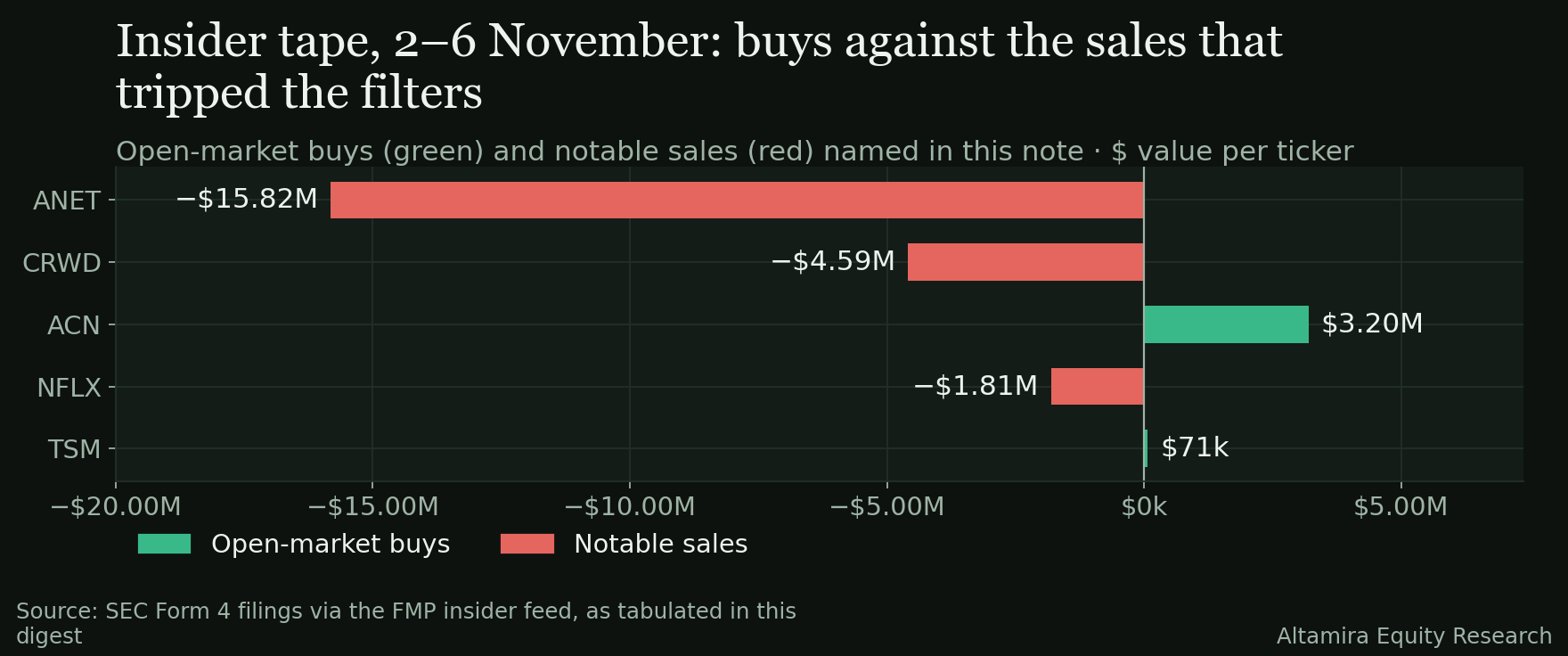
Altamira Equity Research — Money Flows. Sources: Altamira Insider Digest editions of 2–6 November 2026, built from SEC Form 4 filings (via FMP) for the names the digest covers. Method in brief: only open-market purchases (Form 4 code P) count as buy signals, because purchases are the one insider transaction that costs new money; a cluster is three or more distinct insiders buying within 14 days; sales are surfaced only when a notable-sale filter trips (a C-suite sale of $1M or more, any sale of $10M or more, a sale of 25% or more of the seller's stake, or three or more sellers in 14 days).
The headline
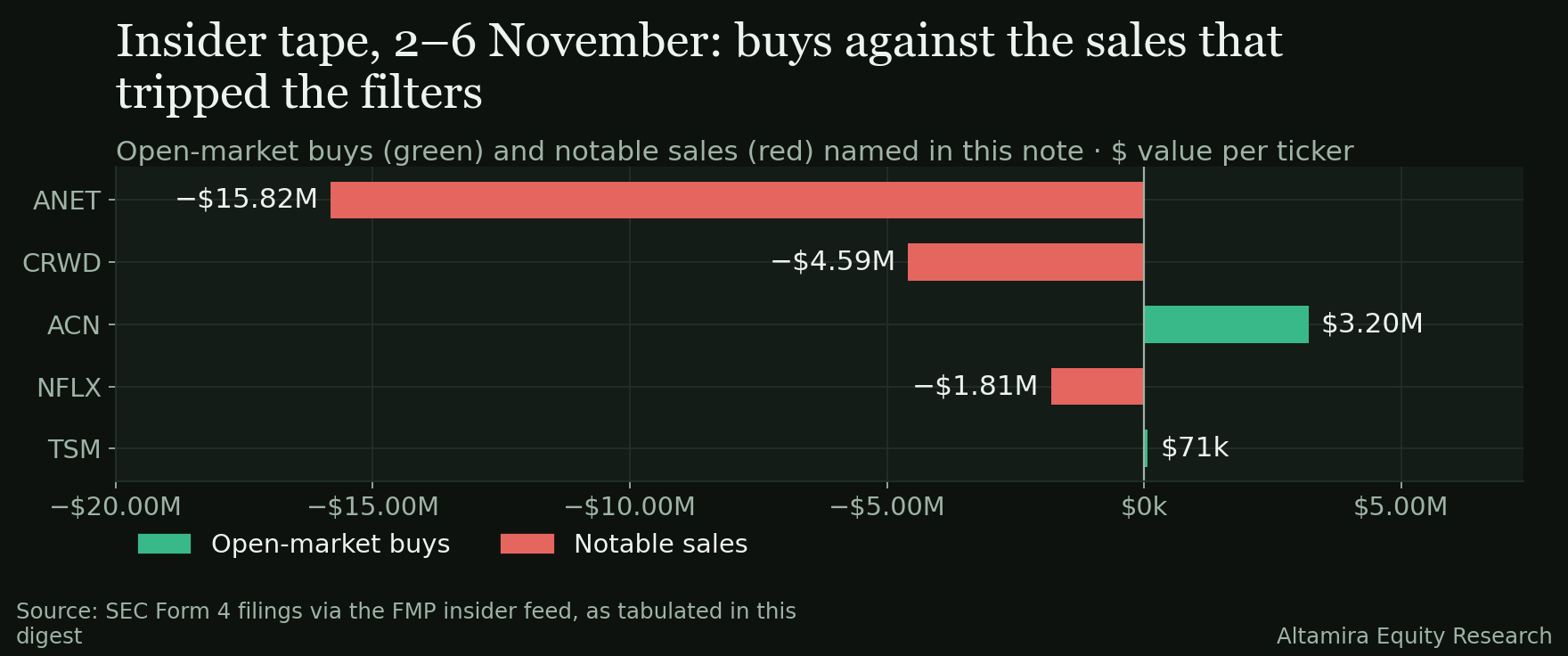
Across five trading days, the buy side of the insider tape was essentially empty. There was no active cluster on any day of the week, no high-conviction single buy on any day, and exactly one new open-market purchase filed all week: a single Taiwan Semiconductor (TSM) vice president buying 1,000 shares for about $71k (transaction date 1 November, filed into the 3 November edition). Monday was a formally quiet day; Wednesday, Thursday and Friday each recorded zero new open-market buys.
That emptiness is itself the signal to read carefully. Insider buying is the highest-conviction tell in this dataset precisely because it is voluntary and costly. A week in which almost nobody steps up — in a tape where the scorecard shows plenty of names below fair value — says insiders, as a group, were content to wait. It does not say they were heading for the exit: the week's sales, examined below, are mostly small fractions of very large stakes.
The one live thread: Accenture, still forming
The week's only continuing buy-side story never completed. Accenture (ACN) sat on the "clusters forming" board all five days with two buyers and $3.20M bought — one buyer short of a cluster. Both purchases happened on a single day, 26 October:
- Julie Spellman Sweet, Chair and CEO — 12,200 shares in two tranches at $245.11 and $246.17, about $3.00M combined.
- Paula A. Price, director — 800 shares at $249.81, about $0.20M.
A CEO-led pair buying $3.20M on one day is a genuine tell; it is also a perishable one. The cluster window is 14 days from the purchase dates, so the forming signal ages out on or about 9 November unless a third distinct insider buys. Watch for exactly that this week: a third ACN buyer converts a stale forming signal into the week's first real cluster; silence retires it.
The scorecard adds an honest tension. In the External 516 KPI Scorecard edition of 7 November 2026, Accenture scores 68.2 (Tier 3) with a growth pillar of 26.1 — the dataset's named weakness for the name — against a shareholder pillar of 88.2 and a health pillar of 91.2. The insiders bought at $245–$250; the stock closed the week at $260.50, which is above the fair value of $223.00 published in the same edition (margin of safety −16.8%). So this was not dip-buying into statistical cheapness. It reads as management buying operating confidence — a strong balance sheet and capital return (shareholder 88.2) — while the dataset's growth cells remain the weak leg.
The sales that tripped the filters — and their true scale
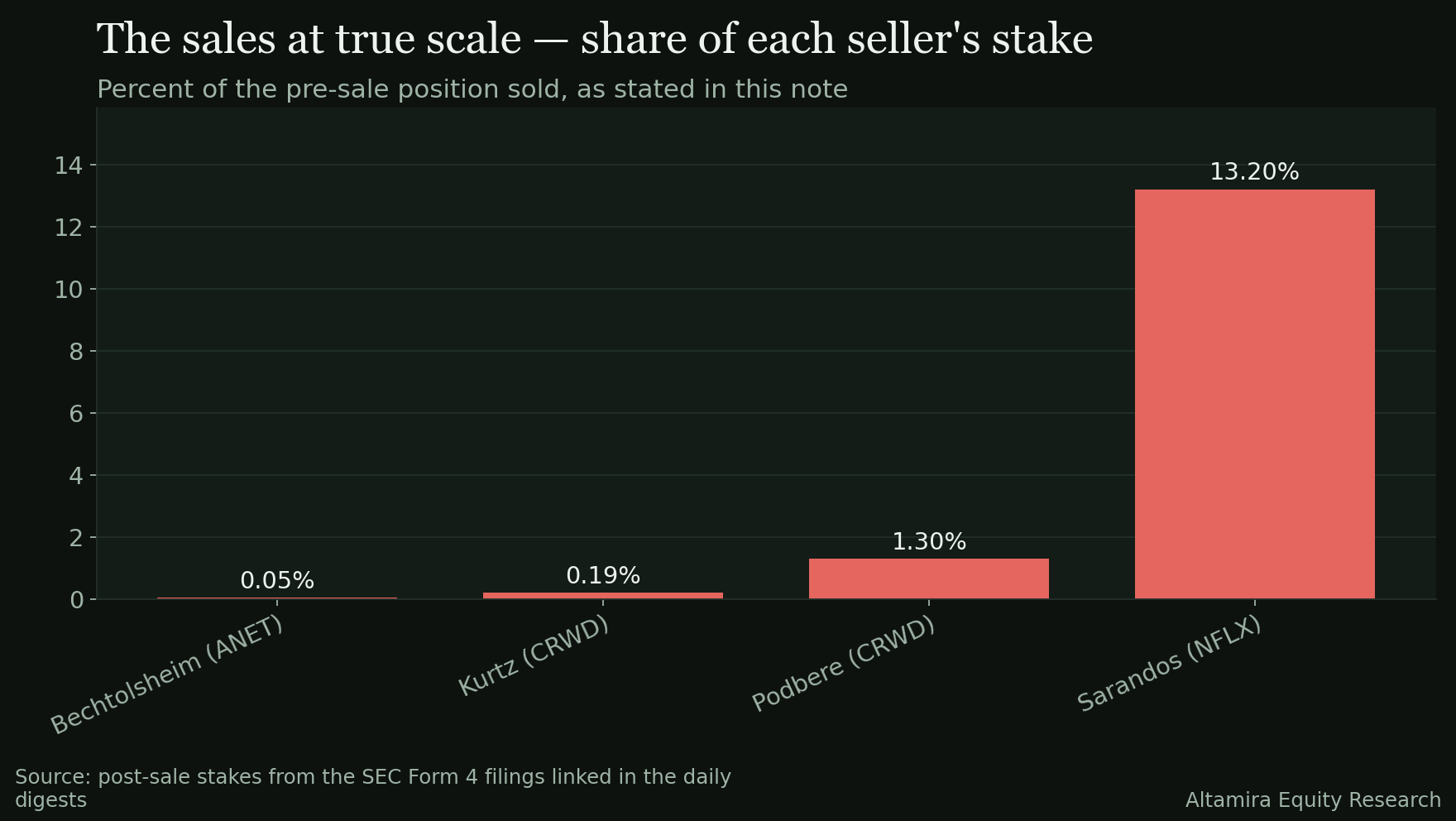
Three names produced notable sales. In each case the post-sale stake, which the digest publishes alongside every flagged sale, changes the reading:
- Arista Networks (ANET) — $15.82M, the week's largest. Andreas Bechtolsheim, a 10% owner, sold 91,746 shares on 30 October. The size trips the $10M mega-sale filter on its own. His stake after the sale: 180,306,720 shares. The sale is roughly 0.05% of his pre-sale position — a trim at the third decimal place, not an exit signal.
- CrowdStrike (CRWD) — $4.59M across the top two officers. On 2 November, CEO George Kurtz sold 13,763 shares for $3.48M (stake after: 7,313,109 shares — about 0.19% sold) and CFO Burt W. Podbere sold 4,410 shares for $1.11M (stake after: 337,816 shares — about 1.3% sold). The digest also flags cluster selling in the name — three distinct sellers over 14 days totalling $32.93M — with its standing caveat that broad officer selling in vest season is usually plan flow, not coordination. The scorecard context is consistent with routine selling rather than information: CrowdStrike scores 49.6 (Tier 4) with a value pillar of 4.1 and a margin of safety of −42.7% (price $216.90 against fair value of $152.00) alongside a growth pillar of 94.9 — an expensive, fast-growing name whose officers sell into vesting as a matter of rhythm. FMP statistics quoted in the 6 November edition put the quarter at 0 open-market purchases against 305 sales for the name: all rhythm, no buying.
- Netflix (NFLX) — $1.81M, the week's largest proportional sale. Co-CEO Theodore A. Sarandos sold 27,312 shares on 4 November, leaving 178,954 shares — about 13.2% of his pre-sale stake, the biggest fraction any C-suite seller parted with this week, though still well under the 25% filter (it was flagged on the $1M C-suite rule). CFO Spencer Adam Neumann sold a further $0.61M the same day, below the notable filter on its own. Four distinct Netflix insiders sold over the 14-day window ($3.94M in total). Against that, the scorecard reads Netflix at 57.5 (Tier 4) with a shareholder pillar of 100.0 and a margin of safety of +20.7% (price $63.41 against fair value of $80.00) — the dataset's fundamentals do not corroborate alarm about the selling.
Congress: small, late, and mostly selling
Newly disclosed congressional trades in the covered names leaned to sales through the week, predominantly in the smallest disclosure band ($1,001–$15,000). These disclosures lag the actual trades by up to roughly 45 days and report ranges rather than amounts, so they are context, not a timing signal — and this week's context is unremarkable.
What to watch next
- ACN before ~9 November: a third distinct buyer makes a cluster; none retires the forming signal.
- Whether the buy drought breaks: one $71k purchase was the entire week's new buying in the 14-day leaderboard, only ACN ($3.20M) and TSM ($71k) show any open-market buying at all. The first cluster of the month, when it comes, will stand out against this baseline.
- CRWD into its 1 December earnings: whether officer selling stays at vest-season rhythm or a purchase finally appears in a name with zero Q4 buying so far.
Sources: Altamira Insider Digest editions 2026-11-02, 2026-11-03, 2026-11-04, 2026-11-05 and 2026-11-06 (insider.txt / insider.html and run logs in the project archive) and the digest's Form 4 store for the Accenture purchase tranches and the Netflix CFO sale — buyer/seller names, roles, transaction dates, shares, prices, values and post-sale stakes as published in those editions; External 516 KPI Scorecard dataset, edition 2026-11-07, for the scorecard scores, pillars, prices and fair values quoted. Every flagged Form 4 row in the digest links to its SEC EDGAR filing, which is the ground truth for each transaction. This note is research commentary on published filings and scorecard data, not investment advice.