Merck: The Beat Is Real — the Bridge Is the Argument

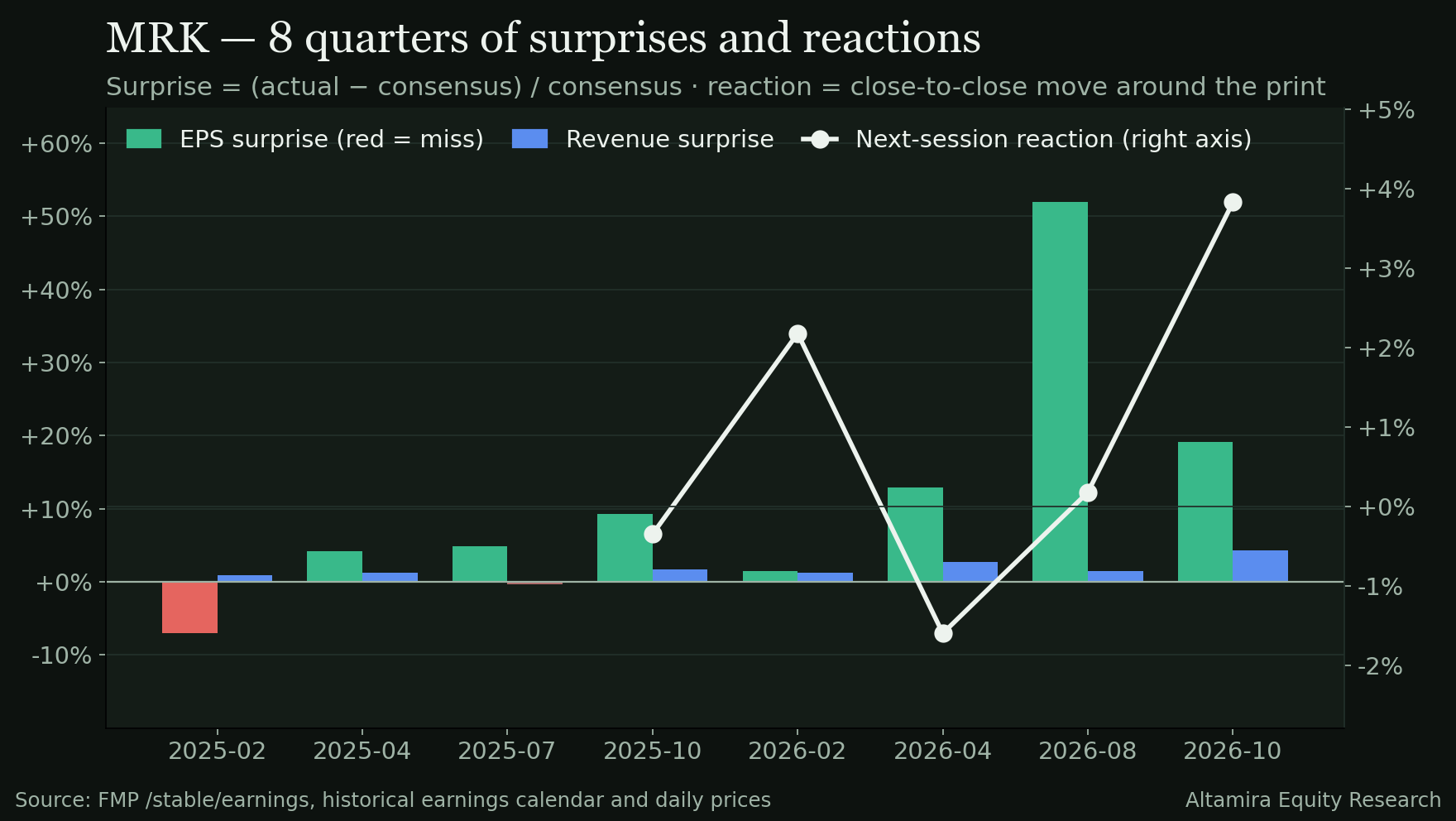
Revenue $18,085M, +4.35% vs estimate and +5.25% YoY on the filed September quarter · non-GAAP EPS $2.49 vs $2.09 (+19.14%) · Keytruda family $8.6B (+6%) with QLEX at $830M — and the close was +3.83% to $146.33
Merck & Co., Inc. (MRK, NYSE) · Q3 2026 (quarter ended Sep 30, 2026), reported Thu Oct 29, 2026 before the open. All figures are filed figures or earnings-call figures, traced to the sources at the end of this post.
The story in 30 seconds
- The headline beat is the cohort's largest — +19.14% on non-GAAP EPS, +4.35% on revenue — and the bridge evidence underneath it is the real story: QLEX at $830M, Winrevair +94%, Welireg +58%.
- Cash quality is clean on the filed September quarter: free cash flow of $5,518M at 108.94% conversion, with $2,099M of dividends paid in the quarter.
- The open question is succession: Keytruda is 47.55% of revenue into a 2028 loss of exclusivity, about $550M of this quarter's sales unwinds in Q4, and 2027 has already been framed as an investment year against more than $2B of headwinds.
Merck's third quarter was the strongest headline beat in its earnings cohort — non-GAAP earnings per share of $2.49 against $2.09 expected is a 19.14% surprise, and revenue of $18,085M against $17,331M expected is 4.35% — and the stock still only rose 3.83%, albeit to $146.33, comfortably more than its own ±2.37% eight-quarter average move. The market was not doubting the quarter. It was pricing the question the quarter cannot answer: what Merck is worth when its largest product, at $8.6B a quarter and 47.55% of revenue, loses exclusivity in 2028.
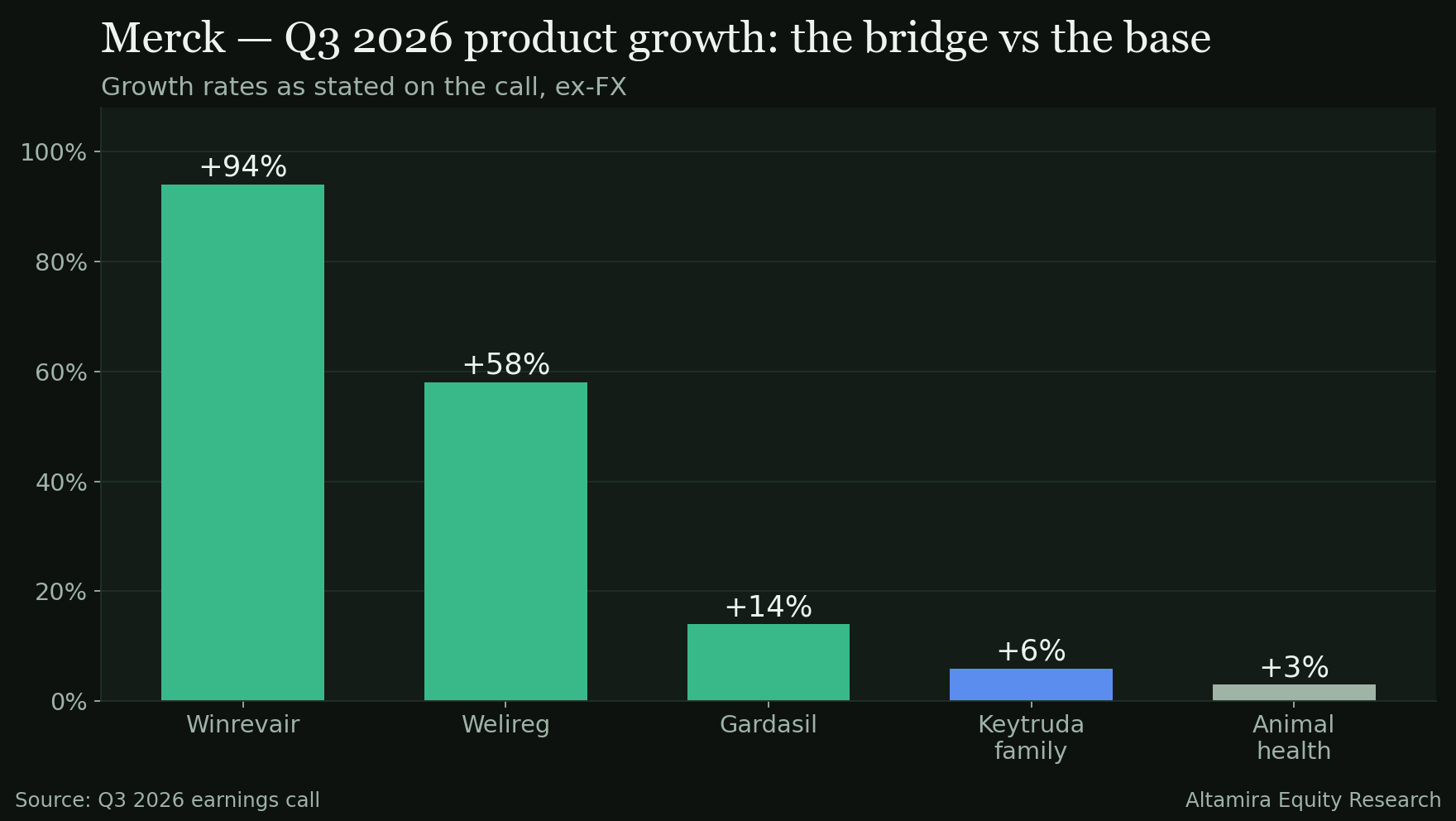
That is why this print matters less for its surprise than for its bridge evidence. The subcutaneous form of Keytruda, QLEX, sold $830M in the quarter — a launch trajectory management says is on track for 30–40% of US Keytruda volume by the end of 2027, which matters because a subcutaneous formulation is harder for biosimilars to displace than the intravenous original. Winrevair, the pulmonary arterial hypertension therapy, grew 94% to $694M. Welireg grew 58% to $370M. Gardasil recovered, up 14% to $2B. Each of those lines is small next to Keytruda; together they are the first draft of the post-2028 company, and this quarter they all pointed the same way.
Management, to its credit, supplied the cautions itself. About $550M of third-quarter sales was purchase timing — $200M of Keytruda and $50M of Winrevair named, the balance across the portfolio — that is expected to unwind in the fourth quarter. And 2027 was framed explicitly as an investment year: moderate top-line growth against more than $2B of generic and loss-of-exclusivity headwinds, with spending rising behind launches and the pipeline. Chief Financial Officer Caroline Litchfield's word for the loss of exclusivity was not "cliff" but "hill" — a shallow revenue dip, then a return to growth. This post tests that word against the numbers.
Why it matters beyond one stock: Merck is the cleanest live case of the defining large-pharma problem of this decade — a single-product concentration so large that the story is a race between pipeline conversion and a dated patent expiry.
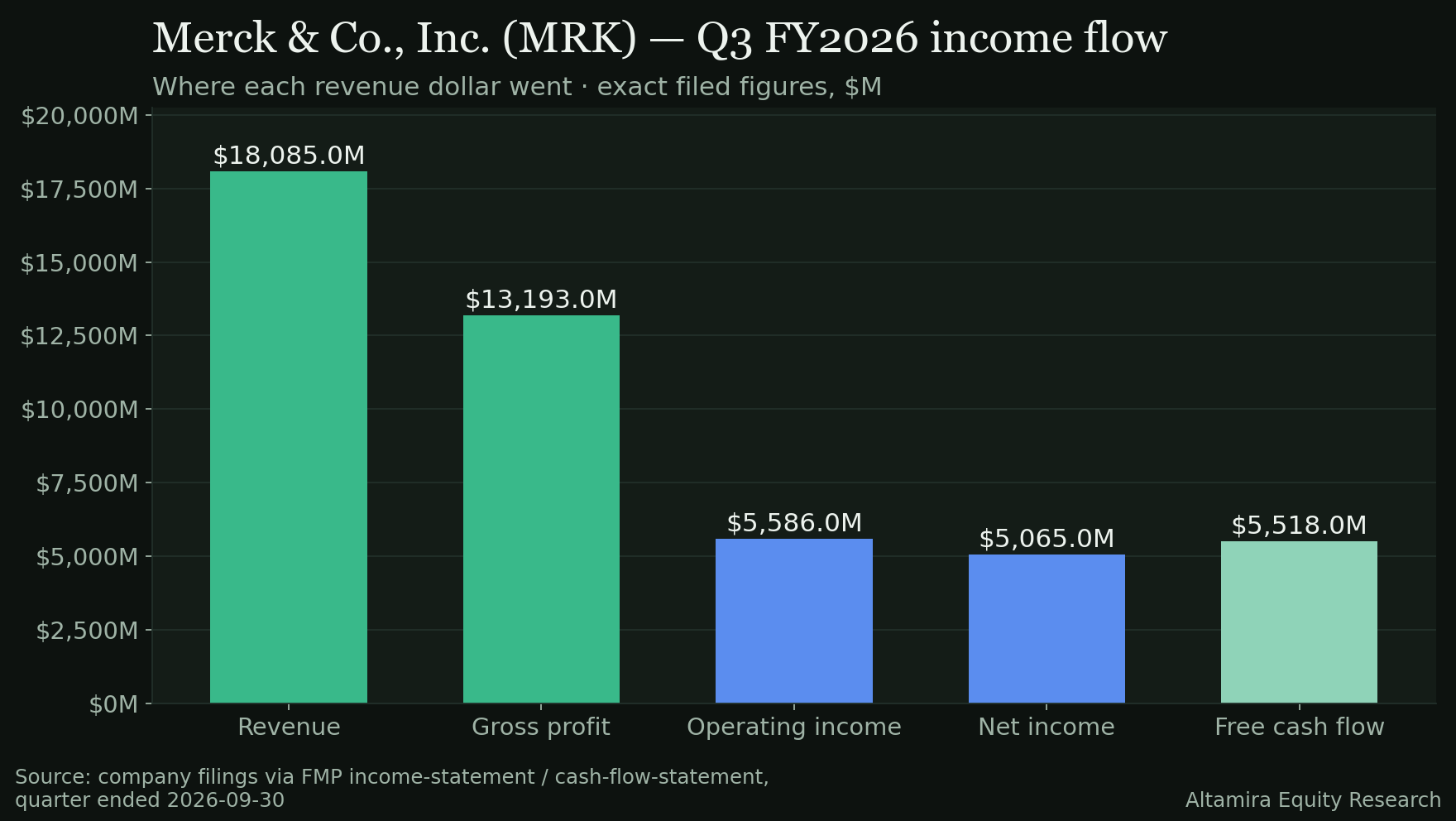
In this edition: (1) the print in one picture — how $18.1 billion of revenue becomes $5.1 billion of net income on the filed September quarter, and why the GAAP and non-GAAP versions of this quarter differ by $0.45 a share; (2) what to make of it — including the quality-of-earnings line; (3) the long view — five filed years in which the margin history carries a charge-distorted 2023 that must be read, not averaged away; (4) the Key Issue — whether the bridge outgrows the hill.
At a glance — Q3 2026 scoreboard
This scoreboard is the quarter on one screen: what was filed, what consensus expected, and how the market reacted.
- Revenue: $18,085M — vs $17,331M est · +4.35% surprise · +5.25% YoY (filed)
- EPS (non-GAAP): $2.49 — vs $2.09 est · +19.14% surprise (GAAP diluted EPS $2.04)
- Guidance: maintained in class, range narrowed with the midpoint raised — FY2026 revenue $66.8–67.3B
- Reaction: +3.83% close, to $146.33 from a $140.93 previous close · eight-quarter average absolute move ±2.37%
- Gross profit: $13,193M · 72.95% of revenue on the filed GAAP basis (−264 bp YoY) · non-GAAP gross margin 81.4% (call)
- Operating income: $5,586M · 30.89% of revenue · research and development $4,537M
- Net income: $5,065M · 28.01% of revenue
- Free cash flow: $5,518M · 108.94% of net income · operating cash flow $6,558M
- Capital return (filed): buybacks $653M · dividends paid $2,099M · roughly $3B of buybacks guided for the year
- Products (call, ex-FX basis): Keytruda family $8.6B (+6%) · QLEX $830M · Winrevair $694M (+94%) · Welireg $370M (+58%) · Gardasil $2B (+14%)
- Balance sheet: cash and short-term investments $9,650M · total debt $53,777M
The quarter in one line: Merck grew the product that must be replaced by 6%, grew its replacements by 14–94%, turned $18,085M of filed revenue into $5,065M of net income and $5,518M of free cash flow — and disclosed that roughly $550M of the sales will give back next quarter.
Data note, stated plainly: the earnings data set this publication first received for Merck carried a June-quarter income statement in place of the September quarter's, so the filed figures in this post come from a direct pull of the September-quarter filing (filed November 4, 2026). The scoreboard surprises, call colour and product figures are unchanged.
What to make of this print
Six readings of the quarter — each is a finding plus what it implies.
- The beat is broad, not single-line. Revenue beat by 4.35% with every named product line growing: Keytruda family +6% to $8.6B on earlier-stage and metastatic demand, Gardasil +14% to $2B (US +18% on a CDC purchase and price, international +6%), Winrevair +94%, Welireg +58%, animal health +3%. Implication: this was not a one-product timing fluke at the revenue line — although timing helped, quantified next.
- Quality of earnings: operational — with the GAAP/non-GAAP gap named. Non-GAAP EPS of $2.49 beat by 19.14% while the diluted share count fell 0.60% year over year to 2,483M (and rose 0.44% sequentially, as filed buybacks of $653M only partly offset issuance) — buybacks did not manufacture this beat, so it is labelled operational. The honest complication sits one line down: GAAP diluted EPS was $2.04, down 12.07% year over year, because GAAP carries the acquisition, restructuring and other items Merck excludes from its non-GAAP results (the $400M Ceybrion licence charge, $0.12 a share, sits inside the non-GAAP figure — management did not exclude it). Stock compensation was $369M, 2.04% of revenue. Read the quarter on the non-GAAP basis management guides to, and keep the $0.45 gap in view.
- Timing borrowed from Q4 — management said so. About $550M of Q3 sales was purchase timing expected to unwind in Q4, including $200M of Keytruda and $50M of Winrevair, and channel inventory built in the quarter. Implication: the Q4 print has a pre-announced headwind of roughly 3% of a quarter's revenue; a soft Q4 revenue line, by itself, will not be new information.
- QLEX is the bridge's load-bearing asset, and it is tracking. $830M in the quarter, mostly US, with adoption rising since the permanent J-code in April and management reaffirming the 30–40% of US Keytruda objective by end-2027. Implication: every point of intravenous volume converted to subcutaneous before 2028 is volume a biosimilar cannot simply take at the cliff — this single number does more de-risking work than any pipeline headline.
- The margin story is investment, on both bases. Non-GAAP gross margin eased slightly to 81.4%; non-GAAP operating expenses rose 12% to $7.4B behind launches and the pipeline, including the Ceybrion charge, partly offset by the multi-year optimisation programme. On the filed GAAP basis, gross margin was 72.95% (−264 bp YoY) and operating margin 30.89%, with R&D of $4,537M the swing line. Management also guided that 2027 gross margin increases as a Keytruda royalty rolls off. Implication: margins are being spent, deliberately, on the bridge — the test is whether 2027's promised royalty relief and launch leverage show up as promised.
- Cash quality is clean on the filed quarter. Free cash flow of $5,518M at 108.94% conversion on operating cash flow of $6,558M. Dividends paid were $2,099M against buybacks of $653M in the quarter, with the roughly $3B full-year repurchase track reaffirmed. Implication: unlike the GAAP earnings line, the cash line needs no adjustments to believe.
Takeaway: a real beat with a disclosed borrow from next quarter, a bridge whose lead asset is tracking to plan, and a 2027 that management has already told you will look worse before the story gets better.
How Merck makes money
This section shows where revenue actually comes from — the mix decides which growth rates matter.
Sector primer — diversified large pharma. Diversified large pharma sells patented medicines, vaccines and animal-health products into markets where a single product can carry a company — and then expire. Economics turn on three things: concentration (how much revenue the largest product carries, and when its exclusivity ends), pipeline conversion (whether late-stage assets, new indications and harder-to-copy formulations replace expiring revenue before the loss-of-exclusivity date, not after it), and cash discipline (patent-protected margins throw off cash that must fund research, dividends, buybacks and business development in that order of strategic necessity). GAAP earnings in this sector swing violently on acquired in-process research charges, licence upfronts and restructuring, so the sector is judged on non-GAAP margins, free-cash-flow conversion, and the dated bridge math around each loss of exclusivity — the worked precedent being AbbVie's Humira succession by Skyrizi and Rinvoq.
Merck & Co. is a global healthcare company working through two segments — Pharmaceuticals (oncology, hospital acute care, immunology, neuroscience, virology, cardiovascular and diabetes medicines, plus preventive vaccines) and Animal Health (veterinary medicines, vaccines and digital identification and monitoring) — headquartered in Rahway, New Jersey, with about 74,000 employees. The revenue structure is the story: the Keytruda family (intravenous Keytruda plus subcutaneous QLEX) was $8.6B of the quarter's $18,085M — 47.55% of the company in one franchise. Behind it: Gardasil $2B, Winrevair $694M, Welireg $370M, Capvaxive $263M, Ohtuvayre $184M, and animal health growing 3% (companion animal +6%, livestock +2%). No fuller segment dollar split is in the traced set, so this section is built from the company's profile description and the call's disclosed figures, labelled as such.
The long view
One quarter is weather; five years are climate. These four lenses judge Merck on its filed history, with the quarter as the latest data point rather than the story. The charts in this section are rendered from verified filed values.
Revenue growth
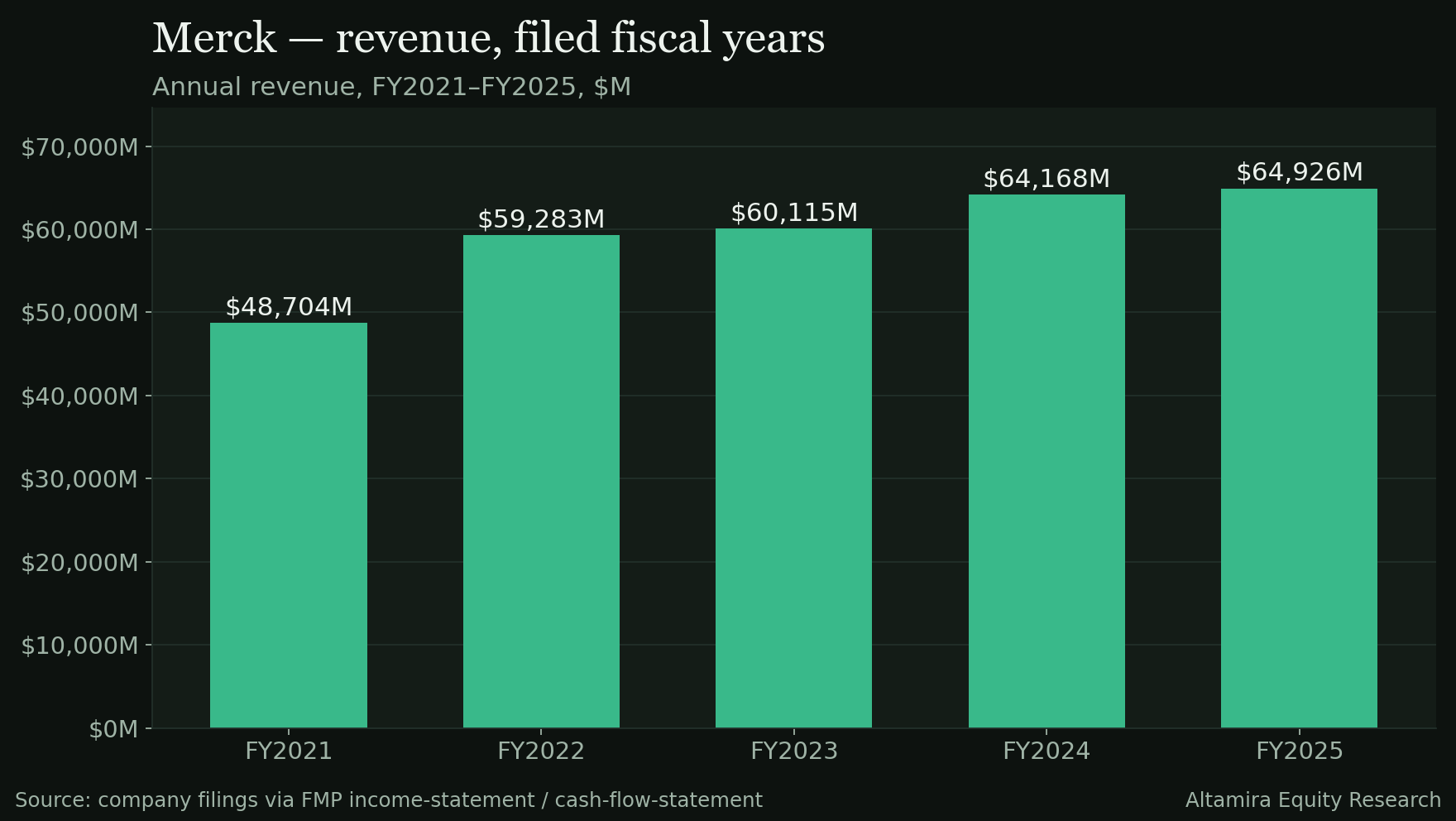
Growth is the first lens because Merck's case is a succession claim, and succession is a growth-rate question. Filed revenue rose from $48,704M (FY2021) to $59,283M (FY2022), $60,115M (FY2023), $64,168M (FY2024) and $64,926M (FY2025) — a five-year compound rate of 9.35%, easing to 3.08% over the most recent three years. The deceleration is the lens's whole message: the compounding has slowed to low single digits as Keytruda matures toward its 2028 exclusivity loss. This quarter's +5.25% year over year (filed basis; +4% ex-FX on the call) sits above the three-year rate, with roughly $550M of timing inside it. Judgment: growth on watch — the five-year record is real, the three-year rate is the honest run-rate, and the bridge has to lift it from here, not merely defend it.
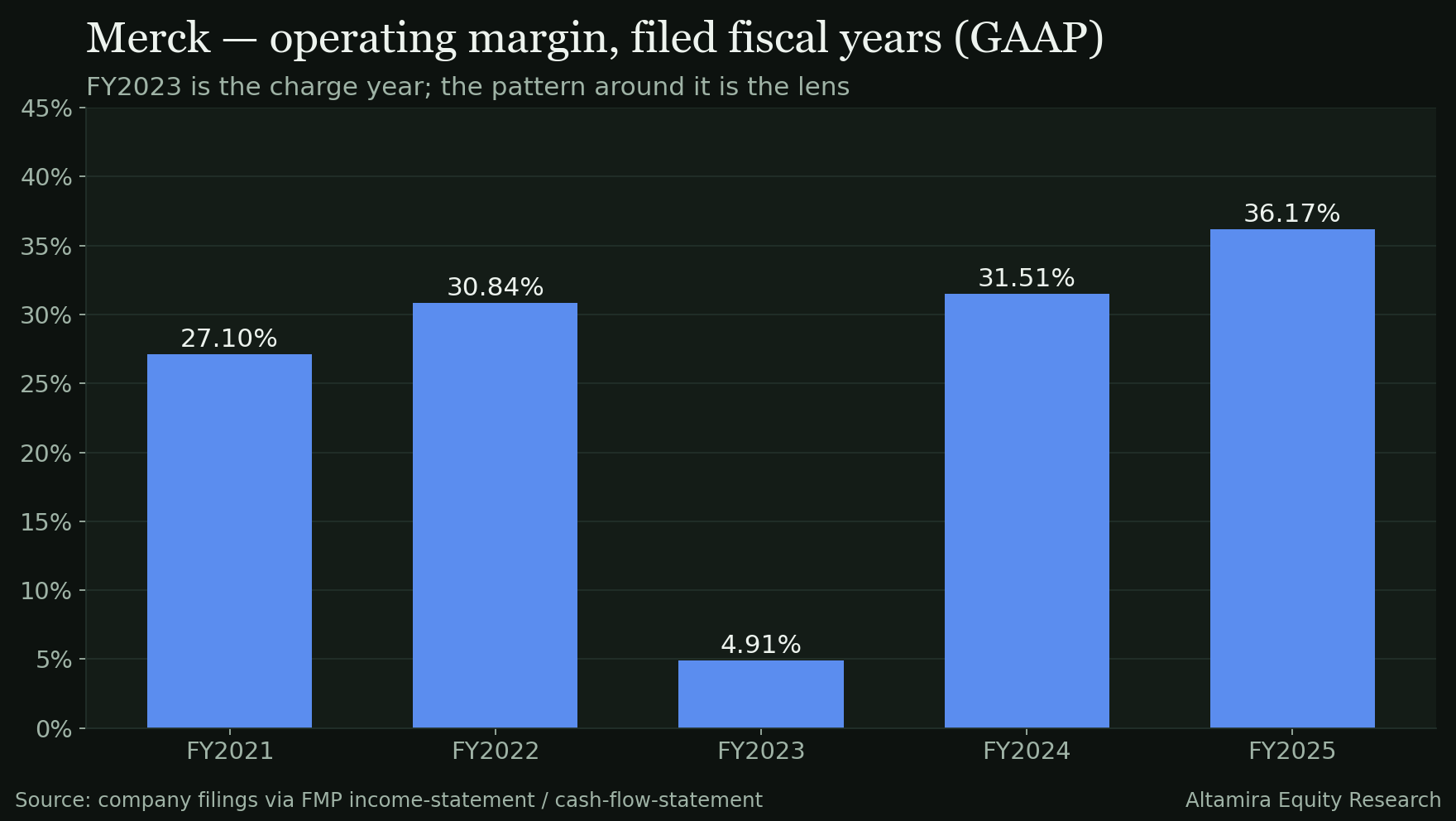
Operating margin
Margin is the second lens because, in pharma, the GAAP margin line is where charges go to distort the story — and this lens must be read, not averaged. Filed GAAP operating margin across FY2021–FY2025 was 27.10%, 30.84%, 4.91%, 31.51% and 36.17% (five-year average 26.11%): the FY2023 collapse to 4.91% is a charge year (filed research and development of $30,531M, including acquired in-process research), not an operating collapse, and FY2025's 36.17% is the cleanest recent read. This quarter printed a GAAP operating margin of 30.89% on research and development of $4,537M, against a non-GAAP gross margin of 81.4% that eased only slightly — the underlying product economics remain patent-grade; the spend rate is the choice. Judgment: margin on watch — the franchise margin is intact on the non-GAAP basis management guides to; the GAAP line will stay noisy for as long as Merck is buying and building the bridge, which is to say, for years.
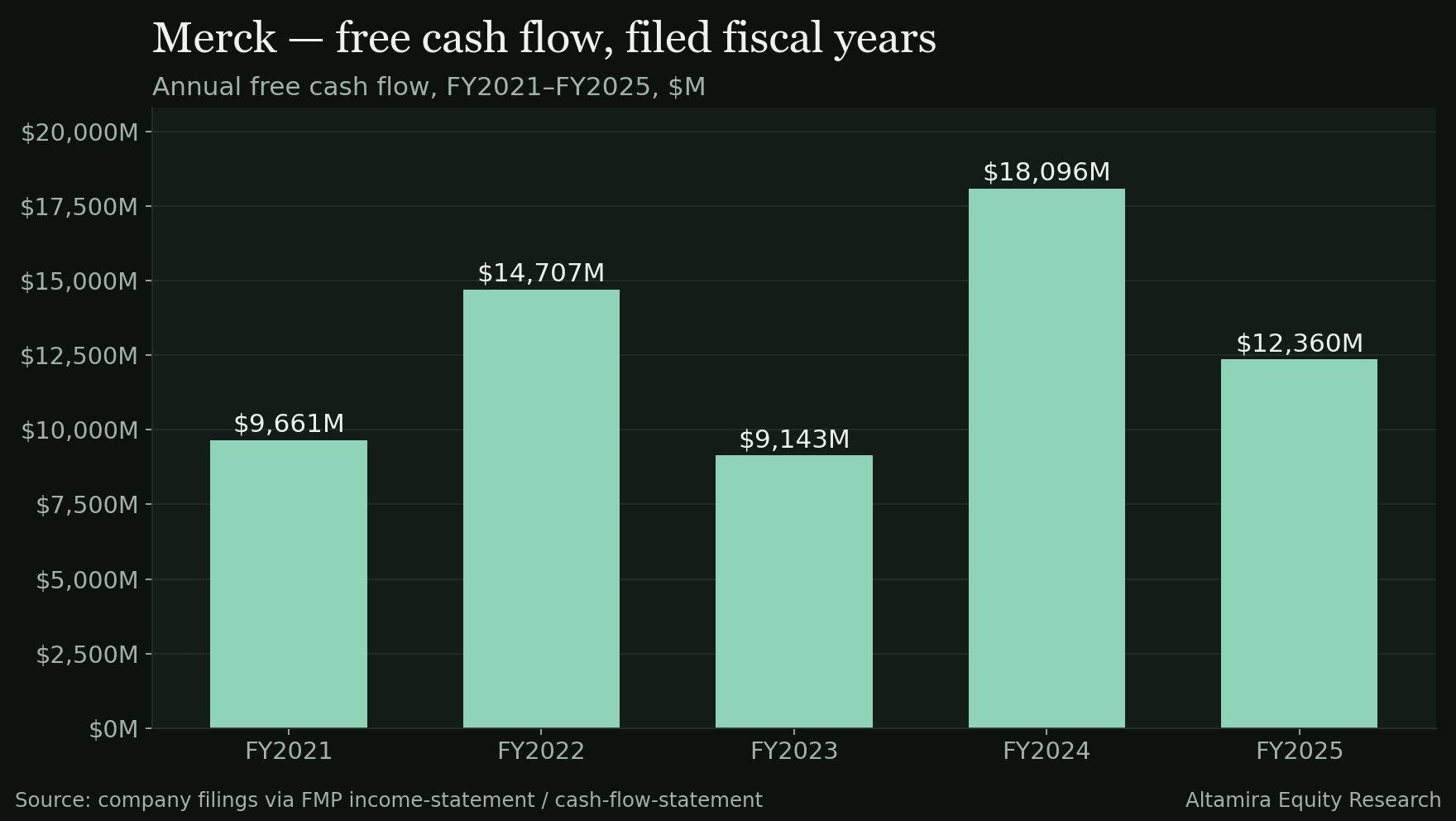
Cash
Cash is the third lens because it is the one line in this sector that charges cannot flatter. Across five years, operating cash flow has run at 132.93% of reported net income, and free cash flow compounded at 16.24% over five years — but fell from $18,096M in FY2024 to $12,360M in FY2025 (19.04% of revenue), a three-year compound rate of −5.63%. This quarter's note is the strongest in the lens: free cash flow of $5,518M at 108.94% conversion. Judgment: cash passes on conversion — cash backing is structural, five years above 100% — with the FY2025 step-down noted as the trend to reverse.
Returns on capital
Returns on capital are the fourth lens because they separate a genuinely advantaged franchise from a merely large one. Five-year return on invested capital is 14.08% and return on capital employed is 17.15% — solidly positive, mid-pack among large companies rather than elite: a patented-medicine return profile diluted by a large acquired-intangible base (goodwill and intangibles of $46,427M on the filed September balance sheet). This quarter, net margin held at 28.01% on the GAAP basis despite the investment spend. Judgment: returns pass on level, honestly graded — adequate returns on a heavy asset base, which is precisely why the bridge must be built from pipeline conversion rather than acquisition at any price.
Beyond the print — the business this quarter
Earnings describe the last thirteen weeks; these developments — each traced like a figure — describe the next several years.
- The pipeline had its strongest quarter of the year at ESMO. Management led the call with the first positive Phase III results from the TROFuse programme for sac-TMT in advanced or recurrent endometrial cancer, partner data supporting sac-TMT in lung and other tumours, and positive Phase 3 data for the therapeutic cancer vaccine as adjuvant treatment in certain melanoma patients — described by the chief executive as landmark validation of the approach. These are the assets the "hill, not cliff" claim ultimately rests on.
- The bridge widened beyond oncology. Results from the Brunello study in diabetic macular edema marked a milestone for the retinal-disease portfolio; Phase 2b results in hidradenitis suppurativa support advancing the TL1A immunology programme; and Winrevair received a label update in the period — breadth across ophthalmology, immunology and cardiometabolic, not a single-therapy bet.
- Business development was bought, not just built. The $400M upfront Ceybrion licence charge ($0.12 a share, inside the non-GAAP result) is the quarter's clearest statement of strategy: Merck is paying for pipeline breadth now, in the profit-and-loss account, ahead of 2028 — and guided that business development remains a priority within an investment-grade balance sheet.
- QLEX's US mechanics are in place; Europe has a seam. The permanent J-code (April 1) underpins the US adoption trajectory; in Europe, a Dutch injunction pending a hearing affects smaller markets, with high-adoption markets (UK, Canada, Austria) described as unaffected on supply. Management's freedom-to-operate confidence was stated, unqualified, on the call — and is quoted verbatim in the next section.
- Gardasil's recovery has a policy engine. US Gardasil sales grew 18% on a significant CDC purchase and price — a reminder that vaccine revenue in this portfolio can be carried by public-health procurement as well as commercial demand.
What management said
These are the call's own words — named executives, short verbatim quotes — because guidance credibility is judged on what was actually said, not on summaries of it.
Caroline Litchfield, Chief Financial Officer (Q&A): “We see the KEYTRUDA LOE as really more of a hill on the overall revenues of our company.” Why it matters: this is the Key Issue in management's own framing, and Litchfield attached numbers to it in the same answer — a shallow revenue dip after IRA price-setting and the loss of exclusivity, a quick return to growth, and an earnings profile expected to mirror it. The claim is now on the record with a shape (shallow, brief) that future prints can be graded against.
Robert Davis, Chairman and Chief Executive Officer (Q&A): “We feel very strongly that we have IP that gives us freedom to operate as it relates to QLEX.” Why it matters: QLEX is the bridge's load-bearing asset, and its hyaluronidase component is under litigation challenge in Europe. Davis's answer — the Dutch injunction is procedural, pending a hearing, and speaks to nothing on the merits — either holds, in which case the 30–40% conversion path stands, or it does not, in which case the bridge loses its strongest plank. There is no middle version of this quote to hide in.
Caroline Litchfield, Chief Financial Officer (prepared remarks): “We remain on track for approximately $3 billion in share repurchases this year.” Why it matters: filed Q3 buybacks were only $653M against $2,099M of dividends — the capital-return mix this quarter was dividend-led, and the reaffirmed full-year track is a commitment the Q4 cash-flow statement will either confirm or quietly miss.
The rest of the call, compressed: guidance was maintained in class with the range narrowed and the midpoint raised (full-year revenue $66.8–67.3B, up 3–4% including about one point of FX; EPS $2.77–2.82 on the guided basis including about $0.15 of FX and the Ceybrion charge; gross margin assumed at about 81%; operating expenses $42.4–42.9B; tax rate 32–33%). The 2027 framing: an investment year — moderate top-line growth against more than $2B of generic and loss-of-exclusivity headwinds, expenses rising behind launches and pipeline, gross margin increasing as a Keytruda royalty rolls off. In Q&A, JPMorgan asked whether the 2027 commentary is in consensus and whether today's research spend pulls the trough forward — answered directly. Bernstein pressed the QLEX litigation — answered directly.
The Key Issue — can the bridge outgrow the hill?
Thesis. Merck's case is a race with a date on it. On one side: Keytruda at $8.6B a quarter, 47.55% of revenue, losing exclusivity in 2028, with IRA price-setting in the same window. On the other: a bridge of QLEX conversion (which defends Keytruda volume in a harder-to-copy form), Winrevair, Welireg, Gardasil, animal health, and a late-stage pipeline that just produced positive Phase III/3 readouts in oncology. Management's claim is precise — the loss of exclusivity is a hill, with a shallow revenue dip and a quick return to growth. The counter-case is not that the bridge assets fail; it is that they are too small for too long: Winrevair at $694M growing 94% still needs years to matter against an $8.6B quarterly base, 2027 is guided as an investment year against $2B-plus of headwinds, and this quarter's growth already includes $550M that unwinds.
Evidence for the bridge. QLEX at $830M in the quarter, mostly US, adoption rising since the April J-code, tracking to the stated 30–40% of US Keytruda by end-2027; Winrevair +94% to $694M with a label update; Welireg +58%; Gardasil +14% with US procurement demand; the ESMO package (first positive sac-TMT Phase III, cancer-vaccine Phase 3) de-risking the longer pipeline; guidance narrowed with the midpoint raised even while absorbing the Ceybrion charge; and filed free cash flow of $5,518M at 108.94% conversion funding all of it without balance-sheet strain (net debt $44,227M filed, against that cash generation).
Evidence against. Scale arithmetic: the entire named bridge is incremental revenue measured in hundreds of millions against a Keytruda base of $34B annualised; the conversion claim (30–40% of US Keytruda) still leaves the majority of the franchise exposed at the cliff; 2027's headwinds (more than $2B) arrive before the bridge's biggest years; Q3 included $550M of timing that unwinds; GAAP EPS fell 12.07% YoY as investment and charges compounded; and the QLEX litigation is a live, named risk to the bridge's strongest plank.
What to watch. (1) The next print: QLEX and Winrevair growth holding after the $550M timing benefit unwinds, and 2027 guidance that keeps the hill shallow when it is formally given. (2) The sector read-across: the growth pole of this industry currently compounds revenue at rates Merck's succession assets must approach even a fraction of, while AbbVie's post-Humira bridge — two immunology successors compounding above 20% — remains the worked example of an exclusivity loss survived by pipeline conversion. (3) QLEX conversion disclosures against the 30–40% path, and any merits ruling in the European hyaluronidase litigation. (4) The Q4 cash-flow statement against the roughly $3B buyback track. Historical analogy: AbbVie's Humira — the industry's largest-ever loss of exclusivity (2023) — is the genuine precedent: the cliff was real, and it was crossed because two successors were already compounding at scale before the date arrived. Merck's position rhymes but is younger: QLEX is its formulation defence, Winrevair and the oncology pipeline its successors, and both are earlier in their ramps than AbbVie's were at the equivalent distance from the cliff. The forward question: by the time 2027 guidance is formally given, will the bridge's combined run-rate be large enough that the "hill" is arithmetic — or will it still be a metaphor?
Sources: Merck Q3 2026 filed financial statements (September-quarter filing, filed November 4, 2026) and filed annual statements FY2021–FY2025, via FMP; consensus estimates via FMP; Q3 2026 earnings-call transcript (October 29, 2026) via FMP. Charts are rendered from the verified filed values cited above. This post is public information and analysis, not financial advice; the author may hold positions in companies discussed.