Quanta Services: A $64 Billion Backlog — and a Labour Force That Has to Build It

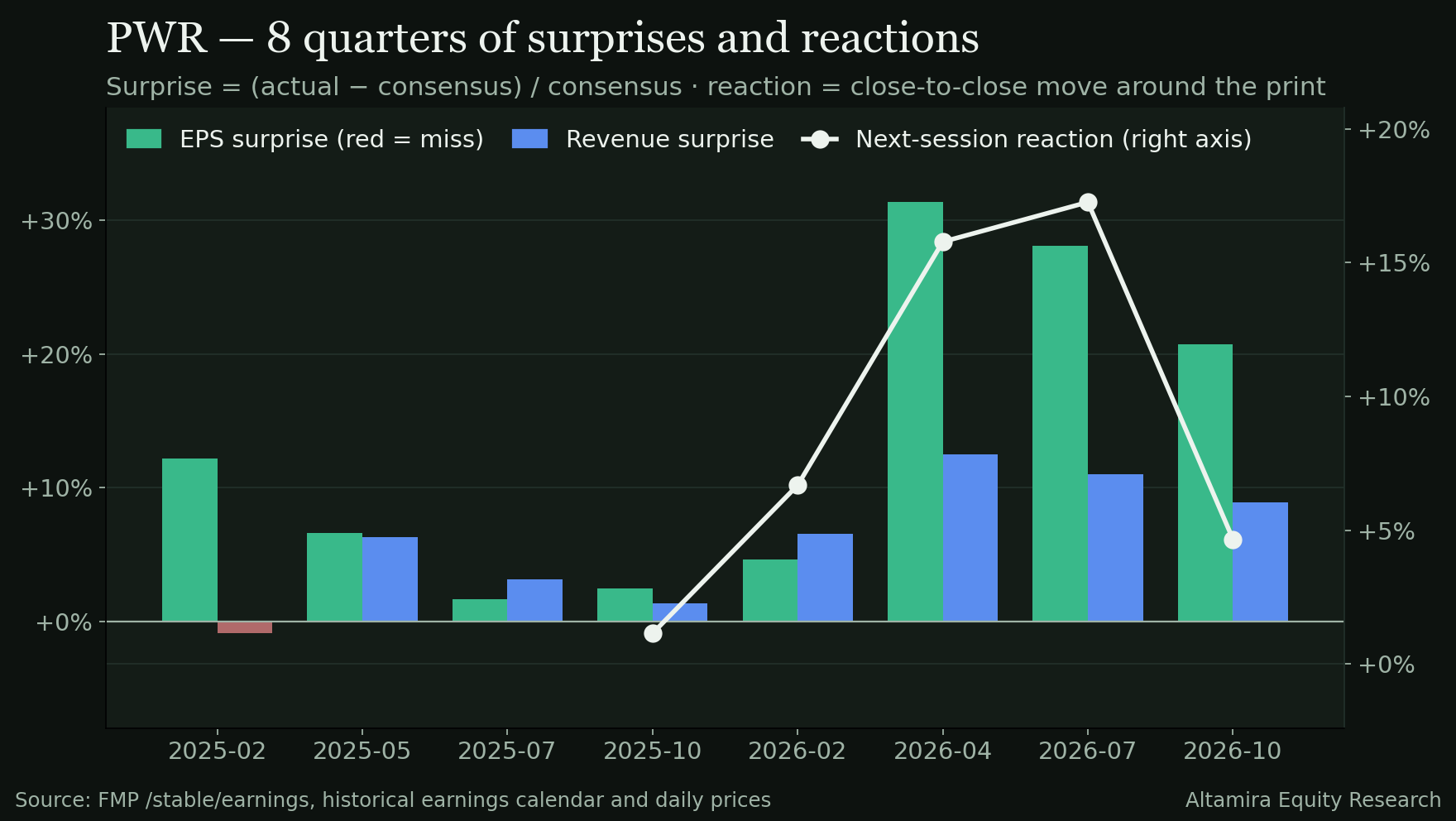
Revenue $12,015M, +8.89% vs estimate and +60.09% YoY · adjusted EPS $6.06 vs $5.02 (+20.72%) · backlog a record $64B, up $10B in one quarter, guidance raised — and the close was +4.66% to $635.18
Quanta Services, Inc. (PWR, NYSE) · Q3 2026 (quarter ended Sep 30, 2026), reported Thu Oct 29, 2026 before the open. All figures are filed figures or earnings-call figures, traced to the sources at the end of this post.
The story in 30 seconds
- The beat is operational, not financial: revenue beat by 8.89% and grew 60.09% year over year while the diluted share count rose just 0.22% — the growth is crews billing work.
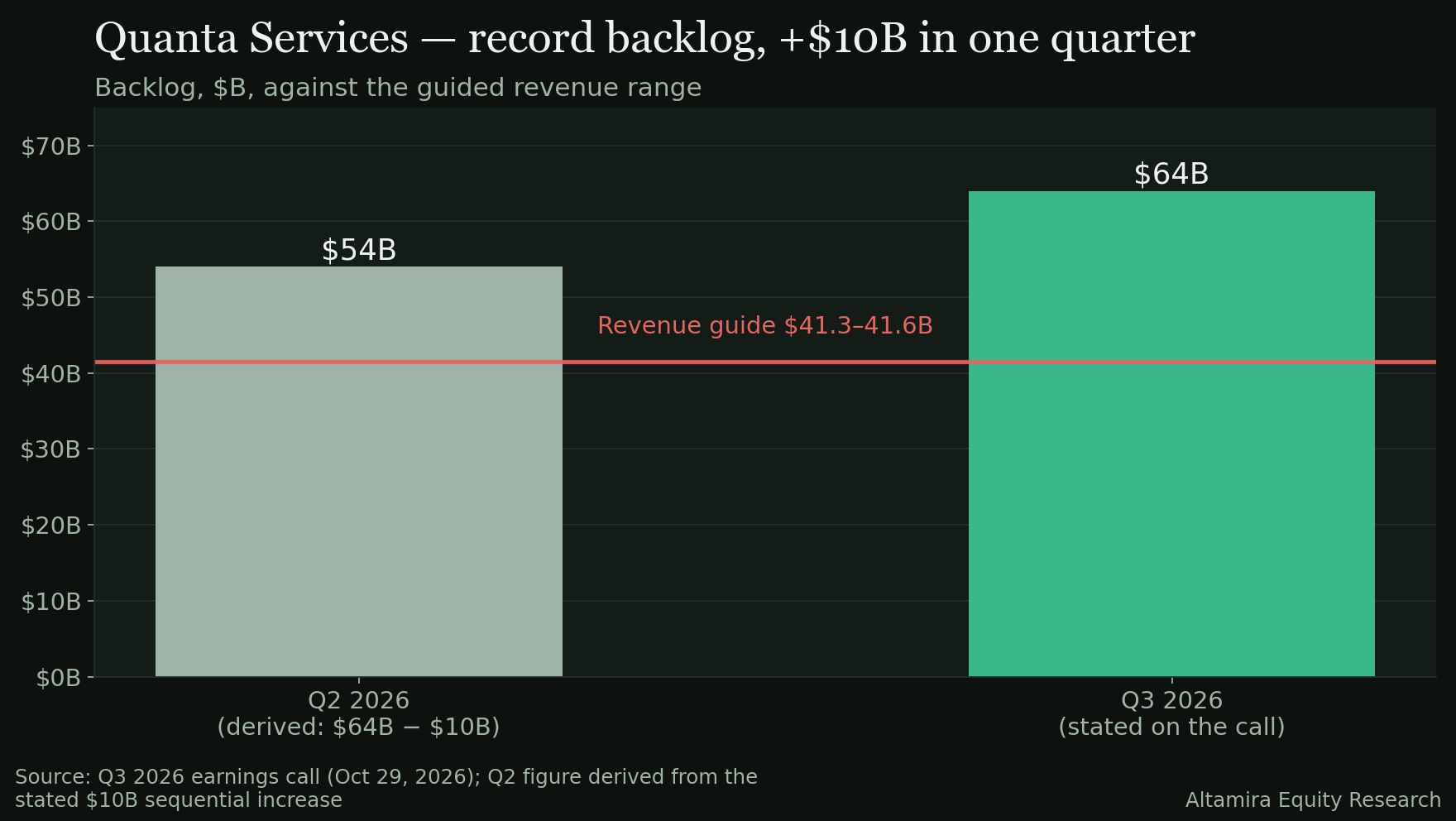
- The backlog is the headline: a record $64B, up $10B sequentially, growing across each key market, with the largest transmission and generation work not yet in the book.
- The open question is capacity, not demand: whether a trained craft workforce — the one input this company cannot buy — can scale as fast as the contracted work demands.
Most earnings beats answer a question about demand. Quanta's third quarter answered a different one. The demand was never really in doubt — utilities being asked to double in size, data-centre load stacking on top, a grid that needs rebuilding for reliability before it needs expanding for growth. The doubt was whether any contractor can actually staff growth of this speed: revenue up 60.09% year over year in a single quarter, backlog up $10 billion sequentially to a record $64 billion, and a workforce that has to be trained, not hired off a shelf.
The market's reaction was measured. The stock closed up 4.66% to $635.18 — a solid move, but well inside Quanta's own eight-quarter average absolute move of ±7.38%, and the shares remain well below their 52-week high. That combination — a record print, a contained reaction — tells the real story of this post: the fundamentals just got demonstrably stronger, and the expectations already embedded in the shares carry the argument.
Why it matters beyond one stock: Quanta is the purest listed expression of the physical side of electrification — the contractor between utility capital budgets, generation builders and the large-load customers racing to connect. When its backlog jumps $10 billion in a quarter with the biggest transmission programmes not yet counted, that is a datapoint about the whole build-out.
In this edition: (1) the print in one picture — where $12.0 billion of revenue actually went, and why structurally thin contracting margins still expanded; (2) what to make of it — including the quality-of-earnings line and the cash-flow correction this post makes to the first read of the print; (3) the long view — five years of compounding volume against structurally thin returns; (4) the Key Issue — whether craft labour can scale as fast as the $64 billion backlog demands.
At a glance — Q3 2026 scoreboard
This scoreboard is the quarter on one screen: what was filed, what consensus expected, and how the market reacted.
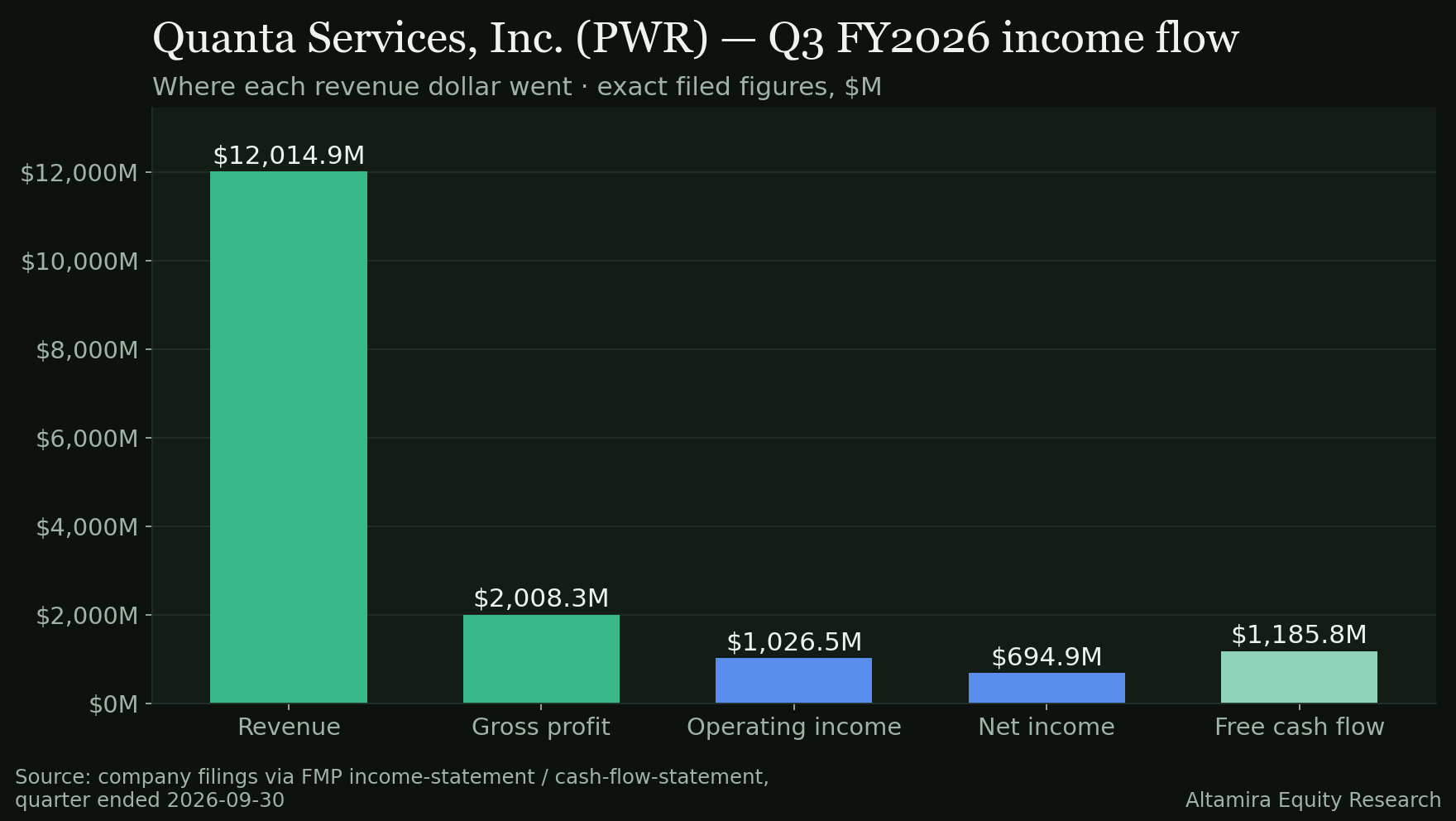
- Revenue: $12,015M — vs $11,034M est · +8.89% surprise · +60.09% YoY · +25.72% QoQ
- Adjusted EPS: $6.06 — vs $5.02 est · +20.72% surprise (GAAP diluted EPS $4.55)
- Guidance: raised — FY2026 revenue $41.3–41.6B · adjusted EBITDA $4.4–4.49B · adjusted EPS $17.90–18.30 · free cash flow $2.5–3.0B
- Reaction: +4.66% close, to $635.18 from a $606.89 previous close · eight-quarter average absolute move ±7.38%
- Gross margin: 16.71% (+219 bp YoY, +55 bp QoQ)
- Operating margin: 8.54% (+165 bp YoY) · adjusted EBITDA $1.4B at a 12.1% margin (call basis)
- Net income: $695M · 5.78% of revenue
- Cash generation (call): operating cash flow $1.5B · free cash flow $1.2B — both quarterly records
- Backlog (call): $64B, a record · +$10B sequentially · growth across each key market
- Balance sheet: cash $2,315M · total debt $7,512M · total liquidity $5.2B (call)
The quarter in one line: Quanta converted an accelerating order book into $12,015M of revenue — up 60.09% year over year — expanded both margins while doing it, added another $10B to a record $64B backlog, and raised the full year on every line it guides.
What to make of this print
Six readings of the quarter — each is a finding plus what it implies.
- The backlog jump is broad, not one award. The $10B sequential increase came with growth across each key market, plus a large utility programme (transmission & distribution and a power plant, with more expected against it) — and the large 765-kV transmission and generation work is not yet in the $64B. Implication: the forward book understates the pipeline management describes; the risk is conversion and staffing, not order intake.
- Quality of earnings: operational. Adjusted EPS of $6.06 grew on volume and margin, not on the share count: the diluted count rose just +0.22% quarter over quarter to 152.7M while earnings per share grew +103.12% year over year on the dashboard basis, no buyback was stated on the call, and stock compensation was $67.9M (0.57% of revenue). The growth is crews billing work — labelled operational, with the small share drift noted rather than hidden.
- Margins expanded while headcount exploded — that is the operating leverage claim, evidenced. Gross margin rose 219 basis points year over year to 16.71% and operating margin 165 basis points to 8.54% in a quarter where the company was absorbing thousands of new trainees. Management attributes it to training leverage and off-site fabrication, and puts the utility business's operating range at 10–12%. Implication: if that range is structural, the margin debate shifts from "can it rise" to "how much mix can sit at the top of it."
- The cash flag on the first read of this print was a data gap, and the call resolves it. The first earnings data set for this quarter carried no cash-flow values for the company, which mechanically produced a zero cash-conversion reading. The call corrects the record: operating cash flow of $1.5B and free cash flow of $1.2B, both quarterly records, with full-year free cash flow guided to $2.5–3.0B at over 60% conversion of adjusted EBITDA. Implication: judge cash quality on the call figures — and treat the data gap itself as the flag, not the company's cash.
- The raise is large and specific. Full-year revenue guidance rose about $1.9B at the midpoint to $41.3–41.6B, with adjusted EPS of $17.90–18.30 and a qualitative guide to strong double-digit adjusted EPS growth again in 2027. Implication: consensus must revise up, and the 2027 compounding claim now has a backlog to be tested against.
- The balance sheet was strengthened into the growth, not stretched by it. A $2B senior-note issue, a revolving facility upsized to $2.98B (maturity July 2031), the term loan prepaid, $2,315M of cash, $5.2B of total liquidity and a bank-defined leverage ratio of about 1.3x — all in the same quarter as two acquisitions for about $245M net of cash acquired. Implication: the growth is funded from strength, which is what makes the labour build-out financeable.
Takeaway: operationally this is the cleanest quarter in the company's traced history — beat, raise, backlog, margins and cash all verified together; the question it leaves open is not about the business that reported, but about how long labour can compound at this speed.
How Quanta makes money
This section shows where revenue actually comes from — the mix decides which growth rates matter.
Sector primer — electrical infrastructure services. These firms build, upgrade and maintain the power grid — transmission and distribution lines, substations, generation interconnection and large-load electrical work — under contract for utilities, generators and large-load customers. Economics turn on backlog (multi-year contracted programmes that convert to revenue over years), craft labour (certified line crews and electricians are the binding capacity constraint, and training pipelines are the only scalable supply), and mix (steady utility work versus renewable, underground and fabrication work at varying margins). The advantage is scale plus self-perform capability: a contractor that can mobilise thousands of trained crew members with certainty wins programme-level awards that smaller rivals cannot credibly bid. Margins are structurally thin versus equipment makers — the value sits in conversion, cash discipline and compounding volume.
Quanta sells certainty at scale: roughly 95,000 employees (the CEO's figure on the Q3 call) deployed across three segments. Electric power infrastructure — transmission, distribution, substations, live-line work, smart-grid integration, commercial and industrial wiring, aviation services and storm restoration — is the foundation, anchored in the utility base management sizes at about $20B of the electric segment and an operating range of 10–12%. Renewable energy infrastructure builds generation and its interconnection — substations, switchyards and transmission for renewable projects. Underground utility and infrastructure work covers gas, oil and commodity pipelines, storage and compression. The connective tissue is fungibility: the same trained craft workforce can be pointed at whichever end market is spending hardest — utility programmes today, generation and large-load (data-centre) work stacking on top — which is why backlog can grow across every market at once, and why management insists the story is compounding volume, not margin. No segment-level revenue split beyond the figures above is in the traced set, so this section is built from the company's segment descriptions and the call's disclosed figures, labelled as such.
The long view
One quarter is weather; five years are climate. These four lenses judge Quanta on its filed history, with the quarter as the latest data point rather than the story. The charts in this section are rendered from verified filed values.
Revenue growth
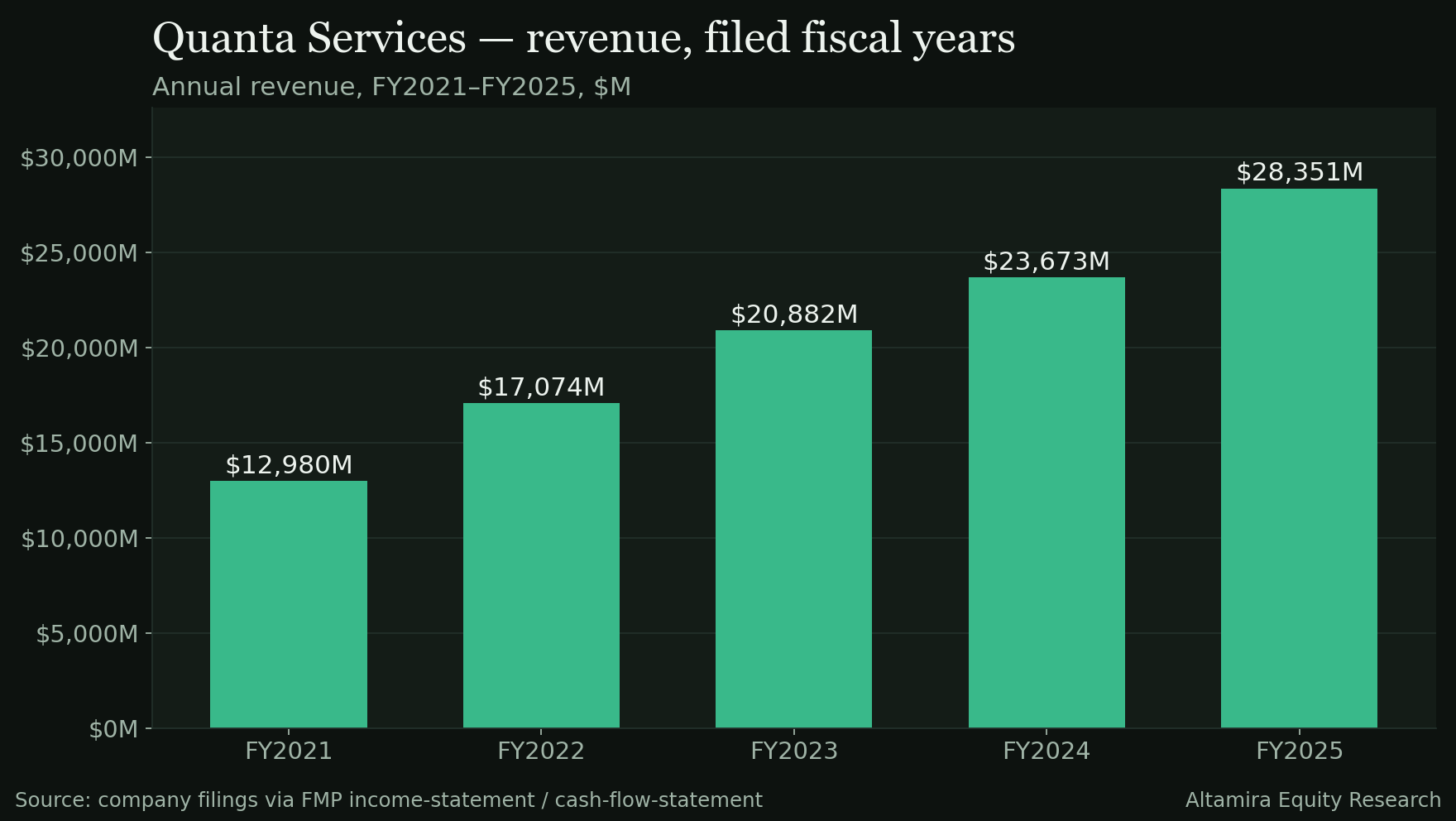
Growth is the first lens because Quanta's case is a volume-compounding claim before it is anything else. Filed revenue rose from $12,980M (FY2021) to $17,074M (FY2022), $20,882M (FY2023), $23,673M (FY2024) and $28,351M (FY2025) — a five-year compound rate of 20.41%, easing to 18.42% over the most recent three years. This quarter's +60.09% year over year, and a raised FY2026 guide of $41.3–41.6B far above the FY2025 bar, reverse that easing violently. Judgment: growth passes — the long compounding record is real, and the quarter is an acceleration of it, not a departure.
Operating margin
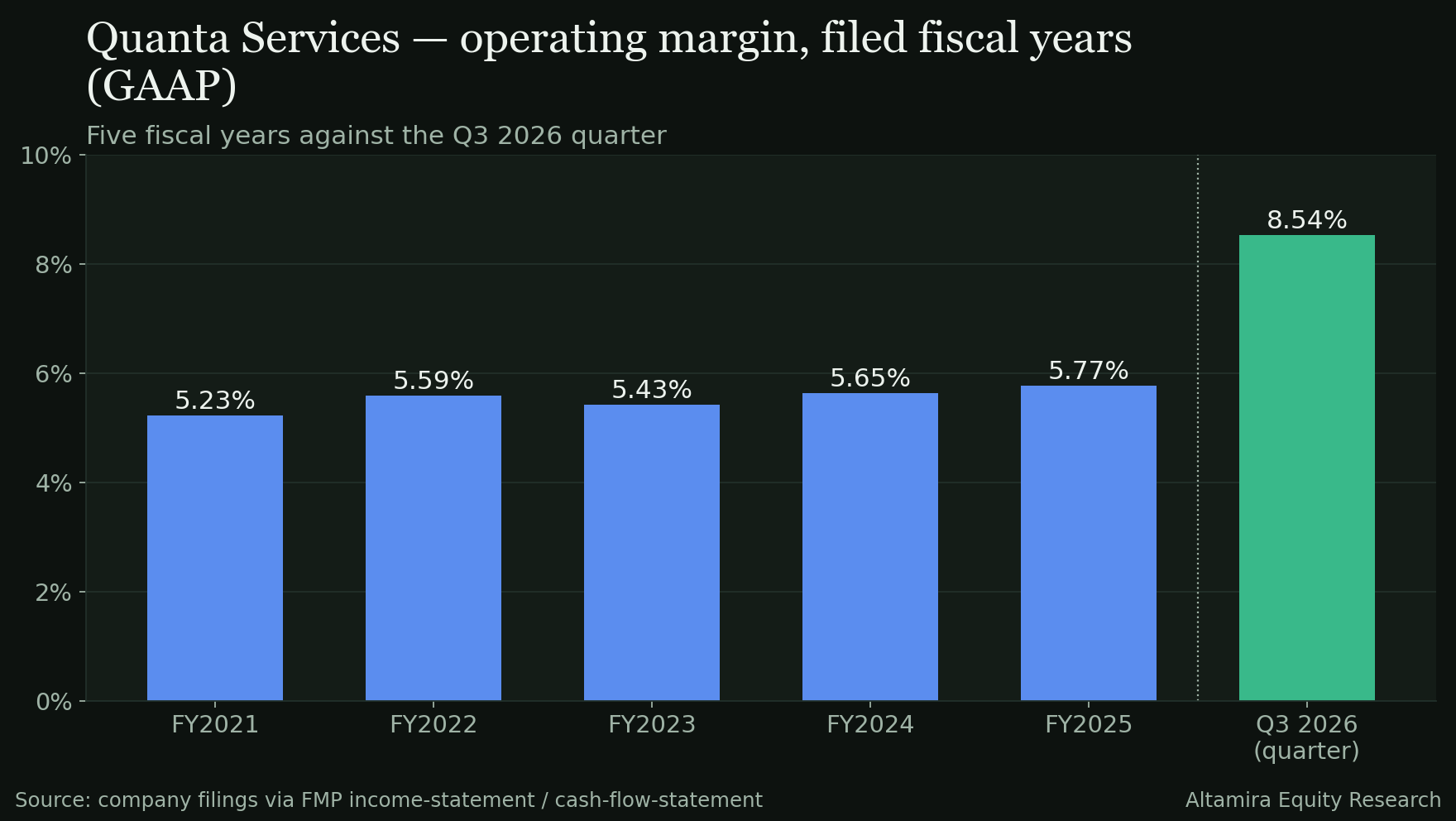
Margin is the second lens because contracting margins are structurally thin, so the question is direction, not level. Filed operating margin averaged 5.53% across FY2021–FY2025 (5.23%, 5.59%, 5.43%, 5.65%, 5.77%) — a narrow band with a gentle upward drift. This quarter printed 8.54%, up 165 basis points year over year, far above the five-year average, with adjusted EBITDA margin at 12.1% and management's utility range at 10–12%. Judgment: margin on watch — the quarter is the best evidence yet that training leverage is structural, but one quarter above the band does not rewrite a five-year history inside it.
Cash
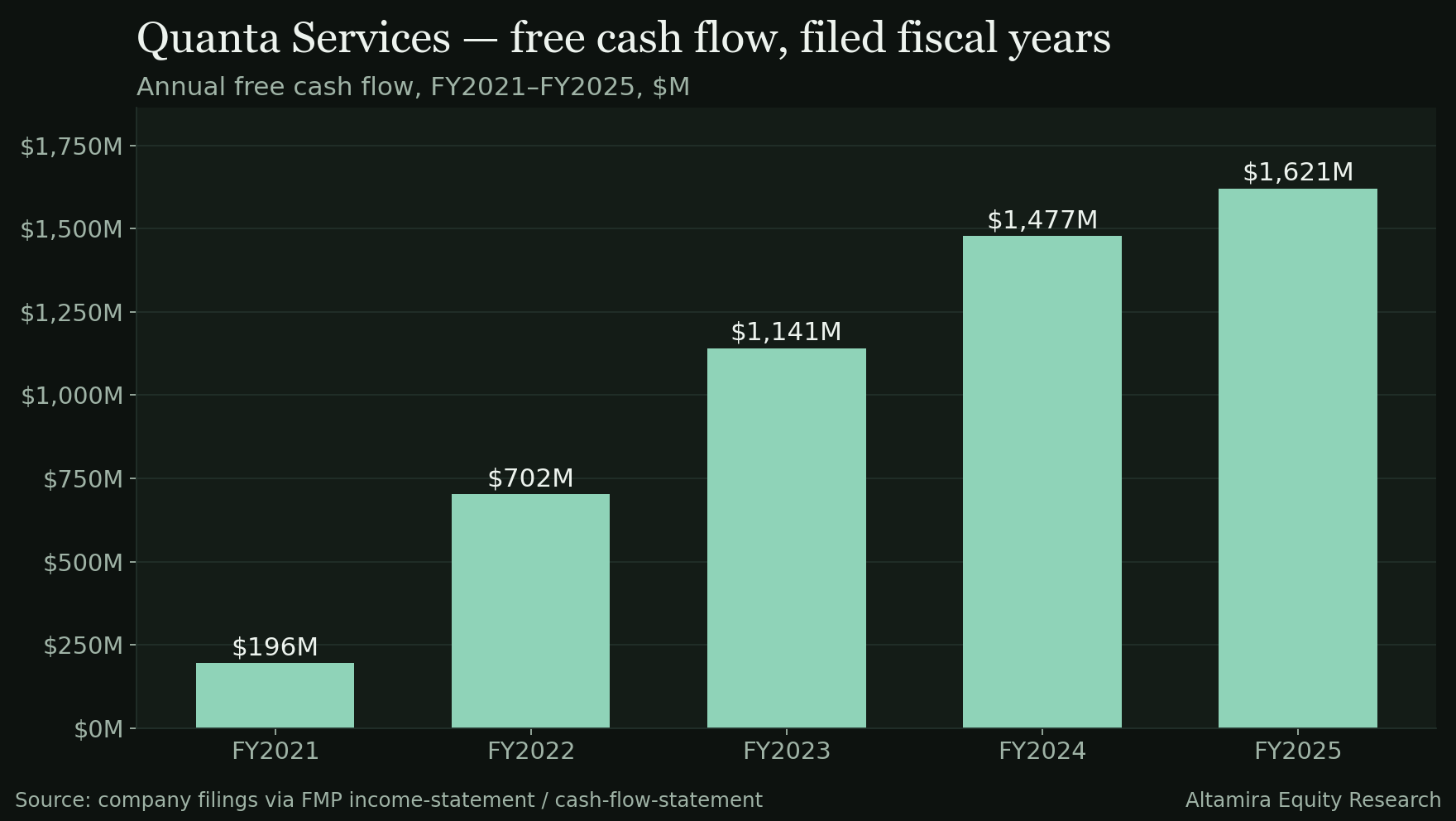
Cash is the third lens because thin-margin contracting earnings are only worth what converts. Here Quanta is quietly excellent: across five years, operating cash flow has run at 207.92% of reported net income — roughly double — and free cash flow compounded at 13.64% to $1,621M in FY2025 (5.72% of revenue). This quarter's operating cash flow of $1.5B and free cash flow of $1.2B, both records, extend the pattern. Judgment: cash passes — conversion is the quality core of this business, and the quarter extends it.
Returns on capital
Returns on capital are the fourth lens because they separate a genuinely advantaged franchise from a merely busy one. Quanta's five-year return on invested capital is 6.98%, with return on capital employed of 9.49% — the honest weakness in the long record: growth has been bought with capital, including a long acquisition programme, at returns that lag high-quality peers. This quarter, management itself pointed investors to return on invested capital growth as the metric it watches, and margin expansion at this volume is exactly how the ratio improves. Judgment: returns fail on the five-year line, improving at the margin — the lens the next two years must fix if the quality case is to match the growth case.
Beyond the print — the business this quarter
Earnings describe the last thirteen weeks; these developments — each traced like a figure — describe the next several years.
- A programme, not a project, was booked. Quanta booked a large utility customer's programme scope in the quarter (transmission & distribution plus a power plant), and management expects to book more against it as that customer's capital programme unfolds. Programme-level awards are the highest-quality backlog a contractor can hold: multi-year, relationship-anchored, expandable.
- The 765-kV build is moving toward backlog, not yet in it. Large transmission programmes are progressing from permitting and approvals through planning and engineering toward contract execution; regulatory hearings referenced in Q&A went favourably. None of the $10B sequential jump required the biggest wires in the story — they are the next tranche.
- Two acquisitions, bought for capability. About $245M net of cash acquired for companies strengthening front-end engineering, fabrication and supply chain — the off-site manufacturing capacity management credits for part of the margin leverage. The pattern is consistent: buy craft-adjacent capability, not revenue.
- The workforce is the capital expenditure. Roughly 25,000–26,000 employees added this year (management, Q&A), with foreman and superintendent leadership grown deliberately as a multiplier, and integrated fabrication expanded as a workforce multiplier. In this business the training pipeline is the capacity announcement.
- 2027 is already framed. Management used the print to guide qualitatively to strong double-digit adjusted EPS growth again in 2027, supported by the record backlog — five months before formal guidance, by the CEO's own "it's super early" caveat. The Q4 print will be judged on whether that framing hardens into numbers.
What management said
These are the call's own words — named executives, short verbatim quotes — because guidance credibility is judged on what was actually said, not on summaries of it.
Earl C. "Duke" Austin Jr., President and CEO: “None of this is possible without our craft labor, and you cannot buy craft, you have to build it.” Why it matters: this is the constraint and the strategy in one sentence. Demand is contracted years out; the scarce input is trained people, and Quanta's decade of training investment is presented — credibly, on this quarter's evidence — as the moat. It also frames the Key Issue: the growth rate of the training pipeline is the growth rate of the company.
Jayshree Desai, CFO: “Third quarter operating cash flow was $1.5 billion and free cash flow was $1.2 billion, both quarterly records.” Why it matters: beyond the records themselves, this sentence corrects the print's own data trail — the first earnings data set carried no cash-flow values for the company, and the first mechanical read of the quarter flagged cash conversion at zero. The verified figures make cash the strongest quality evidence in the print, and the full-year guide ($2.5–3.0B, over 60% conversion of adjusted EBITDA) gives it a forward test.
Earl C. "Duke" Austin Jr., President and CEO (Q&A): “I do think we can increase some margins, but it's not a margin story.” Why it matters: asked directly whether the margin strength is structural or favourable execution, Austin located it in training leverage and off-site fabrication, put the utility business at 10–12%, and then deliberately refused to sell a margin-expansion story — the compounding claim is volume at a held margin profile. That restraint is itself evidence: the guide's credibility rests on not overpromising the line investors most want raised.
The rest of the call, compressed: guidance was raised (revenue $41.3–41.6B, up about $1.9B at the midpoint; adjusted EBITDA $4.4–4.49B; adjusted EPS $17.90–18.30; free cash flow $2.5–3.0B). The balance sheet was strengthened in the quarter: $2B of senior notes issued, the revolving facility upsized to $2.98B maturing July 2031, and the term loan prepaid. In Q&A, BMO asked what constrains 2027 growth — customer spending, labour or execution — and how much margin strength is structural; the answer was training leverage and selectivity. Baird pressed on the makeup of the $10B backlog jump; the answer was broad-based growth plus the utility programme, with large transmission and generation not yet in backlog.
The Key Issue — can craft scale as fast as the backlog?
Thesis. Quanta's case is a capacity claim disguised as a demand story: the work is contracted ($64B and rising, with the largest transmission programmes still outside the book), the customers are among the best-capitalised in the industry, and the only scarce input — trained craft labour — is the one Quanta has spent a decade learning to manufacture. The counter-case is not that demand fades; it is that labour cannot compound at 20%+ without diluting execution quality, that margins earned while absorbing 25,000 new employees flatter the steady state, and that expectations already pay for the capacity claim being true.
Evidence for the capacity claim. Backlog of $64B, +$10B sequentially, growing across each key market; margins expanding (+219 basis points gross, +165 operating year over year) in the very quarters of fastest trainee absorption — the training-leverage mechanism working in the data, not just the narrative; record cash flow funding the build-out internally; headcount up roughly 25,000–26,000 this year with foreman and superintendent depth grown as a multiplier; and demand visibility extending beyond 2030 with the 765-kV and generation stack still to enter backlog.
Evidence against. A five-year return on invested capital of 6.98% says the historical growth was capital-hungry for its returns; the filed five-year operating margin band (5.23–5.77%) is far below this quarter's 8.54%, so the new level is unproven across a cycle; labour availability is a named risk in every serious read of this business; and the shares sit well below their 52-week high despite eight consecutive EPS beats — which is what a market looks like when it is pricing execution risk, not doubting demand.
What to watch. (1) The next print: backlog holding or growing from $64B as 765-kV transmission and generation work begins converting into the book. (2) Margins holding the new level — gross near 16.7%, utility economics inside the stated 10–12% range — while trainee absorption continues. (3) The external datapoint: the build-out chain's equipment prints — in this publication's traced coverage, one grid-equipment maker's orders rose 96% year over year with backlog near $197B, and one data-centre infrastructure maker's organic orders rose over 100% year over year (both Q3 2026) — if equipment orders keep compounding, contractor labour stays the bottleneck and Quanta's training advantage appreciates; if they stall, the backlog's outer years soften first. (4) Full-year free cash flow delivery inside the $2.5–3.0B guide. Historical analogy: Quanta's own recent history is the precedent for the failure mode — the two small revenue misses in the traced eight quarters (Feb 2025, −0.89%; Oct 2024, −1.03%) came on the revenue line, not EPS: when this company disappoints, it is because work did not convert on schedule. The forward question: by the time the 765-kV programmes enter backlog, will the training pipeline have compounded enough that conversion — not intake — is still the thing being proven every quarter?
Sources: Quanta Services Q3 2026 filed financial statements (Form 10-Q filing, accepted Oct 29, 2026); consensus estimates as collected from FMP; Quanta Services Q3 2026 earnings-call transcript (Oct 29, 2026 — quotes verbatim from that transcript; non-GAAP figures are as presented on the call). This post is analysis, not financial advice; the author may hold positions in companies discussed.