Weekly Insights — Week Ending Oct 30, 2026: The AI Bill Came Due
The AI bill came due this week — and the market stopped paying it for everyone equally.

The AI bill came due this week — and the market stopped paying it for everyone equally.
The week in numbers
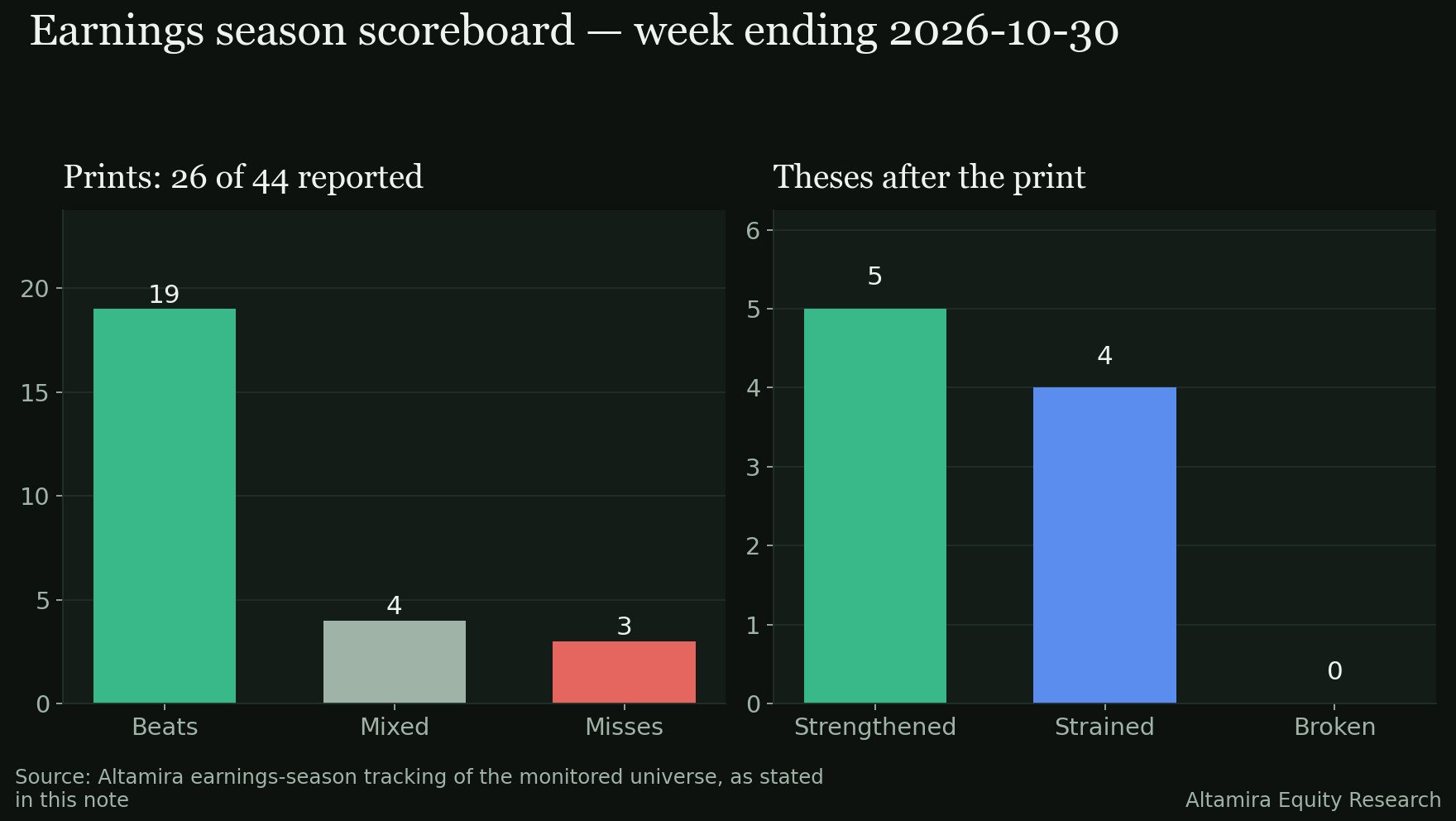
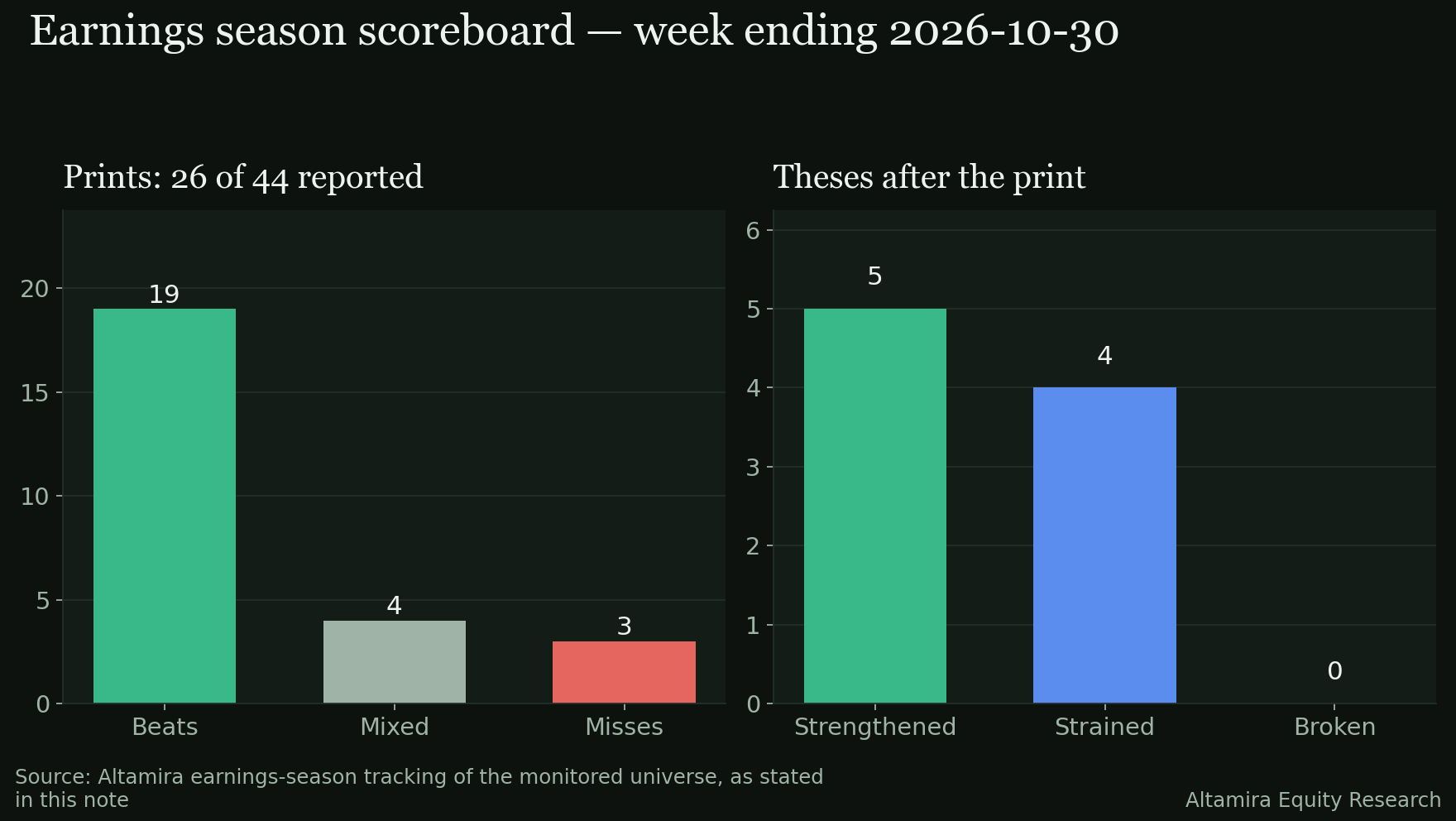
- Earnings season: 26 of 44 reported — 19 beats · 4 mixed · 3 misses across the monitored universe; theses 5 Strengthened · 4 Strained · 0 Broken
- Hyperscaler capex (Q3): $90.7B combined — Microsoft $39.37B + Alphabet $51.36B in a single quarter
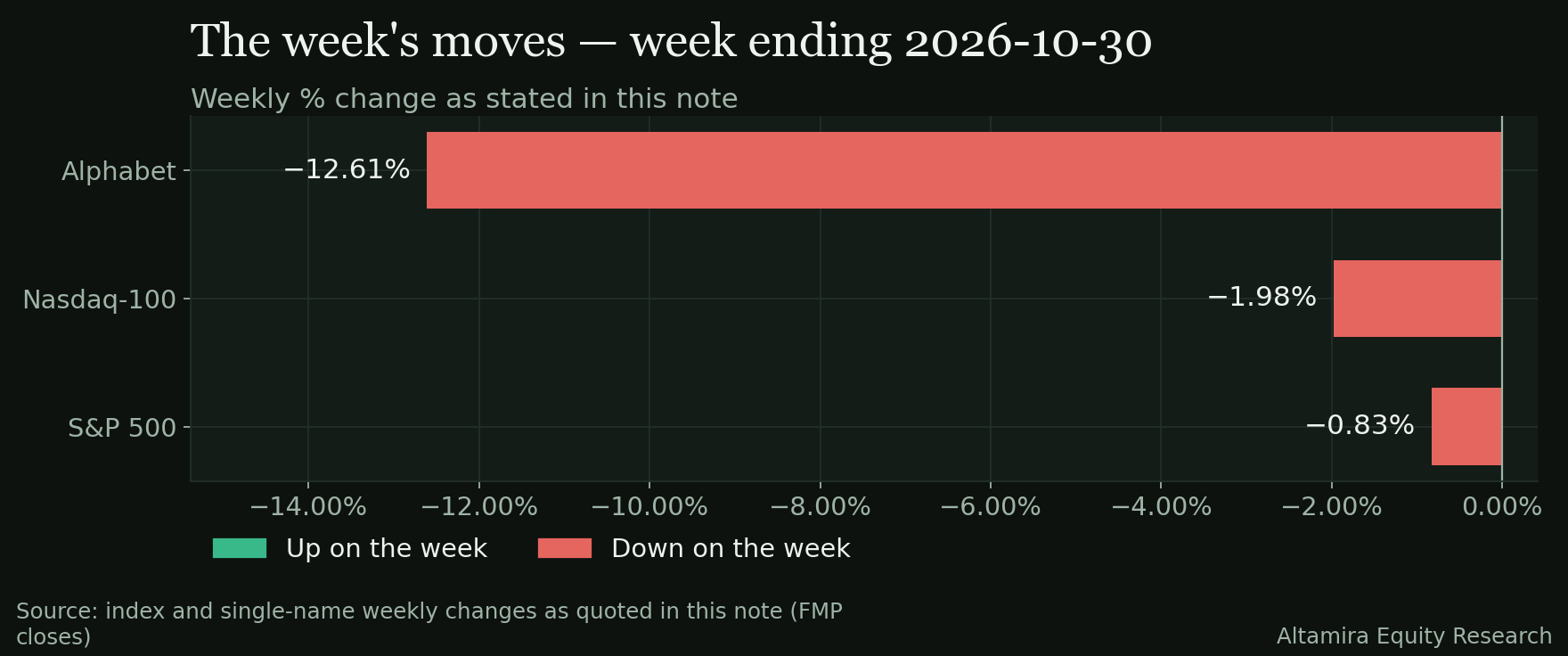
- Alphabet's week: -12.61% — The print repriced the whole AI complex; the WSJ put the market-value loss above $500B
- Indexes (week): S&P 500 -0.83% · Nasdaq-100 -1.98% — Friday was the worst session: S&P -1.82%, Nasdaq -2.86% on the day
- Altamira 516-name KPI Scorecard (Sat full refresh): Macro gate: FULL_DEPLOY — BUY list: ACGL · MU · ABNB · PGR
- Technical breaks: 51 in the week — Damage concentrated Thu–Fri (17 + 17); new highs the same days in ABBV, LLY, V, MA
- 10-year Treasury: 4.934% Friday close — 4.93–5.02% in every daily snapshot all week
Insights
1. The AI supercycle split in two: self-funding vs cash-burning (Long-term)
Microsoft and Alphabet spent a combined $90.7B on capex in a single quarter, and the market treated them as different species. Microsoft's $39.37B came with $18.63B of free cash flow (50.9% conversion) and $11.14B returned to shareholders. Alphabet's $51.36B exceeded its $42.29B of operating cash flow — free cash flow was negative $9.07B, no buyback ran, and the share count rose 0.86%. Alphabet fell 12.61% on the week. Barron's had prefigured the pattern a week earlier with Meta: revenue guided +24%, expenses +42%. The demand leg is not in doubt — Alphabet's cloud revenue grew 103% to $30.7B with a $561B backlog. What is being repriced is who pays for the build, and with whose cash.
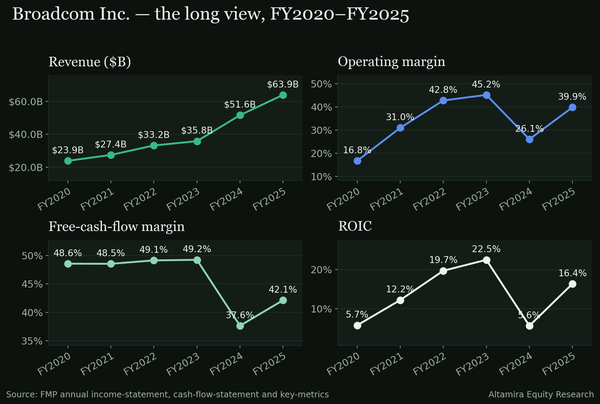
So what: Judge hyperscalers on free-cash-flow conversion per capex dollar, not on capex size or cloud growth. Self-funding spenders earn the benefit of the doubt; cash-burning spenders must show the return leg within quarters, not years. NVDA (late November) and AVGO (December) are the next tests.
2. Cheap money is over — credit, not earnings, is now the binding constraint (Long-term)
Read the week's financial-press threads in sequence and they are one story told five ways: leverage built for cheap money being refinanced at ~5%; lenders rationing the AI build-out; a federal government borrowing at 100% of GDP; debt past $40T with a debt ceiling due early next year. The 10-year Treasury sat between 4.93% and 5.02% every day of the week. Earnings season, meanwhile, was fundamentally fine — 19 beats against 3 misses, no thesis broken. The constraint on valuations is no longer the income statement; it is the cost and availability of credit.
So what: Underwrite duration and leverage as if ~5% is the regime, not a spike. Balance-sheet quality and refinancing distance outrank growth-at-any-price until the 10-year sustainably breaks back below this week's range.
3. The selloff was broad; the quality screens cleared almost nothing (Medium-term)
Friday's risk-off close left technical damage everywhere: 51 breaks in the week, 17 of them on Friday alone, with Amazon, ASML and Quanta crossing below their 200-day averages on heavy volume. Yet Altamira's 516-name KPI Scorecard — which scores quality, value and momentum daily — ended Saturday's full refresh with a BUY list of just four names (ACGL, MU, ABNB, PGR), and most former leaders failed its quality gate outright. Breadth of red on one side, narrowness of quality on the other: that spread is the week's most honest indicator. Price damage alone did not manufacture quality entries.
So what: Treat a broad selloff as a watchlist event, not a buy list. Entries earn attention when price damage and quality scoring agree — this week they mostly didn't, and the disagreement itself argues for patience and staging over immediacy.
4. Power is the scarcest AI input — and it has the longest visibility in the chain (Long-term)
Both reported legs of the physical build-out strengthened in the same week. Vertiv raised its full-year guide across every metric with organic orders up more than 100% year over year. GE Vernova booked $29.3B of orders (+96%), took backlog to roughly $197B, has signed 52 GW of gas agreements this year, and expects at least 130 GW under contract by end-2026 — selling turbine slots for 2032 delivery. The second-order costs are appearing too: the build-out is raising PC and memory prices and pulling workers and copper away from home-building. GPU demand is a forecast that resets every quarter; a turbine slot for 2032 is a contract.
So what: The durable AI exposure may sit in the power chain — generation, grid, cooling — where visibility is measured in years and gigawatts. Track GW under contract and book-to-bill as leading indicators alongside GPU shipments.
5. The persistent compounders are not the headline names (Long-term)
Altamira's Compounder screen asks a simple question: which names survive daily re-scoring? Across the week's six KPI Scorecard editions, Micron and Airbnb appeared on the BUY list every single time. Arch Capital (ACGL) climbed to #1 by Saturday's full refresh — total score 76.3, free-cash-flow yield 15.5%, 10.7x forward earnings — an insurance compounder compounding quietly while the week's attention sat with mega-cap tech. PTC, APA and Mastercard held top-10 seats all week; Progressive joined the BUY list Saturday.
So what: Persistence is the filter: a name earns compounder attention by surviving a full week of re-scoring — including a risk-off Friday — not by appearing once. One-week wonders stay in the watch box.
6. Insiders are not buying this dip — flows say 'not yet' (Medium-term)
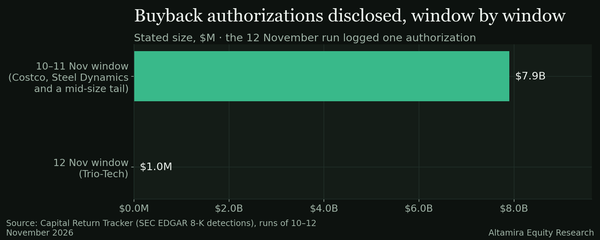
Across the week's insider filings there was not one open-market buy cluster in the large-cap universe we monitor. The only forming cluster anywhere was Accenture — $3.20M across two buyers, anchored by a $2.49M C-suite purchase — while congressional disclosures were active (16 newly disclosed on Friday alone) but diffuse. The unambiguous quality signal was corporate rather than personal: Visa raised its dividend 16.4% ($0.67 to $0.78) alongside its print, while buyback authorisations logged market-wide were almost all small and mid-cap.
So what: Absence is information: a dip with no insider confirmation is a valuation event, not yet a conviction event. The first genuine cluster in a quality name is the flow signal worth acting on — it has not appeared yet.
Where the evidence disagrees
Risk-off tape vs a FULL_DEPLOY macro gate
Friday was the week's worst tape (Nasdaq -2.86% on the day), yet the KPI model's macro gate held at FULL_DEPLOY on Saturday's full refresh. Either the gate's slower fundamentals are right and Friday was positioning, or the gate lags the credit tightening documented all week. Next week's gate reading is the tell.
Alphabet: fortress pillars, failing grade
Alphabet's KPI quality pillars are fortress-grade — Health 77.8, Moat 82.9 — while its total score sits at 42.3, dragged down by a Technical pillar of 5.0 after the post-print fall. Both readings are true at once: the business quality and the stock's momentum have decoupled, and the resolution is a single catalyst — buyback resumption or a credible 2027 capex peak.
What to watch next week
- Earnings: Apple and Palantir (Mon Nov 2), Arista and Skyworks (Tue Nov 3), MercadoLibre (Wed Nov 4).
- U.S. midterm elections Tue Nov 3 — bank oversight, AI hearings, housing and tariffs are the headline-risk channels.
- The KPI macro gate: does FULL_DEPLOY survive a second week of ~5% rates and risk-off tape?
- Accenture's forming insider cluster: a third buyer inside 14 days would make it the selloff's first scored cluster.
Methods: Altamira's 516-name KPI Scorecard (edition dated Oct 31, 2026, prices through Friday's close); earnings-season tracking of a 44-name monitored universe; insider and capital-return flow logs; the week's WSJ and Barron's coverage, synthesised in our own words.
Altamira Equity Research — research for information only, not investment advice. See our disclosures page for details.