Weekly Insights — Week Ending Nov 6, 2026: The Election Repriced the AI Build-Out
The election repriced the AI build-out, the model's BUY list went empty for the first time — and payments and pharma quietly compounded through the storm.

The election repriced the AI build-out, the model's BUY list went empty for the first time — and payments and pharma quietly compounded through the storm.
The week in numbers
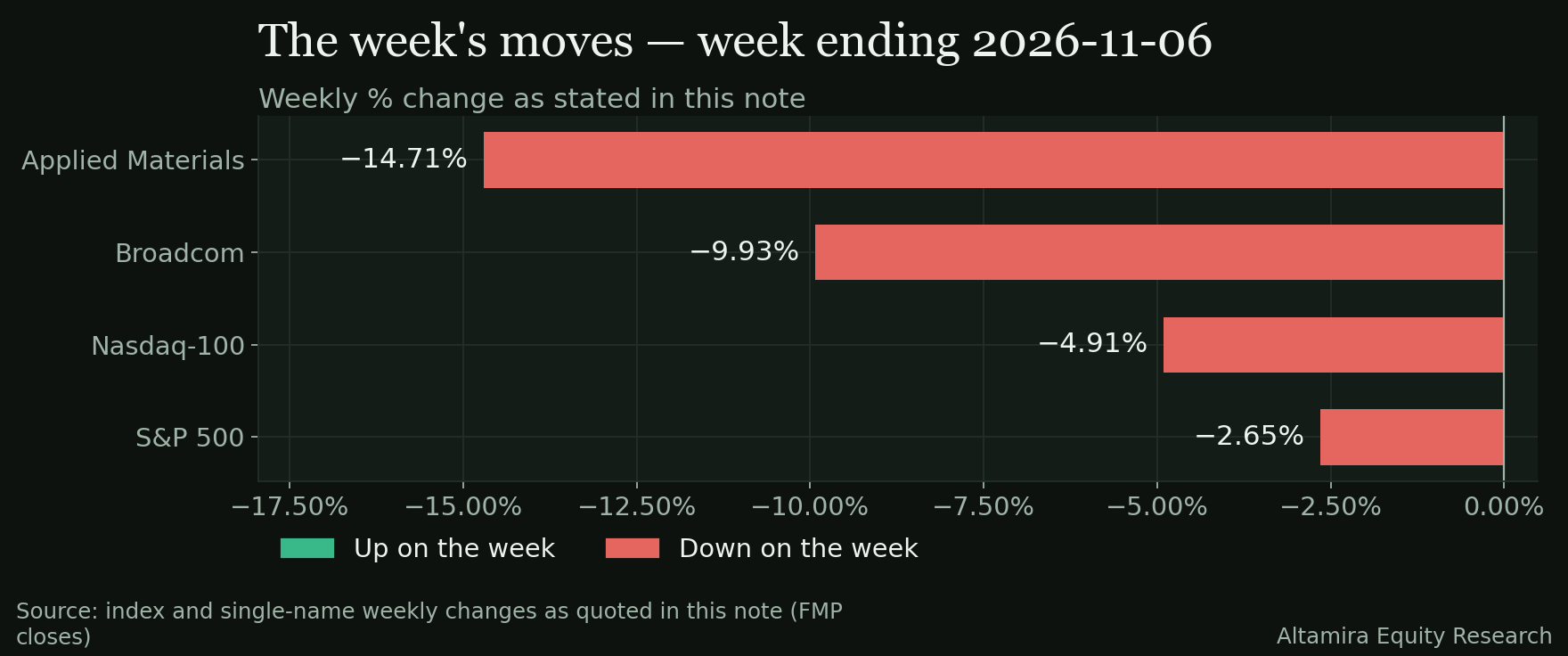
- Indexes (week): S&P 500 -2.65% · Nasdaq-100 -4.91% — Losses concentrated in the AI complex; equal-weight measures fell less than the cap-weighted indexes
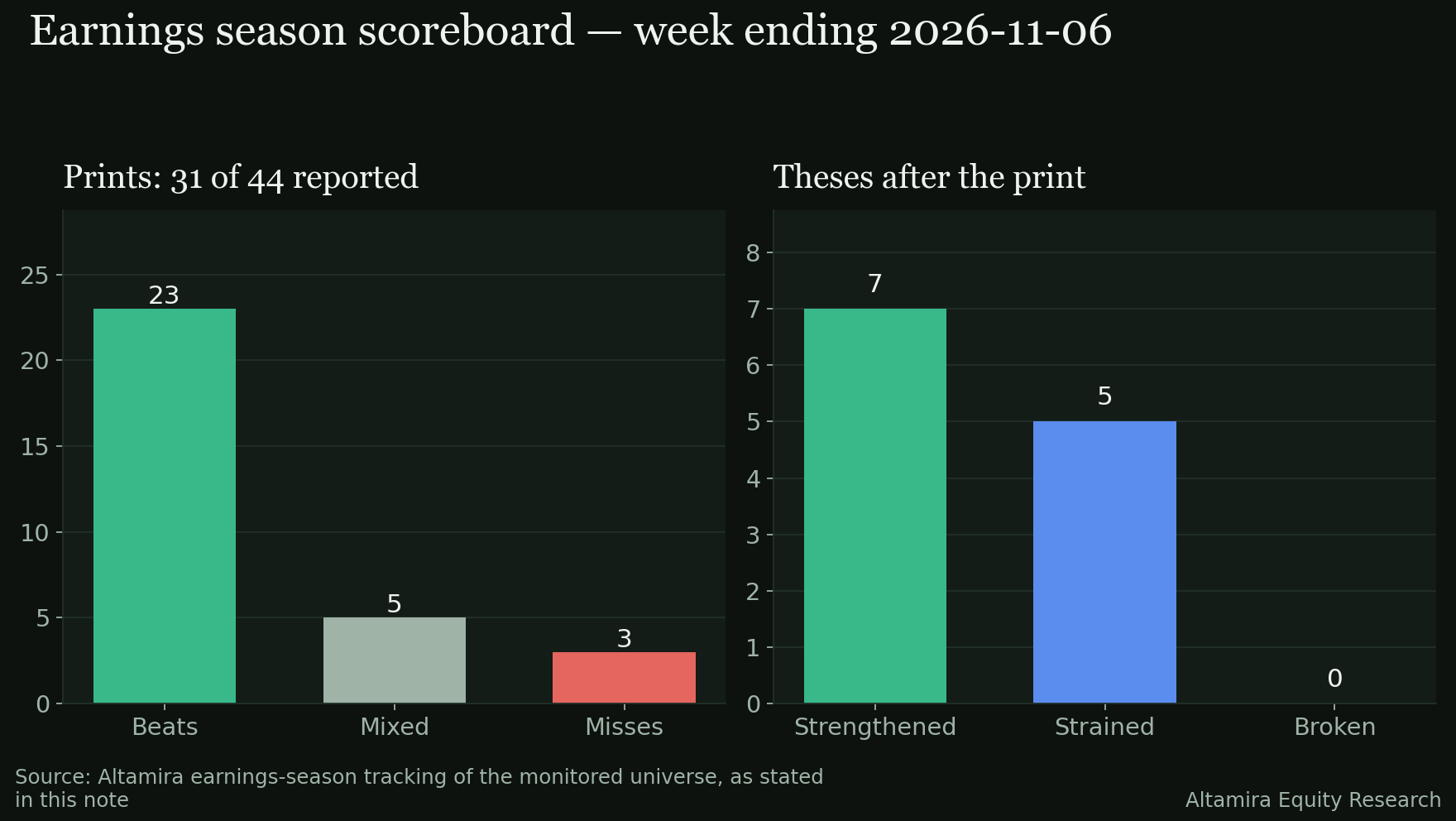
- Earnings season: 31 of 44 reported — 23 beats · 5 mixed · 3 misses; theses 7 Strengthened · 5 Strained · 0 Broken
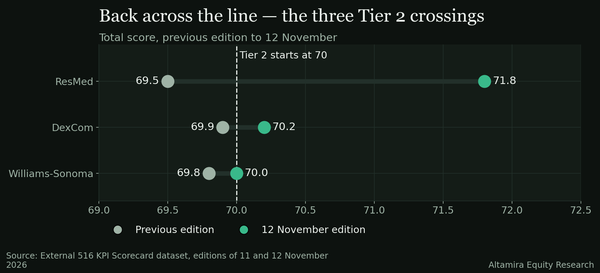
- Altamira 516-name KPI Scorecard (Fri Nov 6 edition): BUY list: EMPTY · gate REDUCED (0.6x) — First empty BUY list in the recorded history; ACGL #1 overall (total 79.2, FCF yield 14.9%)
- Equipment complex (week): Applied Materials -14.71% · Broadcom -9.93% — Friday pre-market snapped both sharply back; Applied Materials reports Thu Nov 12
- Technical breaks: 71 in the week — Death crosses Friday in Applied Materials and Quanta; Broadcom printed a new 52-week low
- Jobs surprise (Fri): +165k vs +55k expected — Unemployment 4.2%; December cut odds fell to ~40% from 60%, a March hike began to be priced
- Insider flows: 0 clusters — second straight week — Accenture still only 'forming' (2 buyers, $3.20M, unchanged all week)
Insights
1. Politics is now an input to the AI trade — the election repriced the build-out, not the economy (Medium-term)
The midterm sweep was won on prices — about 39% of voters called the economy the top issue and roughly 90% said cost of living was crucial — but its market transmission ran through AI, not macro. Wednesday's gridlock rally lifted the indexes while the data-center trade fell: incoming Democratic governors in Texas, Georgia and Ohio back moratoriums or pauses, and SpaceX, Tesla, Nvidia, CoreWeave and NRG all dropped. Thursday the reversal broadened — the Nasdaq fell 3.89% intraday and the VIX jumped 40% as investors ditched AI, chip and data-center names — and by Friday the incoming Senate Banking chair was expected to scrutinise data-center financing itself. GE Vernova and Vertiv fell 6.85% and 7.11% in Wednesday's pre-market movers even though GE Vernova's own print had just strengthened its story (orders $29.3B, +96%; backlog ~$197B; guidance raised). Nothing about demand changed this week; the permission and financing environment did.
So what: Add a political screen to AI infrastructure: contracted backlog with permits in hand now deserves a premium over speculative capacity that still needs approvals and cheap financing. The December funding fight and January's committee gavels are dated checkpoints, not noise.
2. The model went defensive before the tape finished falling: BUY empty, gate REDUCED (Medium-term)
Friday's edition of Altamira's 516-name KPI Scorecard carries an empty BUY list — the first in the recorded history, after 4 names on Monday, 2 on Tuesday and Thursday, and 6 on Wednesday — and its macro gate stepped down to REDUCED (0.6x) from the FULL_DEPLOY reading that closed last week. Yet the quality core did not crack: ACGL, PTC, Mastercard, Lilly and Regeneron held top-10 seats in all five editions, and Micron and Airbnb stayed on the BUY list in four of five before Friday's shutout. This is last week's open question answered: the gate did not survive a second week of ~5% rates and risk-off tape — it stepped down in an orderly way while persistence held, which is what a sizing governor is supposed to do.
So what: While the BUY list is empty and the gate is REDUCED, the persistence list is a watchlist, not a buy list. The tell for re-risking is mechanical — BUY names reappearing for two consecutive editions, not a single green day.
3. Beats stopped being enough: the reaction now grades cash quality, not the surprise (Medium-term)
Five major names reported, and four fell on their prints. Apple beat on both lines (EPS $2.05 vs $1.99; revenue $114.48B, +11.7%) with $25.86B of free cash flow and $24.30B of buybacks — and fell 5.58% after hours, more than double its eight-quarter average move, on a modest beat with gross margin down 217 bps sequentially. Palantir beat, raised full-year guidance +91% and grew U.S. commercial revenue 148% — and fell 9.04% because at 116.6x earnings the multiple did the talking. Skyworks was the tell: a headline beat hid operating margin collapsing to 2.1% and free cash flow of negative $61M, and the stock fell about 13%. The exception proves the rule — Arista beat with expanding operating margin (44.9%, +253 bps) and 70.5% FCF conversion, and rose 7.9%.
So what: In a repricing regime, the pre-print entry is the risky one. Grade prints on FCF conversion and margin direction first and the headline surprise second — that ordering predicted this week's reactions better than the beat/miss badge did — and let the post-print dislocation, not the calendar, set entry timing.
4. Semiconductor equipment lived a full cycle in five days (Medium-term)
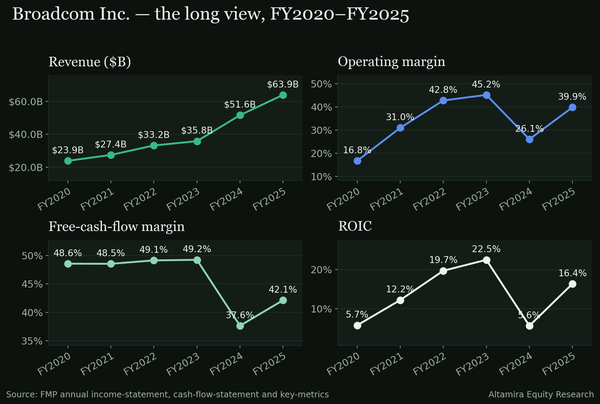
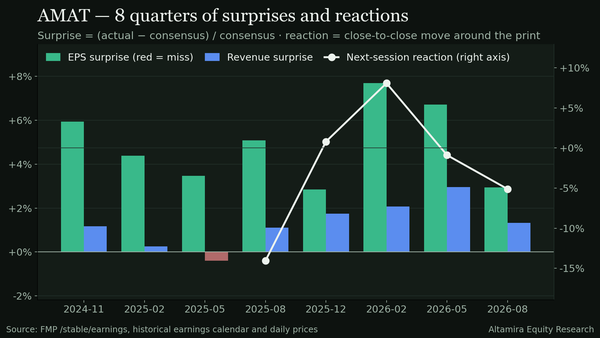
The semiconductor-equipment complex lived a full cycle in five days. Applied Materials fell 14.71% on the week and Broadcom 9.93%; Friday brought death crosses in Applied Materials and Quanta Services and a new 52-week low in Broadcom. Yet the fundamentals underneath kept strengthening — KLA's quarter showed 33.9% five-year ROIC with wafer-fab-equipment demand strengthening, Lam Research authorised a $25B buyback on Friday — and the same Friday's pre-market tape snapped the whole complex back (Applied Materials +8.89%, Lam +12.96%, KLA +8.69% among the morning's movers). Price, model scores and fundamentals pointed three different directions in the same complex in the same week. The arbiter is dated: Applied Materials reports Thursday Nov 12, and its wafer-fab share, services growth and China mix will confirm or break the equipment signal KLA set.
So what: When a complex whipsaws like this, the print calendar — not the chart — is the risk calendar. Equipment exposure sized before Nov 12 is a bet on one evening's numbers; sized after, it is a position in a confirmed or broken trend.
5. Ballast identified itself: payments and pharma compounded through the storm (Long-term)
While AI names whipsawed around their 200-day lines — TSMC crossed its 200-day three times in five sessions, Arista crossed down on 2.5x volume Thursday and back up on 2.0x volume Friday — the week's repeat new-52-week-high makers were Visa, Mastercard, MSCI and Lilly, with AbbVie joining Thursday. That is the same set Altamira's Compounder screen keeps selecting: Mastercard, Lilly and Regeneron held KPI top-10 seats in all five editions, Visa in four, and the earnings read-across has pharma strengthening (AbbVie's immunology franchise compounding — Skyrizi +22.9%, full-year immunology guide raised to $34.9B). In a week when the model's BUY list emptied, the names that never left the top 10 and kept printing highs were the market's actual compounders — they just were not the headline trade.
So what: The ballast sleeve is identifiable in advance — top-10 persistence plus repeated highs through a risk-off week — not just in hindsight. When quality gates reopen, persistent compounders are where added weight carries the least regime risk.
6. Insiders still say 'not yet' — but the corporate bid stepped in underneath (Medium-term)
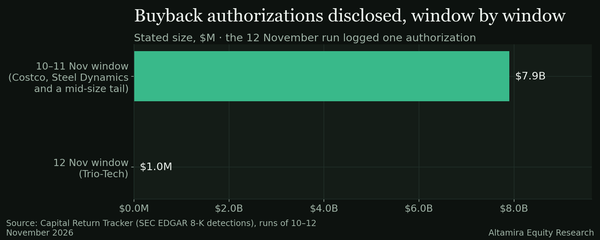
For a second consecutive week, insider filings recorded no open-market buy cluster anywhere in the monitored large-cap universe. The Accenture watch from last week froze in place: still exactly 2 buyers and $3.20M on all five days, never adding the third buyer that would score it as a cluster — while notable sales appeared instead (a $15.82M Arista mega sale, CrowdStrike C-suite sales, a routine Netflix C-suite sale) and congressional disclosures stayed active but diffuse (46 newly disclosed trades across the week). What did step in was corporate, not personal: Friday's capital-return log carries a $25B Lam Research authorisation, $3.0B at Arch Capital and $2.7B at Airbnb — the last two being the KPI screen's most persistent BUY names — on top of Apple's actual $24.30B of buybacks in its reported quarter.
So what: Keep the two bids separate: buyback authorisations are floor support only where free cash flow backs them (Arch Capital's FCF yield is 14.9% in Friday's KPI edition), while a genuine insider cluster remains the higher-grade signal — and it still has not appeared. Two weeks frozen at 'forming' weakens, not strengthens, the Accenture signal.
Last week we said — scored
- STRENGTHENED — The AI supercycle split in two: self-funding vs cash-burning: The split widened: counterparty exposure across the AI chain was quantified in the week's Barron's, Anthropic's mooted $1.5T IPO valuation was publicly doubted, and credit spreads hit five-year highs. Microsoft remained the resilient leg (+1.67% on the week, new 52-week high Wednesday).
- CONFIRMED — Cheap money is over — credit is the binding constraint: Credit spreads at five-year highs, the Bank of England hiked Nov 5, December cut odds fell to ~40% with a March hike priced after the jobs beat; the 10-year held 4.87–4.96% all week.
- HELD — The selloff was broad; the quality screens cleared almost nothing: The screens narrowed further, not wider: the KPI BUY list went from four names to empty while prices kept falling. GOOGL remained the archetypal trap case — cheapest on price screens, flagged on cash flow.
- MIXED — long-term intact, new political risk — Power is the scarcest AI input: GE Vernova's contracted backlog story strengthened on its print, but the election added a permitting and moratorium risk the original insight did not carry — the long-term claim is intact, the path now runs through politics.
- CONFIRMED — The persistent compounders are not the headline names: ACGL was #1 in all five editions this week (total 79.2 Friday); ACGL, PTC, MA, LLY and REGN held top-10 seats in 5 of 5; Micron and Airbnb stayed BUY-persistent 4 of 5 before Friday's empty list. ACGL then authorised a $3.0B buyback.
- CONFIRMED, with a refinement — Insiders are not buying this dip: A second straight week with zero clusters, and the Accenture watch never added its third buyer. One refinement, carried in this week's Insight 6: the corporate bid (Lam $25B, ACGL $3.0B, Airbnb $2.7B authorisations) stepped in where insiders did not.
Where the evidence disagrees
Good jobs news, tighter policy: growth and the discount rate now fight
Friday's jobs report beat by 110,000 (+165k vs +55k expected, unemployment down to 4.2%) and markets cut December cut odds to ~40% from 60%, even beginning to price a hike by March — in the same week the Bank of England hiked into war-driven inflation and the 10-year sat at 4.87–4.96% in every daily snapshot. The economy the election punished is, on the data, still hiring; the constraint is that every strong print now tightens financial conditions. Which force wins is the December 8–9 FOMC's problem — and the market's.
Breadth says 'everything broke'; the quality model says 'nothing cleared'
Technical breadth says the selloff was indiscriminate — 71 breaks in the week, death crosses in bellwethers, a former leader printing a new 52-week low. The quality model says it cleared nothing: an empty BUY list for the first time on record. Both are internally consistent — prices have fallen far enough to break charts almost everywhere, and quality-plus-tape scoring still passes nothing — and the tension between them is precisely why this is a watchlist moment rather than a buying moment.
What to watch next week
- Applied Materials reports Thu Nov 12 — the week's bellwether print for the whole equipment complex: wafer-fab share, services growth and China mix are the confirmation points.
- The KPI Scorecard: does the BUY list stay empty, and does REDUCED deepen? Monday's edition is the first full-week read.
- Anthropic's IPO pricing: investor meetings were reported 'within days' — where it prices against the mooted $1.5T mark re-prices the whole AI counterparty chain.
- The December 8–9 FOMC, and mid-December's government-funding deadline — the week's two dated macro checkpoints.
Methods: Altamira's 516-name KPI Scorecard (editions dated Nov 2–6, 2026); earnings-season tracking of a 44-name monitored universe, graded on definitive post-call recaps; insider and capital-return flow logs; the week's WSJ and Barron's coverage, synthesised in our own words.
Altamira Equity Research — research for information only, not investment advice. See our disclosures page for details.